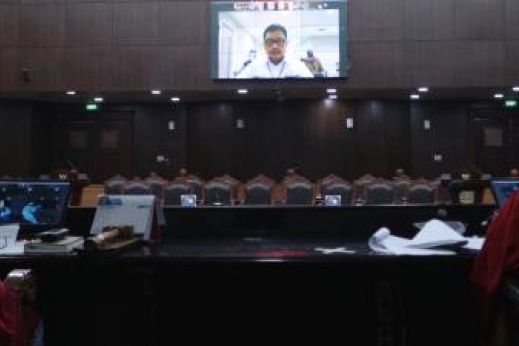
Secretary to the Minister of BUMN Susyanto giving a statement in the judicial review hearing of Law No. 19 of 2003 on State-Owned Enterprises (BUMN Law), Wednesday (14/10) in the Courtroom of the Constitutional Court. Photo by Humas MK/Ifa.
JAKARTA, Public Relations of the Constitutional Court—The sale of subsidiary shares isn’t a form of privatization because those shares do not constitute shares of (SEO) persero companies, said secretary to the Minister of BUMN Susyanto as the Government’s representative at the judicial review hearing of Law No. 19 of 2003 on State-Owned Enterprises (BUMN Law) was held by the Constitutional Court on Wednesday, October 14, 2020. The petition No. 61/PUU-XVIII/2020 was filed by the Federation of Pertamina United Labor Unions (FSPPB), who believes that the provision on privatization in Article 77 letters c and d of the BUMN Law violates Article 33 paragraphs (2) and (3) of the 1945 Constitution.
“The sale of shares in a subsidiary to another party doesn’t constitute privatization because what is being sold is not the persero company’s shares. This is in accordance with Article 1 number 12 of the BUMN Law, which reads, ‘Privatization is the sale of shares of a Persero, either partially or completely, to other parties in order to increase company performance and value, increase benefits for the state and society, and expand share ownership by the community.’ So, the sustainability of (PT Pertamina Persero) will not be threatened by the sale of shares in PT Pertamina Persero’s subsidiaries," Susyanto explained before the hearing chaired by Chief Justice Anwar Usman.
Study and Analysis
Susyanto also emphasized that an in-depth study and analysis shows that PT Pertamina Persero’s sustainability is not threatened by the sale of its subsidiaries’ shares. The sale is aimed to improve the performance of these subsidiaries, which directly supports the parent company. The Petitioner must also note, he added, that the sale of subsidiary shares not only profits private companies, but also takes into account the society’s welfare.
"If there is a sale [of shares], there will be a study which in the end aims to increase the value of the subsidiary and support the business of PT Pertamina. So, this will directly and indirectly improve the welfare of the community. Therefore, in the Petitioner's statement that his constitutional rights have been impaired by this, of course, are just a baseless assumption," he explained at the virtual hearing.
Therefore, the Government is of the opinion that based on efforts to increase the efficiency of a SOE company, restructuring and privatization can be carried out. Susyanto added that the restructuring is carried out through SOE holding, by transferring state ownership to one or more SOEs into additional state share capital in another SOE so that the SOE became the holding company. Meanwhile, privatization doesn’t mean simply selling companies because not all SOEs can be privatized.
Also read: Constitutionality of Privatization of Pertamina Subsidiaries
Conditions for SOE Privatization
Susyanto added that the SOEs to be privatized are ones allowed to be privatized according to the provisions of sectoral laws and regulations stipulated by the Minister in a government regulation or an agreement between the Government and the DPR (House) so the BUMN Minister cannot arbitrarily determine the privatization. SOEs that can and cannot be privatized are regulated by Article 76 paragraph (1) of the BUMN Law, which reads, “(1) Persero that can be privatized must at least meet the following criteria: a. of a competitive industry/business sector; or b. of an industry/business sector whose technological elements change rapidly.”
"It can be concluded that the holding SOE company where the Petitioner works is one in a competitive business as regulated in Article 76 of the BUMN Law. It is irrelevant that the Petitioner wants additional norms in Article 77 letter c and letter d of the BUMN Law, when the company is included in the provision of Article 76 of the BUMN Law. Thus, the Government concluded that the provision in Article 77 letters c and d of the BUMN Law cannot be applied to the sale of shares of subsidiaries,” he explained.
Not SOE
Susyanto said there is no causal relationship between the Petitioner’s loss and the enactment of the a quo norm because the provision of Article 33 paragraphs (2) and (3) of the 1945 Constitution as touchstones gives the state the right to control and manage production sectors that are vital and affect the livelihood of a considerable part of the population while the Petitioner’s company is not an SOE but a subsidiary that follows the provisions on PT Pertamina.
In addition, the Petitioner’s loss wasn’t specific as the provision of Article 33 paragraphs (2) and (3) of the 1945 Constitution doesn’t guarantee the welfare of the people. The Petitioner should have used the provision of Article 27 paragraph (2) of the 1945 Constitution that states that all citizens are entitled to decent living. “It is inaccurate to say that the provision of Article 77 letter c and letter d of the BUMN Law has led to families not becoming prosperous,” he said.
Also read: Petitioner of BUMN Law Says Petition Non Nebis in Idem
The Petitioner believesArticle 77 letters c and d of the BUMN Law prohibits the privatization of limited liability companies in certain business lines. They argued that based on the amendment to PT Pertamina’s (Persero) articles of association No. 27 of December 19, 2016, it does energy businesses. Therefore, it cannot be privatized based on the provision of Article 77 of the BUMN Law. Its businesses are integrated from upstream to downstream, covering upstream/exploration, processing/refinery, marketing and trading, as well as distribution/transportation and shipping.
The Petitioner stated that to improve competitiveness, increase value, expand business networks, and manage independence of State-Owned Enterprises (BUMN), the government may form a holding company for SOEs/company group/holding companies. One of the ways is to establish sub-holdings and subsidiaries of PT Pertamina as shown in the Decree of Pertamina Board of Directors No. Kpts-18/C00000.2020-SO on the Basic Organizational Structure of PT Pertamina: Subholding Upstream, Refining & Petrochemical, Commercial & Trading, Gas, Power & NRE, and Shipping Co. The privatization of PT Pertamina subsidiaries by the government has been planned to be done through IPO at sub-holding level.
Before concluding the session, Chief Justice Anwar reminded that the hearing would resume on Monday, November 9, 2020 at 11:00 WIB to hear the statements of the House and the Relevant Party PT Pertamina.
Writer: Sri Pujianti
Editor: Lulu Anjarsari
PR: Annisa Lestari
Translator: Yuniar Widiastuti (NL)
Translation uploaded on 10/16/2020 14:16 WIB
Disclaimer: The original version of the news is in Indonesian. In case of any differences between the English and the Indonesian version, the Indonesian version will prevail.
Thursday, October 15, 2020 | 08:43 WIB 467