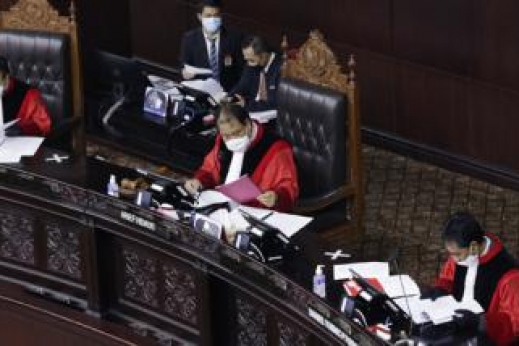
Panel petition revision hearing of the judicial review hearing of the Civil Code, Tuesday (13/10) in the Plenary Courtroom of the Constitutional Court. Photo by Humas MK/Gani.
JAKARTA, Public Relations of the Constitutional Court—The Constitutional Court (MK) held another material judicial review hearing of Article 1365 of the Civil Code (KUHPer) along the word “damage” was held by the Constitutional Court (MK) on Tuesday, October 13, 2020. The case No. 77/PUU-XVIII/2020 was filed by Zico Leonard Djagardo Simanjuntak. In this second hearing, the Petitioner’s attorney Bayu Segara explained the points of the revision on the Petitioner’s legal standing and identity as individual citizen, as well as improving his argument in the petitum.
Bayu said that the Petitioner refers to the Constitutional Court Decision No.30/PUU-XVI/2018 that prohibits political party functionaries from running for the Regional Representatives Council (DPD). The Constitutional Court based the prohibition on the interpretation of ‘another occupation’ to include political party functionaries.
“Therefore, in the a quo case, such a model can be used in the petitum filed by the Petitioner so that the word ‘damage’ in Article 1365 of the Civil Code is not interpreted to include advocate fees,” he explained virtually before Constitutional Justices Arief Hidayat (panel chairman), Manahan M. P. Sitompul, and Daniel Yusmic P. Foekh.
Therefore, Bayu added, the Petitioner requested that the Court grant the entire petition and declare the word “damage” in Article 1365 of the Civil Code unconstitutional and not legally binding insofar as interpreted to include advocate fees.
Also read: Online Transport App’s Reward Scheme Leads to Material Review Petition of Civil Code
The Petitioner felt aggrieved by the enactment of Article 1365 of the Civil Code along the word “damage.” On August 1, 2019 Grab Indonesia had held a jugglenaut challenge in which Grab users must use the GrabBike facility 74 times to be receive a reward of one million rupiahs. The Petitioner completed the challenge on August 8, 2019 but he didn’t receive the reward. He waited until September 2, 2019 but there received no reward nor any explanation.
On September 3, 2019, through his attorney, the Petitioner filed a lawsuit to the Central Jakarta District Court. The next day, Grab suddenly sent the reward to his Grab account. Grab then filed a counter-suit against the Petitioner on the grounds that a reward had been given, and argued that they had suffered damage for the legal services offered by the law firm Rajamada & Partners. The case was ruled inadmissible with a niet ontvankelijke verklaard (NO) ruling because the Grab application has a clause that says that any dispute between Grab and consumers shall be resolved at the Indonesian National Board of Arbitration, not the district court. Thus, the Petitioner couldn’t seek any more legal remedies on the issue.
On February 5, 2020 he received a legal notice from Grab Indonesia through Rajamada & Partners, whose reason and motion were exactly the same as those of the counter-suit. The Petitioner ignored the notice and then was sued at the West Jakarta District Court on March 10, 2020. The Petitioner felt directly harmed by the word “damage” as referred to in Article 1365 of the Civil Code, which is interpreted to include the legal services of the plaintiff (Grab Indonesia) to the Petitioner in casu the defendant.
Writer: Sri Pujianti
Editor: Lulu Anjarsari
PR: Fitri Yuliana
Translator: Yuniar Widiastuti (NL)
Translation uploaded on 10/14/2020 15:48 WIB
Disclaimer: The original version of the news is in Indonesian. In case of any differences between the English and the Indonesian versions, the Indonesian version will prevail.
Wednesday, October 14, 2020 | 07:19 WIB 247