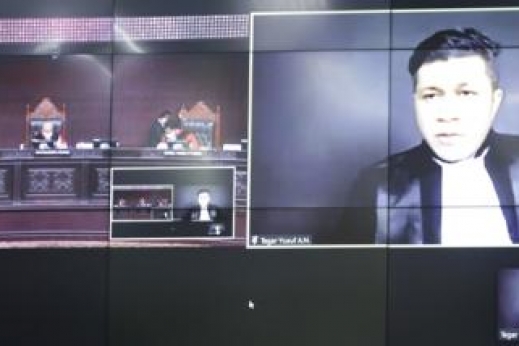
Virtual panel petition revision hearing of the judicial review of the Postal Service Law, Wednesday (14/10) in the Plenary Courtroom of the Constitutional Court. Photo by Humas MK/Gani.
JAKARTA, Public Relations of the Constitutional Court—The Constitutional Court (MK) held another judicial review hearing of Law No. 38 of 2009 on Postal Services on Wednesday, October 14, 2020 in the Plenary Courtroom. The case No. 78/PUU-XVII/2020 was filed by PT Pos Indonesia and Harry Setya Putra (Petitioners I and II), who argue that Article 1 number 2, Article 1 number 8, Article 15, Article 27 paragraph (2), Article 29 paragraph (2), Article 30, Article 46, Article 51 of the Postal Service Law are in violation of Article 33 paragraphs (2), Article 33 paragraph (4), and Article 34 paragraph (3) of the 1945 Constitution.
At the petition revision hearing, attorney Tegar Yusuf A. N. said Petitioner I revised their status and legal standing as board of directors’ member that represents the company in and out of court. He also added Article 4 and Article 29 paragraph (2) of the Postal Service Law to be reviewed against Article 33 paragraph (4) of the 1945 Constitution.
Tegar explained that Petitioner I’s legal standing is supported by Article 98 of Law No. 40 of 2007 on Limited Liability Companies (PT Law), which reads, “(1) The Board of Directors represents the Company both in and outside of the courts. (2) In the event that the membership of the Board of Directors consists of more than 1 (one) person, each member of the Board of Directors shall be authorized to represent the Company, unless stipulated otherwise in the articles of association.”
“In addition, the deed of establishment of the persero company also stipulates that the board of directors are authorized to represent PT Pos Indonesia in the a quo case,” he said virtually before Constitutional Justices Arief Hidayat (panel chairman), Suhartoyo, and Daniel Yusmic P. Foekh.
Also read: PT Pos Indonesia on Postal Service Losing Exclusivity
Widat, another attorney of the Petitioners, said Article 51 of the Postal Service Law is contrary to the Preamble of the 1945 Constitution and Article 33 paragraph (4) of the 1945 Constitution with a reference to Article 1 of the BUMN (SOE) Law, which reads, “Restructuring is an effort made for the recovery of BUMN, which is one of the strategic steps to improve the internal condition of the company to improve performance and increase the value of the company.”
“For this reason, Petitioner I believe, as the norm affirms, that restructuring in order for a business entity is able to provide the best services must involve the state, but the Postal Service Law doesn’t regulate it clearly,” he explained.
Also read: Preliminary Hearing of Postal Service Law Continues
At the previous hearing, Petitioner I said they are one of the state-owned enterprises that play an important role in the country’s development. Petitioner I organizes the mail, and deliver goods, and offers other postal services for the public. Based on Law No. 19 of 2003 on State-Owned Enterprises (BUMN), Petitioner I aims to contribute to the development of the national economy in general and state revenue in particular, and to pursue and generate profits.
Petitioner I argued that Article 1 number 2 of the Postal Service Law that reads, “The Postal Service is a business entity that manages postal services,” has disrupted its performance. The article means that postal services can be offered by any business entity that meets requirements. This has led to Petitioner I losing its exclusive rights as the state’s postal company and that is now on par with other non-state postal companies. The enactment of the article has also led to Petitioner I having difficulties in competing with private postal companies.
Petitioner II, who is an individual citizen, feels harmed by the enactment of Article 1 number 8, Article 27 paragraph (2), Article 29 paragraph (2), Article 30, and Article 46 of the Postal Service Law due to letters receiving equal treatment with other postal goods. He believes letters require the protection of the right to privacy, making it stand out compared to other postal goods. Letters contain private information between the sender and the recipient, which constitutes a human right that is expressly guaranteed in Article 28G paragraph (1) of the 1945 Constitution. However, in practice, any letter could be opened and checked by the postal company before being delivered, which violates the right to privacy. Therefore, he requested that the a quo articles be declared unconstitutional and not legally binding.
Writer: Sri Pujianti
Editor: Lulu Anjarsari
PR: Annisa Lestari
Translator: Yuniar Widiastuti (NL)
Translation uploaded on 10/14/2020 18:34 WIB
Disclaimer: The original version of the news is in Indonesian. In case of any differences between the English and the Indonesian versions, the Indonesian version will prevail.
Wednesday, October 14, 2020 | 15:22 WIB 534