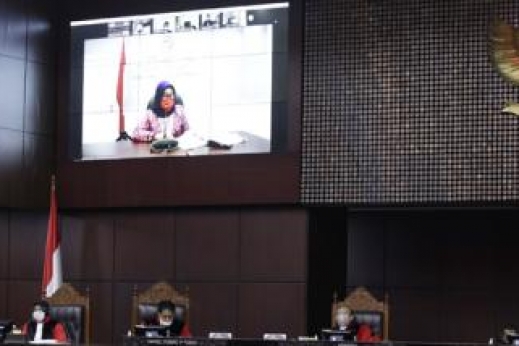
Plenary judicial review hearing of the Manpower Law to hear a statement by the House given by House Commission IX member Sri Rahayu, Tuesday (13/10) in the Plenary Courtroom of the Constitutional Court. Photo by Humas MK/Gani.
JAKARTA, Public Relations of the Constitutional Court—Another judicial review hearing of Law No. 13 of 2003 on Manpower was held by the Constitutional Court (MK) on Tuesday, October 13, 2020. House Commission IX member Sri Rahayuresponded to the Petitioners’ argument against Article 42 paragraphs (4), (5), and (6) of the Manpower Law. Sri said the Manpower Law serves to fulfill the rights of and provide basic protection for workers, as well as to create a conducive business environment and eliminate outdated provisions.
“The ratification of the Omnibus bill in the plenary meeting on October 5, 2020 means the content of the a quo article has changed. Therefore, the Petitioners’ judicial review petition of Article 42 paragraphs (4), (5), and (6) of the Manpower Law has lost its object. The Constitutional Court doesn’t have to consider the Petitioners’ petition’s subject matter and other matters related to the petition. However, the House will give a statement regarding the issues brought up by the Petitioners in this petition,” she stressed before panel chairman Chief Justice Anwar Usman.
Also read: Provision on Positions and Employment Period for Expatriates Challenged
The Petitioners’ argument that the phrases “certain positions” and “certain periods of time” in Article 42 paragraph (5) of the Manpower Law are multi-interpretive, Sri said, shows that they didn’t read the provision carefully, as it doesn’t regulate the positions in question or the type of positions that expatriates can be employed for. The article mandates that that the positions in question be regulated in the Decree of the Minister of Manpower No. 228 of 2019 on the positions that expatriates can hold.
“The Petitioners should also understand that the provision of the a quo article doesn’t regulate the positions that must be filled by expatriates that exclude Indonesian workers. In the provision of the a quo article regarding the filling of certain positions, the word 'can' means that certain positions can also be filled by Indonesian workers who meet the competencies and skills required such positions. In addition, 'certain positions' and 'certain periods of time' must also follow the human resource policy of each company,” Sri said.
Indiscriminate
The Petitioners believe the article to be discriminatory based on the Constitutional Court Decisions No. 070/PUU-II/2004 on April 12, 2005; No. 024/PUU-III/2005 on March 29, 2006; and No. 27/PUU-V/2007 on February 22, 2008 on what constitutes discrimination. However, the House believes that based on those decisions, the a quo article doesn’t contain anything discriminatory because it doesn’t cause reduction, deviation, or elimination of both individual and collective human rights and fundamental freedoms in the political, economic, legal, socio-cultural, and other aspects of life.
The House informed that Article 44 of the Manpower Law had been annulled, but the provision regarding the appropriateness of expatriates’ competencies for their positions is regulated in Article 42 paragraph (4) of the Manpower Law.
Not Permanent
The House also responded to the Petitioners’ argument regarding the phrase “certain periods of time” in Articles 56 and 59 of the Manpower Law by saying that expatriates can only be employed for non-permanent positions. Their work periods depend on the period and type of positions according to the employment agreements made for a specified period. It should also be noted that in the a quo provision there is the word “can,” which makes the hiring of expatriates not absolute. Any position filled by expatriates for a specified period as referred to in the Manpower Law doesn’t make the provision of the a quo article unconstitutional. The House also said that the provisions of Articles 56 and 59 of the Manpower Law had been amended.
In response to the House’s statement that parts of the Manpower Law have been transferred to the Omnibus Law, Chief Justice Anwar Usman asked the Petitioners’ attorneys, “Would [the Petitioners] withdraw this petition?” The Petitioners answered that they would like to wait on the Court’s decision.
Constitutional Justice Saldi Isra said, “As the substance petitioned by the Petitioners has been taken over by the Omnibus Law, the Court will state its stance after the Omnibus Law has been promulgated in the State Gazette.
Also read: Petitioners of Add Paragraphs of Manpower Law to Review
The Petitioners of case No. 66/PUU-XVIII/2020 are Slamet Iswanto (Petitioner I) and Maul Gani (Petitioner II). The two residents of Southeast Sulawesi Province challenged the phrases “certain positions” and “certain periods of time” in Article 42 paragraph (4) of the Manpower Law. They felt disadvantaged by the enactment of the a quo article, which reads, “Workers of foreign citizenship can be employed in Indonesia in employment relations for certain positions and for a certain period of time only.”
They claimed that the phrase “certain positions” is ambiguous and is not well-explained in the elucidation to the law. There is no specific explanation on the positions in question or the type of positions that expatriates can be employed for. They believe this provision allows the Government to interpret it however it wishes. They also believe that it discriminates them as local workers because it also doesn’t specify the period of employment for expatriates to work in Indonesia.
The Petitioners argued that they can fill certain positions for foreign workers as stipulated in the Decree of the Minister of Manpower No. 228 of 2019 and that the phrase “certain periods of time” is ambiguous and harm the Petitioners’ chances to find work. They concluded that, therefore, the phrases “certain positions” and “certain periods of time” are in violation of Article 28D paragraph (1) of the 1945 Constitution.
Writer: Nano Tresna Arfana
Editor: Lulu Anjarsari
PR: Annisa Lestari
Translator: Yuniar Widiastuti (NL)
Translation uploaded on 10/14/2020 15:52 WIB
Disclaimer: The original version of the news is in Indonesian. In case of any differences between the English and the Indonesian versions, the Indonesian version will prevail.
Wednesday, October 14, 2020 | 07:26 WIB 563