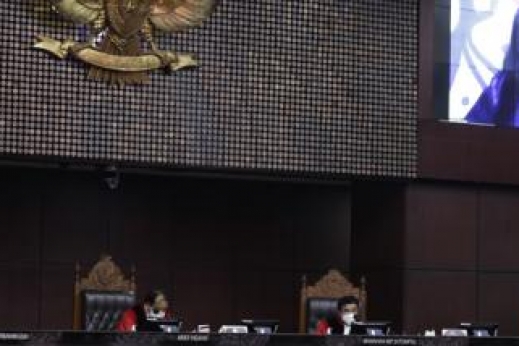
Panel preliminary examination hearing of the judicial review of Pornography Law, Monday (12/10). Photo by Humas MK/Gani.
JAKARTA, Public Relations of the Constitutional Court—The Constitutional Court (MK) held a preliminary judicial review hearing of Law No. 44 of 2008 on Pornography place on Monday, October 12, 2020 in the Plenary Courtroom. The case No. 82/PUU-XVIII/2020 was filed by Pina Aprilianti, a woman from Garut Regency, who is serving a sentence.
Through one of her attorneys Asri Vidya Dewi, Pina Aprilianti argued that Article 8 of the Pornography Law that reads, “Any person is prohibited from deliberately or unintentionally becoming an object or model of pornographic content,” violates Article 28D paragraph (1) and Article 28G paragraph (1) of the 1945 Constitution.
Asri revealed that due to the enactment of the a quo article, the Petitioner was sentence to three years in prison for being “an object or model” in a porn video. She reported her ex-husband for commercially distributing their record of sexual activity without her consent. She was 16 when she entered into an unregistered marriage with him, who is 14 years her senior and has sexual deviance.
Asri said Article 4 of the Pornography Law regulates privacy and prohibition of commercial reproduction and distribution of pornographic content. The Constitutional Court in its legal opinion in decision No. 48/PUU-VII/2010 also stressed the constitutionality of the phrase “for private consumption” in the Elucidation to Article 4 of the Pornography Law. She said that Article 8 of the Pornography Law then has created two subjects in a pornographic activity, i.e. the “object or model” thereof, without any affirmation on the context of commercial distribution.
“In conclusion, Article 8 of the Pornography Law actually leads to legal uncertainty, and this clearly is against Article 28B paragraph (1) of the 1945 Constitution,” said Asri virtually before Constitutional Justice Arief Hidayat (panel chairman), Enny Nurbaningsih, and Manahan M. P. Sitompul.
She also said that the a quo article has given the state the right to infringe on personal privacy, in contrast to the Elucidation to Article 4 of the Pornography Law. She added that the Elucidation to Article 8 only talks about the motives or situations that compels someone to be an “object or model,” including for personal reasons that is one’s privacy.
Conflict Between Rights and Freedom
Another attorney Mohammad Fandi Dennisatria said the Pornography Law is part of the public law, meaning that the state can regulate and restrict the freedom individuals for the sake of public order. However, the state’s interference in this private matter has led to a conflict between individual rights and freedom, which can be abused by law enforcers.
“Therefore, as a public law, the Pornography Law, which prohibits anyone from becoming an ‘object or model’ of pornographic content for personal use, has restricted the expressions of citizens, including in sexual activities that are not meant for public consumption,” Fandi argued.
Ambiguous Implementation
The Petitioner believes Article 8 of the Pornography Law has subjected anyone who agrees to be an “object or model” of pornographic content to abuse of power and ambiguity, which happened to the Petitioner. She was a victim but after reporting to the crime, she was instead charged with deliberately or with her consent committing such an action. The norm’s ambiguity potentially leads to other cases and victims, whether for personal reasons or even under force, threat, or deception.
“In reality, this cannot be readily interpreted and proven. The law is the extract of public phenomena, which is regulated and can provide solutions to existing problems,” Fandi said.
Argument for Constitutional Impairment
Constitutional Justice Enny Nurbaningsih advised the Petitioner to revise the petition in relation to the Court’s authority based on the 1945 Constitution, the Judicial Power Law, the Constitutional Court Law, as well as the object and conclusion of the petition. She also recommended that the Petitioner emphasize her legal standing.
Justice Enny also said that the Petitioner should include the conditions that the Petitioner’s rights are said to have been violated and explained the contradiction between the article being petitioned and the articles in the 1945 Constitution used as touchstones. “Since there are many articles in the 1945 Constitution. Are [the article in question in violation of] all the articles in the 1945 Constitution?” she asked the Petitioner’s attorneys.
She also asked the Petitioner to support her argument that Article 8 of the Pornography Law is only directed to women, when the phrase “any person” can mean both men and women.
Implementation or Constitutionality
Constitutional Justice Manahan M. P. Sitompul stressed that the criminal case that the Petitioner highlighted is only a stepping stone but not a basis for the judicial review because the Constitutional Court is not authorized to rule on cases that other courts are handling. Therefore, he asked the Petitioner to strengthen her legal argument that regardless of the case, the a quo can be declared unconstitutional.
“Basing it on a concrete case will make it difficult to examine it further. It is true that the Petitioner is a victim, but it needs elaboration whether this is a matter of implementation or constitutionality [of the norm]. If it is a matter of constitutionality, please build the legal argument for it,” he explained.
Constitutional Justice Arief Hidayat reminded the Petitioner to strengthen her legal standing as an individual citizen who factually suffered constitutional impairment due to the enactment of the a quo article. Before concluding the hearing, he informed the Petitioner to submit the petition revision by Monday, October 26, 2020 at 14:00 WIB to the Registrar’s Office.
Writer: Sri Pujianti
Editor: Nur R.
PR: Tiara Agustina
Photographer: Gani
Translator: Yuniar Widiastuti (NL)
Translation uploaded on 10/14/2020 13:04 WIB
Disclaimer: The original version of the news is in Indonesian. In case of any differences between the English and the Indonesian version, the Indonesian version will prevail.
Tuesday, October 13, 2020 | 08:15 WIB 3128