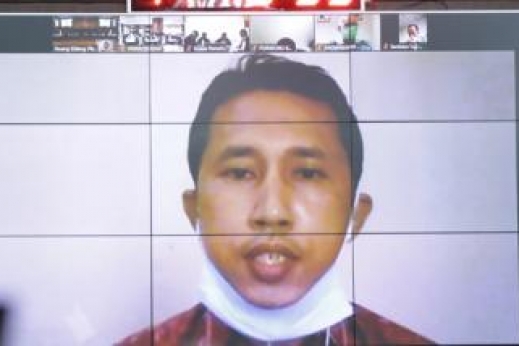
Constitutional law expert Yusdiyanto delivering his expertise for the Petitioners virtually at the judicial review hearing of the Pilkada Law, Monday (12/10). Photo by Humas MK/Gani.
JAKARTA, Public Relations of the Constitutional Court—The judicial review hearing of Law No. 10 of 2016 on the Second Amendment to Law No. 1 of 2015 on the Stipulation of the Government Regulation in Lieu of Law No. 1 of 2014 on the Election of Governors, Regents, and Mayors into Law (Pilkada Law) was held by the Constitutional Court (MK) on Monday afternoon, October 12, 2020. The hearing had been scheduled to hear the statement of an expert for the Petitioners.
The case No. 67/PUU-XVIII/2020 was filed by Mohammad Kilat Wartabone and Imran Ahmad, who challenge Article 7 paragraph (2) letter n of the Pilkada Law along the phrase “have never served as Governor/Regent/Mayor….”
Also read: One Term for Regional Heads Challenged
The Petitioners presentedconstitutional law expert Yusdiyanto, who explained that in relation to Article 7 paragraph (2) of Law No. 10 of 2016, the objects of constitutional law education are offices, the election of officials, as well as the duties and obligations, power, and authorities of those offices. Without the officials to fill the vacancies, the offices cannot run. The filling of the vacancies of officials and regional leaders to further the administration is not done only once, but regular, in a certain period.
“Indonesia’s Constitution adapt the restriction of presidential term from the United States. According to Daniel Zapato, a president could run again [and again] with the absence of any restriction. In other words, unlimited terms. Secondly, a consecutive reelection. Third, a non-consecutive reelection. Fourth, no reelection,” he said, explaining the types of reelection, before the justices led by Chief Justice Anwar Usman.
Also read: Regional Head Candidates Revise Petition on Pilkada Law
Yusdiyanto added that the fulfillment of regional head vacancies in the amended the 1945 Constitution means those offices are the most important part of the democracy in Indonesia. Article 18 paragraph (4) of the 1945 Constitution reads, “Governors, Regents, and Mayors, as the heads of provincial, regency, and city administrations shall be elected democratically.”
Democratic elections were then interpreted by the Constitutional Court as direct elections of regional heads for the improvement of the local democracy. Pilkada is expected to achieve government accountability, carry out checks and balances, and improve political awareness and education.
Are the offices ofgovernors, regents, and mayors singular offices or a unit along with the deputies? Yusdiyanto said there are three approaches. First, the historical approach in the special amendment of Article 18 paragraph (4) of the 1945 Constitution. Second, the formal approach in Article 18 paragraph (4) of the 1945 Constitution that only regulates regional heads, but not their deputies. Third, the semantic approach. There are philosophical reasons regarding the office of regional head deputies. Governors as the representation of the central government in the regions are assisted by an apparatus to carry out their authorities. Article 1 paragraph (3) of Law No. 23 of 2014 on the Regional Government reads, “The Regional Government is the regional head as the official elements of the Regional Government who leads the implementation of government affairs under the authority of the autonomous region.”
Article 63 paragraph (1) of the Regional Government Law stresses that a regional head may be assisted by a deputy. The phrase “may be” could mean two things: that a regional head is assisted by a deputy or that they don’t need a deputy. A deputy regional head in the regional administration in Indonesia assists a regional head in carrying their duties pursuant to prevailing legislation. The article means that it isn’t incorrect to assume that deputy regional heads are complementary to the regional administration.
Also read: House: Regional Heads Absent Too Long Must Be Dismissed
“The enactment of Article 7 paragraph (2) letter n of Law No. 10 of 2016 potentially leads to violation of the law and is not in line with the Constitutional Court Decisions No. 6 of 2008 and No. 22 of 2009 on the enactment of Article 32 letter o of Law No. 32 of 2004 that interpreted a half or over a half term as one term,” Yusdiyanto stressed.
Bone Bolango regent elect for 2010-2015 Abdul Haris Nadjmudin was temporarily dismissed for his involvement in a criminal case and replaced by vice regent Hamim Pou since September 18, 2010 to May 27, 2013. After 2 years and 3 months, Abdul Haris Nadjmudin passed away, allowing Hamim Pou to become acting regent since May 27, 2013 to September 17, 2015. He then was elected regent for February 17, 2016 to February 17, 2021. Pou, who is also a party chairman, was again nominated for regent in the 2020 simultaneous Pilkada for 2021-2026.
The question is: when did Hamim Pou start his term as regent? Yusdiyanto believes this means his appointment as regent, not acting regent, as the inauguration of officials including regents follows Law No. 30 of 2014 on Government Administration, especially Article 1 paragraph (24). Hamim Pou was declared one of the tickets in the pilkada for 2021-2026 by the General Elections Commission (KPU). If he is reelected based on the polling on December 9, 2020, his term as a regent will start.
The a quo article is in violation of Article 7 of the 1945 Constitution and Article 60 of Law No. 23 of 2014 on the term of a regional head, which is 5 years, with a one-time reelection. “The phrase ‘for 5 years since the date of inauguration and thereafter can be reelected in the same position for only one term of office’ provides a guideline that the term of a regional head cannot exceed 10 years. Therefore, Hamim Pou automatically cannot run in the pilkada for the 2021 term because he will have exceeded his term limit,” Yusdiyanto said.
Also read: Govt Says Regional Heads Only Serve Two Terms at Most
The petition was filed by Mohammad Kilat Wartabone and Imran Ahmad. Mohammad Kilat Wartabone is an independent regional head candidate for the 2020 simultaneous Pilkada in Bone Bolango Regency, Gorontalo Province while Imran Ahmad is a resident of Bone Bolango Regency, Gorontalo Province who has the rightto vote in and run for the 2020 simultaneous Pilkada.
They challenge Article 7 paragraph (2) letter n of the Pilkada Law that stipulates that candidates of governors, regents, and mayors and their deputies must “have never served as Governor/Regent/Mayor…,” which is interpreted to only apply to governors/regents/mayors. The norm only limits the term of office of regional heads but not to deputy regional heads acting as regional heads when the regional head position can be occupied by regional heads and acting regional heads.
Writer: Nano Tresna Arfana
Editor: Nur R.
PR: Lambang T. S.
Photographer: Gani
Translator: Yuniar Widiastuti (NL)
Translation uploaded on 10/14/2020 15:44 WIB
Disclaimer: The original version of the news is in Indonesian. In case of any differences between the English and the Indonesian version, the Indonesian version will prevail.
Tuesday, October 13, 2020 | 08:19 WIB 340