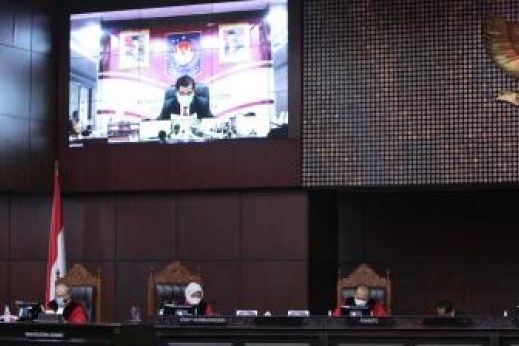
Government representative Suhajar Diantoro giving a testimony virtually judicial review hearing of the Law on the Election of Governors, Regents, and Mayors, Monday (5/10) in the Plenary Courtroom of the Constitutional Court. Photo by Humas MK/Ifa.
JAKARTA, Public Relations of the Constitutional Court—The 1945 Constitution regulates the term limit of president at five years and a one-time reelection. This also applies to heads of region as stipulated in Law No. 22 of 1999, Law No. 32 of 2004, and Law No, 23 of 2014 on the Regional Government. This means that laws and regulations stipulate that offices in the Indonesian administrations are limited to two terms, said expert staff for government of the Ministry of Home Affairs Suhajar Diantoro as the Government’s representative at the fourth judicial review hearing of Law No. 10 of 2016 on the Second Amendment to Law No. 1 of 2015 on the Stipulation of the Government Regulation in Lieu of Law No. 1 of 2014 on the Election of Governors, Regents, and Mayors into Law (Pilkada Law) on Monday, October 5, 2020.
The case No. 67/PUU-XVIII/2020 was filed by Mohammad Kilat Wartabone and Imran Ahmad, who challenge Article 7 paragraph (2) letter n of the Pilkada Law along the phrase “have never served as Governor/Regent/Mayor….”
In response to the Petitioners’ argument, Suhajar explained that the provisions are clear and not multi-interpretive as a people-elect head of region has to uphold the law in pursuit of the people’s welfare. Therefore, their term must be limited in order to avoid abuse of power and authority.
“This restriction is intended to reduce incumbents’ intention to do actions that is not in accordance with the rules, governance, and democracy, and to provide opportunities for other competent citizens [to run] as heads of region in the following period," he said before Chief Justice Anwar Usman and the other eight constitutional justices.
In response to the Petitioners’ argument that the a quo norm potentially leads to interim heads of region to stall the process of their stipulation as acting heads of region when the head of regions are dismissed before half into their term of office, the Government stressed that such an action is a violation to the existing laws and regulations. Therefore, it doesn’t warrant such concern that the Petitioners have.
Suhajar also said that the a quo norm serves to provide recognition, guarantee, protection, and fair legal certainty as well as equal treatment before the law for all citizens who intend to contest in regional head elections. Without such a norm, heads of region could abuse their authority and power, and intimidate the people to keep on electing them in every election. Thus, according to the Government, the a quo provision doesn’t contradict the 1945 Constitution.
Authority of Minister of Home Affairs
On behalf of Hamim Pou as the Relevant Party, attorney Duke Ari Widagdo explained that when a head of region is dismissed or dies and is replaced by their deputy, the deputy is stipulated as an interim head of region based on the authority of the Minister of Home Affairs with a consideration of the Regional Legislative Council (DPRD). This is regulated in Article 34 paragraph (3) of Law No. 32 of 2004 on the Regional Government, which reads, “In case the regional head and the deputy regional head are temporarily dismissed as referred to in Article 30 paragraph (1), Article 31 paragraph (1), and Article 32 paragraph (5), the President shall appoint an acting Governor upon the recommendation of the Minister of Home Affairs or acting Regent/Mayor upon the recommendation of the Governor and opinion from DPRD until there is a court decision that has obtained a permanent legal force.”
This means that when a head of region dies, their deputy replaces them until the term is over. This is also regulated in Article 26 paragraph (3) of Law No. 32 of 2004. The election of a deputy regional head as an interim head of region is also regulated in the Regulation of the Minister of Home Affairs No. 35 of 2013 on the Procedure of Election of Regional Head and/or Deputy Regional Head. The interim head of region is elected by the local DPRD at an extraordinary DPRD plenary meeting. In this case, the Relevant Party’s (Hamim Pou) election as the regent of Bone Bolango replacing Abdul Haris Nadjamudin who had passed away was based on the Letter of the Governor of Gorontalo No. 880/Pan/262/IV/2013 on April 23, 2013.
“The deputy regent (Relevant Party) did not deliberately delay his appointment and inauguration as Bone Bolango Regent because the authority lay with Bone Bolango Regency DPRD as the elector, the Governor of Gorontalo as the appointer, and the Minister of Home Affairs who issued the confirmation decision,” said Duke virtually.
Also read:
One Term for Regional Heads Challenged
Regional Head Candidates Revise Petition on Pilkada Law
House: Regional Heads Absent Too Long Must Be Dismissed
The petition was filed by Mohammad Kilat Wartabone and Imran Ahmad. Mohammad Kilat Wartabone is an independent regional head candidate for the 2020 simultaneous Pilkada in Bone Bolango Regency, Gorontalo Province while Imran Ahmad is a resident of Bone Bolango Regency, Gorontalo Province who has the rightto vote in and run for the 2020 simultaneous Pilkada.
They challenge Article 7 paragraph (2) letter n of the Pilkada Law that stipulates that candidates of governors, regents, and mayors and their deputies must “have never served as Governor/Regent/Mayor…,” which is interpreted to only apply to governors/regents/mayors. The norm only limits the term of office of regional heads but not to deputy regional heads acting as regional heads when the regional head position can be occupied by regional heads and acting regional heads.
The Petitioners feel disadvantaged because the Bone Bolango regent elected for 2010-2015 Abdul Haris Nadjmudin was temporarily dismissed for his involvement in a criminal case and replaced by vice regent Hamim Pou since September 18, 2010 to May 27, 2013. After 2 years and 3 months, Abdul Haris Nadjmudin passed away, allowing Hamim Pou to become acting regent since May 27, 2013 to September 17, 2015. He then was elected regent for February 17, 2016 to February 17, 2021. Pou, who is also a party chairman, was again nominated for regent in the 2020 simultaneous Pilkada for 2021-2026.
Writer: Sri Pujianti
Editor: Nur R.
PR: Lambang T. S.
Translator: Yuniar Widiastuti (NL)
Translation uploaded on 10/09/2020 14:57 WIB
Disclaimer: The original version of the news is in Indonesian. In case of any differences between the English and the Indonesian version, the Indonesian version will prevail.
Tuesday, October 06, 2020 | 05:55 WIB 355