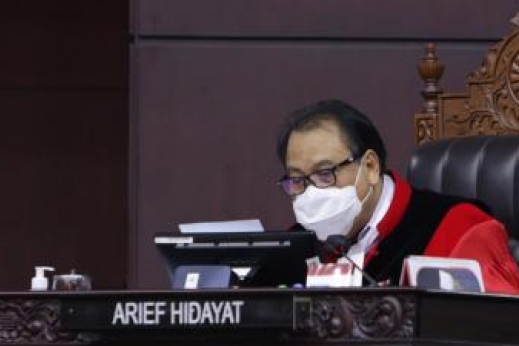
Constitutional Justice Arief Hidayat reading out the Court’s legal considerations at the ruling hearing of the judicial review of the Law on Fiscal Decentralization between Central and Regional Governments through video conference, Monday (28/9) in the Courtroom of the Constitutional Court. Photo by Humas MK/Ifa.
JAKARTA, Public Relations of the Constitutional Court—The Constitutional Court (MK) decided to dismiss the judicial review petition of Article 19 paragraph (2) letter b and paragraph (3) letter b and Article 20 paragraph (2) letter b of Law No. 33 of 2004 on Fiscal Decentralization between Central and Regional Governments at the virtual ruling hearing of case No. 63/PUU-XVIII/2020 on Monday, September 28, 2020 in the Plenary Courtroom. The petition was filed by the Civil Society Alliance of Blora, Sujad, Umar Ma’ruf, Jalal Umaruddin, Susanto Rahardjo, Febrian Candra Widya Atmaja, and Exi Agus Wijaya.
Constitutional Justice Arief Hidayat read out the Court’s legal considerations that the Petitioners’ petition was under the purview of the regional government, which had legal standing in the case. No other individuals, groups, customary law communities, or private and public legal entities can file the judicial review petition for the case.
"Thus, the Petitioners do not have the legal standing to act as petitioners in the a quo petition," he said.
Also read:
Provision on Revenue Sharing Fund between Central and Regional Govts Challenged
Two Petitioners Withdraw from Case on Revenue Sharing Fund between Central and Regional Govts
The Petitioners, consisting of associations and individual citizens of various professions, argued that the phrase “the producing regency/city” in the articles being reviewed has led to regencies/cities in certain working territories (WK) to not receive revenue sharing fund (DBH) while Article 1 number 14 of Law No. 22 of 2001 on Oil and Natural Gas reads, “Working Territory shall be a certain area within the Indonesian Legal Mining Territory for the execution of Exploration and Exploitation.” He added that this means before exploitation, exploration is done on the territory of the producing regency/city. The exploitation of mining resources should improve the people’s welfare, including the producing regency/city.
The Court considered that affairs devolved to the regional government, whether based on decentralization, de-concentration, or co-administration, cannot be managed without the distribution of central and regional finances. Due to the petition’s substance relating to regional rights, both provincial and regency/city, it is the provincial or regency/city governments who have the legal standing to file the petition.
The Court stressed that the constitutionality issues related to the rights of the regional government have been decided in the Constitutional Court Decisions No. 45/PUU-IX/2011 dated February 21, 2012, No. 87/PUU-XIII/2015 dated October 13, 2016, No. 136/PUU-XIII/2015 dated January 11, 2017, and No. 89/PUUXVI/2018 dated January 24, 2019.
"Therefore, the Court concluded that the Petitioners do not have the legal standing, thus, the Petitioners’ petition was not considered further," said Chief Justice Anwar Usman reading out the conclusion.
Writer: Sri Pujianti
Editor: Nur R.
PR: Muhammad Halim
Translator: Yuniar Widiastuti (NL)
Translation uploaded on 8/29/2020 22:46 WIB
Disclaimer: The original version of the news is in Indonesian. In case of any differences between the English and the Indonesian version, the Indonesian version will prevail.
Tuesday, September 29, 2020 | 08:25 WIB 267