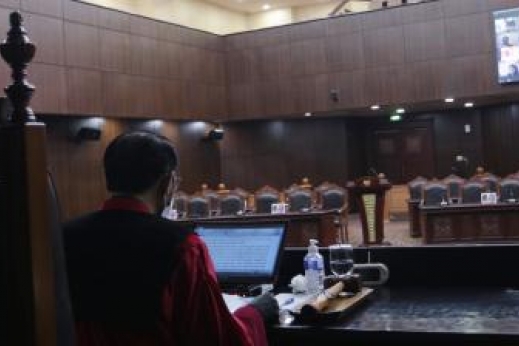
Chief Justice Anwar Usman reading out the verdict of the judicial review of the Law No. 11 of 2008 concerning Information and Electronic Transactions (ITE), Tuesday (29/9) in the Courtroom of the Constitutional Court. Photo by Humas MK/Ifa.
JAKARTA, Public Relations of the Constitutional Court—The judicial review petition of Law No. 11 of 2008 concerning Information and Electronic Transactions (ITE) filed by PT Nadira Intermedia Nusantara was rejected at the plenary ruling hearing of case No. 78/PUU-XVII/2019 on Tuesday, September 29, 2020.
The case No. 78/PUU-XVII/2019 was petitioned by PT Nadira Intermedia Nusantara, who argued that they had been disadvantaged by the enactment of Article 25 paragraph (2) of the Copyright Law because they were deemed having done "re-broadcast" or reruns. The Petitioner, who exercises the provisions of the Broadcasting Law to distribute at least 10% of the programs of public broadcasters (TVRI) and private broadcasters (private TV-stations that broadcast free to air), was reported by PT MNC SKY VISION to the police for rebroadcasting MNC Group’s TV contents.
Also read: Owning Exclusive Rights for Broadcast Contents, RCTI Affirms the Importance of ITE Law
In the legal considerations read out by Constitutional Justice Wahiduddin Adams, the Court stated that the provision on rebroadcast in Article 25 paragraph (2) letter a of Law No. 28 of 2014 on Copyright should be interpreted as a whole and understood comprehensively. He said that rebroadcast or rerun is not defined merely as the activity of reproducing and replaying a broadcast. Reruns also include relaying broadcasts or simultaneously broadcasting a broadcast produced or owned by another broadcasting institution. The Court also emphasized that the objective of the a quo law was to provide protection for the economic rights of broadcasting institutions as intended by Article 25 paragraph (2) letter a of Law No. 28 of 2014.
"Because economic rights are attached to copyright. This means that the economic rights of broadcasting institutions of their broadcasts will not be protected if other broadcasters, on the grounds of having broadcasting operation permit, can to rebroadcast their broadcasts without permission. In that context, although everyone has the right, among other things, to convey information, which by the definition of Article 32 paragraph (1) of Law No. 11 of 2008 means transmitting, they must understand that the information to be transmitted to the wider community is the property or under the copyright of another person. Therefore, they are obliged to respect said property or copyright," he said.
Also read: House: ITE Law Protects Private and Public Electronic Information
Broadcasting Cooperation
Justice Wahiduddin added that Article 26 paragraph (2) of Law No. 32 of 2002 allows channels to distribute at least 10% of the programs of public and private broadcasting institutions (LPP and LPS) without permission, but it doesn’t mean that subscription broadcasting institutions (LPB) are free to do so because the law also stipulates the broadcasting right that a broadcasting institution has to broadcast any program or show that it obtains legally from the copyright owner or creator of said program.
“Regarding the allocation of at least 10% of the programs of [public and private broadcasting institutions], Law No. 32 of 2002 already has a solution in Article 41 that reads, ‘Broadcasting institutions may cooperate to conduct joint-broadcast insofar as the said broadcast shall not lead to information monopoly and opinion shaping monopoly.’ The [word] ‘cooperate’ in Article 41 of Law No. 32 of 2002 means that between [public, private, and subscription broadcasting institutions],” he said.
Also read: Cable TV Operators Association Reveals Facts on ITE Law Hearing
Protection of Broadcast Right
The Court believes that Article 32 paragraph (1) of Law No. 11 of 2008 cannot be said to have led to legal uncertainty. On the contrary, it provides protection of broadcast right as the private economic right of broadcasting institutions from any unlawful transmission. Private law regulates special interests including the economic rights of broadcasters.
"Therefore, the Petitioners’ argument that Article 32 paragraph (1) of Law No. 11 of 2008 has created legal uncertainty is legally unwarranted," Constitutional Justice Saldi Isra reading out the Court’s legal considerations.
The Court also believes that Article 32 paragraph (1) of Law No. 11 of 2008 and Article 25 paragraph (2) letter a of Law No. 28 of 2014 doesn’t restrict one’s right to store, process, and convey information. In fact, it stipulates that this right is exercised within the legal framework, that certain information which is public or private property can still be conveyed by other parties as long as they have the permission of the owner. Thus, Justice Saldi added, the a quo law only regulates that this right is implemented in protection of other parties who have legal rights to control certain information as their copyright.
"Therefore, Article 32 paragraph (1) of Law No. 11 of 2008 does not contradict Article 28F of the 1945 Constitution because the right to obtain information and convey information can be carried out by subscription broadcasting institutions after obtaining permission from the broadcast right’s owner. Based on all legal considerations above, the Court believes the Petitioner’s petition is legally groundless in its entirety," Justice Saldi said.
Writer: Nano Tresna Arfana
Editor: Lulu Anjarsari
PR: M. Halim
Translator: Yuniar Widiastuti (NL)
Translation uploaded on 9/30/2020 13:22 WIB
Disclaimer: The original version of the news is in Indonesian. In case of any differences between the English and the Indonesian version, the Indonesian version will prevail.
Tuesday, September 29, 2020 | 14:50 WIB 277