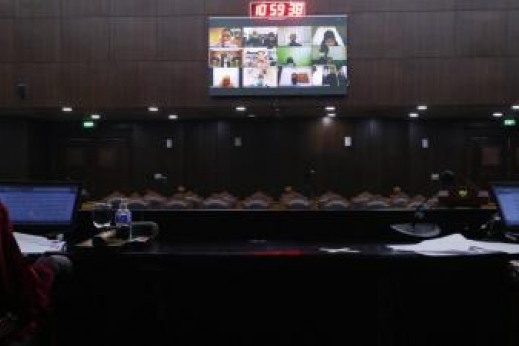
The virtual judicial review hearing of Law No. 14 of 2002 on Tax Court, Monday (28/9) in the Courtroom of the Constitutional Court. Photo by Humas MK/Ifa.
JAKARTA, Public Relations of the Constitutional Court—The Constitutional Court (MK) granted part of the judicial review petition of Law No. 14 of 2002 on Tax Court regarding the appointment mechanism and the term of office of the chairperson and vice chairperson of the tax court. The Decision No. 10/PUU-XVIII/2020 was read out on Monday, September 28, 2020 in the Plenary Courtroom.
"[The Court] grants the Petitioners’ petition in part, declares Article 8 paragraph (2) of Law No. 14 of 2002 on the Tax Court that reads, ‘The Chairperson and Vice Chairperson shall be appointed for a 5- (five) year term and can be re-appointed for 1 (one) more term’ to be in violation of the 1945 Constitution of the Republic of Indonesia and not legally binding as long as it is not interpreted as The Chairperson and Vice Chairperson shall be appointed by the President-elect from and by the Judges who are subsequently proposed through the Minister after obtaining the approval of the Chief Supreme Justice for a 5 (five) year term and can be re-appointed for 1 (one) more term’,” said Chief Justice Anwar Usman, reading out the verdict.
Also read: Leadership Appointment Mechanism Inconsistent, Three Judges Challenge Tax Court Law
Tax court judges Triyono Martanto, Haposan Lumban Gaol, and Redno Sri Rezeki had previously argued that Article 5 paragraph (2) and Article 8 paragraph (2) of the Tax Court Law contradict Article 24 paragraph (1) and Article 25 of the 1945 Constitution. They claimed that the a quo norm had disadvantaged them because the appointment of the chairperson and vice chairperson of the tax court with a nomination by the Minister of Finance, pursuant to Article 8 paragraph (2) of the Tax Court Law, was problematic. It relates to the appointment and dismissal of those judges, as well as the independence and authority of judges to examine, hear, and decide on tax disputes. They also believed the a quo law didn’t clearly and firmly stipulate the mechanism for determining the candidates for the chairperson and vice chairperson of the tax court before the approval of the Chief Supreme Justice is requested and the nomination is proposed to the president by the Minister of Finance (MoF).
Administrative Involvement of MoF
In the Court’s legal considerations read out by Constitutional Justice Suhartoyo, the Court stated that tax court judges must have judicial freedom and the freedom to appoint its leaders since coordination is imperative in carrying out its functions. External parties (in this case the MoF) might not know about the quality and characters of these judges.
“Therefore, the Court believes that the appointment mechanism of the chairperson and vice chairperson of the tax court must be free from the Finance Minister’s involvement so that the judges can reflect their choices based on their conscience, which is based on their capabilities, integrity, and leadership, and account for the consequences of those choices,” he said.
Justice Suhartoyo said that the Finance Minister’s involvement is merely an administrative follow-up on the selection of the chairperson and vice chairperson, which then will be proposed to the president after obtaining the approval of the Chief Supreme Justice. Likewise, such is the Finance Minister’s involvement in nomination and/or honorable or dishonorable discharge of the chairperson and vice chairperson of the tax court.
Also read:
Petitioners Challenging Provision on Appointment of Tax Court Leaders Revise Petition
Govt: Nomination of Tax Court Leaders Constitutional
Constitutional Justice Manahan M. P. Sitompul said that judicial review wasn’t the appropriate legal measure to challenge the phrase “organizational fostering” in Article 5 paragraph (2) of the Tax Court Law that intended the chairperson and vice chairperson of the tax court be appointed not with nomination by the Finance Ministry as the phrase might not necessarily include the appointment of the chairperson and vice chairperson of the tax court. Not to mention, the a quo norm doesn’t regulate the procedure and requirements of the nomination and appointment of the chairperson and vice chairperson of the tax court.
“Therefore, it is irrelevant to declare Article 5 paragraph (2) of the a quo law conditionally constitutional in relation to requirements of the nomination and appointment of the chairperson and vice chairperson of the tax court,” he said.
In addition, he added, as a consequence of the constitutionality of Article 5 paragraph (2) of the a quo law, the Finance Minister might still be involved in the nomination and appointment of the chairperson and vice chairperson of the tax court until the one-stop system of the tax court is implemented under the Supreme Court. Therefore, any doubt on the issue of the judges’ independence in relation to this matter is inevitable.
“However, to assuage this doubt, the Court asserts that the Finance Minister’s involvement in the nomination and appointment of the chairperson and vice chairperson of the tax court is strictly regarding administrative formal requirements,” he stressed.
Also read: House Absent in Last Hearing on Tax Court Law
Tax Court Judges’ Term of Office
The Court stated that the periodical rotation of leaders is necessary in democracy to avoid authoritarianism and power abuse, which is done through limiting the judges’ term of office. This is also part of regeneration in an organization. Therefore, the relevant tenure for the chairperson and vice chairperson of the tax court is one five-year term of office.
“Therefore, the Petitioners’ argument that the phrase ‘from judges’ in Article 8 paragraph (2) of Law No. 14 of 2002 is unconstitutional and not legally binding as long as it is not interpreted as ‘The Chairperson and Vice Chairperson shall be appointed by the President-elect from and by the Judges who are subsequently proposed through the Minister after obtaining the approval of the Chief Supreme Justice for a 5 (five) year term and can be re-appointed for 1 (one) more term’ is legally grounded. However, the Petitioners’ argument along the phrase ‘proposed by the Minister’ is legally groundless and the Court interpreted it as ‘proposed through the Minister,’” Justice Suhartoyo said.
Writer: Sri Pujianti
Editor: Lulu Anjarsari
PR: Annisa Lestari
Translator: Yuniar Widiastuti (NL)
Translation uploaded on 9/30/2020 13:20 WIB
Disclaimer: The original version of the news is in Indonesian. In case of any differences between the English and the Indonesian version, the Indonesian version will prevail.
Tuesday, September 29, 2020 | 08:34 WIB 318