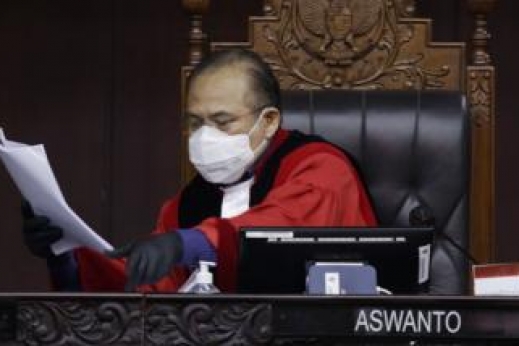
Panel preliminary examination hearing of the judicial review of the Law on the State’s Financial Policy and Fiscal Stability for the Mitigation of the COVID-19 Pandemic, Tuesday (22/9) in the Plenary Courtroom of the Constitutional Court. Photo by Humas MK/Gani.
JAKARTA, Public Relations of the Constitutional Court—Din Syamsuddin, Amien Rais, and their peers continue fighting for justice in relation to the state’s financial policy for the mitigation of the COVID-19 pandemic in Law No. 2 of 2020 on the Government Regulation in Lieu of Law No. 1 of 2020 regarding the Stipulation of the State’s Financial Policy and Fiscal Stability for the Mitigation of the COVID-19 Pandemic and/or in Order to Face Threats That Endanger the National Economy and/or the Financial System’s Stability into Law. For the second time, 56 petitioners, consisting of individuals and Muslim groups the Persatuan Islam’s (Persis) central executive, Wanita Al-Irsyad, and Pemuda Al-Irsyad’s executive board.
The preliminary hearing of case No. 75/PUU-XVIII/2020 was held by the Constitutional Court on Tuesday afternoon, September 22, 2020. The Petitioners challenge Article 2 paragraph (1) letter a numbers 1, 2, and 3; Article 6 paragraph (12); Article 27; and Article 28 of the Elucidation to Law No. 2 of 2020. Some of the petitioners have challenged the law in case No. 23/PUU-XVIII/2020, which was rejected by the Court. Attorney Ibnu Sina Chandranegara explained that the Constitutional Court Decision No. 004/PUU-I/2003 states that the 1945 Constitution, especially Article 24C, is the Court’s basis. However, in the judicial review of Article 50 of the Constitutional Court Law, the Court firmly stated, albeit not in its decision, that the restriction to the Court in reviewing Article 50 of the Constitutional Court Law is unconstitutional.
“In the same vein, the Constitutional Court Decision No. 27/PUU-VII/2009 states the need for a deadline for a law to be reviewed formally. In its legal opinion, the Court believes 45 days would be a sufficient time to file a [petition for] formal review,” said Ibnu before Deputy Chief Justice Aswanto and Constitutional Justices Wahiduddin Adams and Daniel Yusmic P. Foekh.
The Petitioners believe that the opinion on the deadline at 45 days after a law is promulgated in the State Gazette is only based on the characteristic differences of formal and material reviews, while Article 24C paragraph (1) of the 1945 Constitution doesn’t set any limit. Using the Court’s rationale in Decision No. 004/PUU-I/2003 in relation to Article 50 of the Constitutional Court Law, which results in the implicit revocation of the a quo article, the limitation to 45 days is unnecessary as it denies the Constitutional Court’s authority to examine, hear, and decide cases. It is limitative in the sense that the Constitutional Court’s authority is defined by only what is mentioned in this article.
“Based on the legal argument, the Court is authorized to decide on the formal review filed by the Petitioners without a 45-day deadline after the law in casu Law No. 2 of 2020 be promulgated in the State Gazette,” Ibnu said.
Not in Line with the 1945 Constitution
Ibnu then said that the articles challenged by the Petitioners are explicitly and implicitly not in line with the principles of a legal state as stipulated in the 1945 Constitution. This is because some of the a quo provisions give the president absolute authority and deny the lawmaking authority of the DPR (House) and DPD (Regional Representatives Council). The a quo provisions also gives institutions and/or policy executors impunity should there be any violation of abuse of authority.
Ibnu added that the a quo provisions ignore the legal principles as emphasized in Article 1 paragraphs (2) and (3) of the 1945 Constitution. One of the state financial policies regulated in the Elucidation to Law No. 2 of 2020 is the Government’s authority to set the state budget deficit beyond the 3% gross domestic product (GDP) limit until fiscal year 2022 stipulated in Article 2 paragraph (1) letter a numbers 1, 2, and 3. The Petitioners believe this to be unconstitutional because of three reasons: the state budget must be regulated in a law, not any other regulation; the state budget must be approved by the House; and the State Budget Law is periodical and stipulated annually.
The Petitioners also argued that Article 6 paragraph (12) of the Elucidation to Law No. 2 of 2020 on the tariff, tax base, and calculation procedure of income tax, which are regulated with a government regulation. They believe the a quo provisions are unconstitutional as taxes and other levies must be regulated by a law that is approved by the House, pursuant to Article 23A of the 1945 Constitution, not by a government regulation.
Judicial Review Deadline
Constitutional Justice Wahiduddin Adams highlighted the deadline of formal review of the law, as the Petitioners’ petition was registered on September 9, 2020. “Meanwhile, the law came into force and was enacted since May 18, 2020, so the petition has passed the 45-day deadline according to the Constitutional Court Decision No. 27/PUU-VII/2009. In addition, the Petitioners built an argument to ignore the Constitutional Court Decision No. 27/PUU-VII/2009, using the same argument when the Court revoked Article 50 of the Constitutional Court Law. However, the argument hasn’t been elaborated by the Petitioners,” he said.
Constitutional Justice Daniel Yusmic P. Foekh highlighted the fact that the articles that the Petitioners intend to review and the subjects of the petition are mostly the same as those in previous cases. “Please reconsider whether [you] would like to continue filing for a formal review or not. This is [your] right, although we have the obligation to remind [you]. I would not comment on other matters related to the petition as this petition is a repeat of the previous ones,” he said.
Chairman of the panel, Deputy Chief Justice Aswanto, said that in principle, the Petitioners’ petition is similar to the previous ones, with the addition of Article 6 paragraph (1) of Law No. 2 of 2020. He also reminded 12 individual petitioners to sign their powers of attorney.
Writer: Nano Tresna Arfana
Editor: Lulu Anjarsari
PR: M. Halim
Translator: Yuniar Widiastuti (NL)
Translation uploaded on 9/25/2020 11:28 WIB
Disclaimer: The original version of the news is in Indonesian. In case of any differences between the English and the Indonesian version, the Indonesian version will prevail.
Wednesday, September 23, 2020 | 08:50 WIB 303