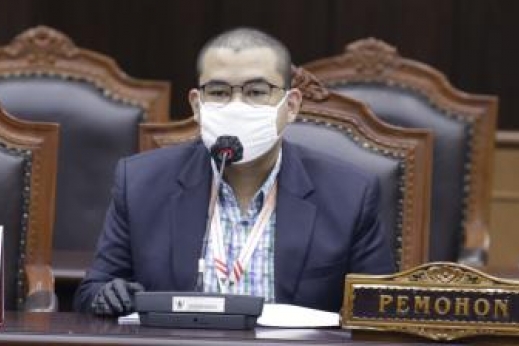
Principal petitioner Muhammad Anis Zhafran Al Anwary conveying the petition revision of the judicial review of the Higher Education Law, Wednesday (19/8/2020) in the Plenary Courtroom of the Constitutional Court. Photo by Humas MK/Gani.
JAKARTA, Public Relations of the Constitutional Court—The Constitutional Court (MK) held another judicial review hearing of Law No. 12 of 2012 on Higher Education on Wednesday, August 19, 2020. In the second hearing of case No. 53/PUU-XVIII/2020, Brawijaya University student Muhammad Anis Zhafran Al Anwary conveyed several revision points, especially regarding legal standing. The Petitioner has two identities: as an Indonesian citizen and a student in his campus. As a citizen, he added, his freedom to express criticism and suggestions on state issues is guaranteed by the law. However, any academic criticism, suggestion, and solution that he expresses can only be expressed openly on state issues when it has clear theoretical basis, in order to ensure accountability.
He also revised the definition of discrimination on the point of academic discrimination. Based on the Constitutional Court Decision No. 024/PUU-III/2005, the Court stated that discrimination occurs when there is direct or indirect restriction, harassment, or exclusion based on differentiation against humans on the basis of religion, race, ethnicity, and basic freedom in individual or collective life in political, economic, legal, social, cultural, and other aspects of life. The phrase “and other aspects of life” in the decision, he said, can be interpreted as education, especially higher education.
“Therefore, the argument of discrimination against students regarding freedom of speech in academia has a strong legal basis,” said Anis before panel chairman Constitutional Justice Manahan M. P. Sitompul, along with Constitutional Justices Arief Hidayat and Saldi Isra.
Also read: Discussion Restricted, Brawijaya Student Challenges Provision on Freedom of Academic Expression
In the preliminary hearing, the Petitioner argued that Article 9 paragraph (2) of the Higher Education violates Article 28, Article 28C paragraph (1), Article 28E paragraphs (2) and (3), Article 28F, and Article 28I paragraph (2) of the 1945 Constitution. He believes that the a quo article has restricted his freedom to express his thoughts, opinions, and any information in relation to the scientific clusters and branches that he knows. University students who spoke in discussions, seminars, public talks, and similar events receive intimidation, terrors, and verbal and nonverbal threats. They are not professors or lecturers, hence deemed not having the authority to convey thoughts and information in certain scientific clusters or branches. He also fears that the article be used to restrict university students’ freedom of academic expression in public.
The Petitioner also argued that the elucidation to the a quo article judges a person’s cognitive abilities based on the length of their formal studies, which he believes doesn’t reflect one’s academic capabilities. Therefore, requested that the Constitutional Court declare Article 9 paragraph (2) of the Higher Education unconstitutional and not legally binding. (*)
Writer: Sri Pujianti
Editor: Lulu Anjarsari
PR: Annisa Lestari
Translator: Yuniar Widiastuti (NL)
Translation uploaded on 8/24/2020 14:39 WIB
Disclaimer: The original version of the news is in Indonesian. In case where any differences occur between the English and the Indonesian version, the Indonesian version will prevail.
Wednesday, August 19, 2020 | 22:15 WIB 250