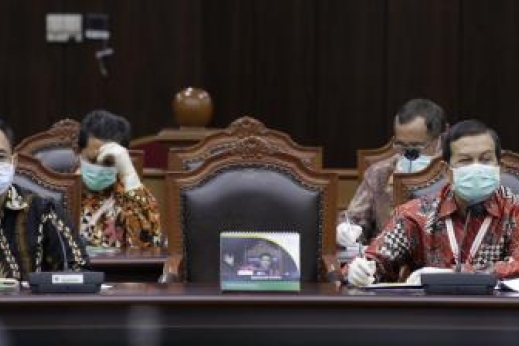
Strategic Planning and Information Technology Director of Employment BPJS Sumarjono and Executive Director of PT Asabri (Persero) Sony Wijaya (left to right) as relevant parties giving their statements in a judicial review hearing of the Law on Social Security Administrative Agency, Thursday (23/7) in the Courtroom of the Constitutional Court. Photo by Humas MK/Ifa.
JAKARTA, Public Relations of the Constitutional Court—The Constitutional Court (MK) held another judicial review hearing of Law No. 24 of 2011 on the Social Security Administrative Agency (BPJS Law) on Thursday, July 23, 2020. The hearing of case No. 6/PUU-XVIII/2020 had been scheduled to hear statements by the Relevant Parties: the Employment BPJS, PT Asabri (Persero), and PT Taspen (Persero). The hearing was led by Chief Justice Anwar Usman.
Strategic Planning and Information Technology Director of Employment BPJS Sumarjono said the transfer of Asabri program and pension payment from PT Asabri (Persero) to the Employment BPJS is based on the principles of mutual cooperation, nonprofit, trust fund, etc. therefore, social security cannot be managed by profit-oriented BUMN (SOEs), but by a public legal entity whose profits are obtained, used, and returned to the Employment BPJS participants. It is also the implementation of the will of the state and not intended to reduce the benefits received by participants, who are army and Polri (police force) retirees.
Sumarjono added that the state’s goal, which is reinforced by developing a social security system, is to improve the people’s welfare. "The national social security system is a state program aimed at providing certainty of protection and social welfare for all people as mandated by the 1945 Constitution," he said.
Law No. 40 of 2004 on the National Social Security System complies with Article 34 paragraph (2) of the 1945 Constitution, which stipulates that the state is obligated to develop a social security system that empowers the weak and underprivileged. The regulation and organization of BPJS, however, is an open legal policy. “The legislature worked on a mechanism for managing social security through the Social Security Administrative Agency," he said. He added that any exchange of information will only be between the BPJS and participants, so the participants’ data’s confidentiality will be kept.
Distinctive Characteristics
Another Relevant Party, Executive Director of PT Asabri (Persero) Sony Wijaya, said that social insurance for the armed forces, the police, and ASN employees in the Ministry of Defense and the Police force has special history and considerations because of their distinctive nature and characteristics. He explained social insurance for Asabri members started with Taspenmil in 1964, a special branch of state-owned pension insurance Taspen for the military. The high risk of death while on active duty is a distinct characteristic that warrants military death benefits.
Sony added that the Asabri programs include old age savings, work accident insurance, life insurance, pension plans, KPR (mortgage) down payment loans, policy loans, Taspen Life scholarship, etc. Asabri participants are members of the armed forces (TNI), the police, and ASN employees in the Ministry of Defense and the Police force who are on active duty and those who have retired.
Sony said that the philosophy behind the issuance of the National Social Security System Law and the Social Security Administrative Agency Law is to provide social protection and welfare for all Indonesian people. He added that the transfer of Asabri program and pension payment from PT Asabri (Persero) to the Employment BPJS must provide better welfare to participants. No benefits can be reduced because of the high risk of death among members of the armed forces and the police force while on active duty.
He also said that PT Asabri has two strategic goals going forward. First, to transform into BPJS TNI or Polri by 2029. Second, to design a program that has a comparable benefit to the risks faced by participants.
Executive Director of PT Taspen (Persero) A. N. S. Kosasih explained that PT Taspen (Persero) had given a statement on the same issue in case No. 72/PUU-XVII/2019. However, PT Taspen would like to emphasize that the government insists that the social security for state administrators are self-managed, not combined with public or private workers. He added that PT Taspen (Persero) and PT Asabri (Persero) that manages the Petitioners’ social security was appointed by the government.
"The task mandated to PT Taspen also applies in countries of similar social, political, demographical, and prosperity standing as Indonesia, for example Malaysia, the Philippines, Thailand, and South Korea," he said.
Also read: Transfer from ASABRI Program to Employment BPJS Challenged
The case No. 6/PUU-XVIII/2020 was filed by retired Indonesian military (TNI) officials Endang Hairudin, M. Dwi Purnomo, Adis Banjere, and Adieli Hulu, who challenge Article 65 paragraph (1) of the BPJS Law that reads, "PT Asabri (Persero) shall transfer its social insurance program for the Armed Forces of the Republic of Indonesia and pension program to BPJS Employment at the latest by 2029."
The Petitioners argued that the article potentially harm their constitutional rights. They used to receive duties that carry the risk of death, disability, missing in action, and high mobility. After retirement, they expect not to lose the pension benefits that they have been receiving from PT Asabri, especially position confidentiality and personal data that they believe must be kept according to their oath.
Writer: Nano Tresna Arfana
Editor: Lulu Anjarsari P.
PR: M. Halim
Translator: Yuniar Widiastuti (NL)
Translation uploaded on 7/24/2020 14:11 WIB
Disclaimer: The original version of the news is in Indonesian. In case where any differences occur between the English and the Indonesian version, the Indonesian version will prevail.
Thursday, July 23, 2020 | 19:37 WIB 486