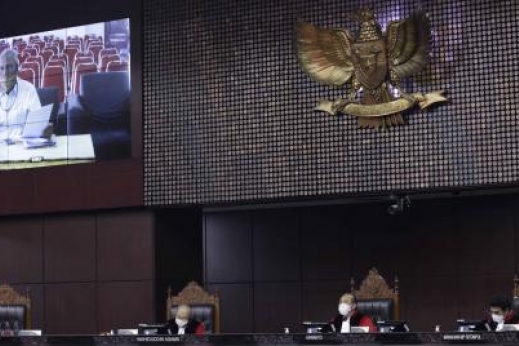
Petitioner Channy Oberlin Aritonang delivering the subjects of the judicial review petition of the Criminal Procedure Code via video conference on Wednesday (22/7) in the Courtroom of the Constitutional Court. Photo by Humas MK/Ifa.
JAKARTA, Public Relations of the Constitutional Court—The Constitutional Court (MK) held a preliminary material review hearing of the Criminal Procedure Code (KUHAP) on Wednesday noon, July 22, 2020 following COVID-19 health protocols.
Petitioner of case No. 56/PUU-XVIII/2020 Channy Oberlin Aritonang challenges Article 1 number 14, Article 184 paragraphs (1) and (2) of the Criminal Procedure Code. Article 1 number 14 reads, “Suspect is a person who, because of his act or condition, on the basis of initial proof, can reasonably be suspected of being a perpetrator of a criminal act.” Article 184 paragraph (1) reads, “Legal evidence materials are: a. the testimony of a witness; b. information by an expert; c. a letter; d. an indication; e. the statement of a defendant.” Article 184 and paragraph (2) reads, “Matters which are generally known need not be proved.”
The Petitioner claimed he had been scammed by a state civil apparatus (ASN) at the National Development Planning Board (Bappenas), who claimed they would get the Petitioner’s child a job at PT Aneka Tambang with a certain sum of money. He then reported the ASN to Medan Metropolitan Police (Polrestabes), which then terminated the investigation through investigation termination warrant No. SPPP/2032a/IV/Res.1.11/2020/Reskrim on April 17, 2020.
Concrete Case
Deputy Chief Justice Aswanto as panel chairman observed that the Petitioner’s case is a concrete one, not a judicial review one. “The petition doesn’t have a petitum. Your petition doesn’t meet formal requirements. We will give you the chance to revise the petition following the procedural law at the Constitutional Court. Two weeks at most,” he stressed.
Justice Wahiduddin Adams advised the Petitioner to study other petitions lodged to the Court and include touchstones in the form of articles of the 1945 Constitution as well as evidence. Justice Manahan M. P. Sitompul explained that the Court is authorized to review phrases or articles in laws, not the decision of other courts. He also advised the Petitioner to study the structure of judicial review petition in the Constitutional Court and to detail the norms that are deemed unconstitutional.
Writer: Nano Tresna Arfana
Editor: Lulu Anjarsari P.
PR: Fitri Yuliana
Translator: Yuniar Widiastuti (NL)
Translation uploaded on 7/23/2020 20:55 WIB
Disclaimer: The original version of the news is in Indonesian. In case where any differences occur between the English and the Indonesian version, the Indonesian version will prevail.
Wednesday, July 22, 2020 | 15:58 WIB 385