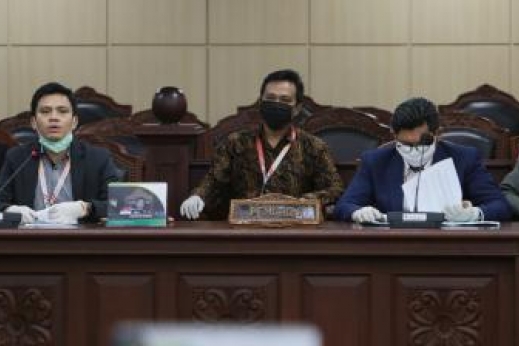
Petitioners in the preliminary hearing of the material review of the Information and Electronic Transactions (IET) Law, Monday (13/7) in the Plenary Courtroom of the Constitutional Court. Photo by Humas MK/Ifa.
JAKARTA, Public Relations of the Constitutional Court—The Constitutional Court (MK) held a hearing on Monday, July 13, 2020 in the Plenary Courtroom, to review Articles 29 and 45B of Law No. 11 of 2008 on Information and Electronic Transactions (IET), as amended by Law No. 19 of 2016 on Information and Electronic Transactions (IET). The case No. 50/PUU-XVIII/2020 was filed by seven advocates.
Article 29 of the IET Law reads, “No Person shall intentionally and without authorization sends Electronic Information and/or Electronic Records that contain threats of violence or intimidation against individuals.”
Article 45B of the IET Law reads, “Any Person who intentionally and without authorization sends Electronic Information and/or Electronic Records that contain threats of violence or intimidation against individuals as referred to in Article 29 shall be sentenced to imprisonment of at most 4 (four) years and/or a fine of at most Rp750,000,000 (seven hundred fifty million rupiah).”
The Petitioners believe that the articles are ambiguous and could be used to report any individual. In the petition, Petitioner I Gunawan Simangunsong explained that he is one of the attorneys of twelve students of the National Institute of Science and Technology (ISTN) who was put on academic leave unilaterally by the rector because of late payment of tuition fees. He then sent letter legal notices and invitations for mediation No. 17/BGP/III/2019 on March 18, 2019 and No. 21/BGP/III/2019 on March 21, 2019 (Evidence P-8) that question the rector’s decision. Petitioner I was then reported by the ISTN’s rector to the police for threat of violence and intimidation.
After mediated by the Ministry of Research, Technology, and Higher Education, the report was to be retracted but Petitioner I received a notice that a police investigation had started three months after the mediation was over. The Petitioner felt that his constitutional rights have been violated due to the enactment of the a quo article. Thus, the other petitioners, who are the attorneys of Petitioner I’s clients, fear potential damage due to this issue.
The Petitioners argued that the a quo article doesn’t have clear parameters. Petitioner V Nurharis Wijaya said that the elucidation to the article only reads “sufficiently clear.” The elucidation to Article 45B of the IET Law only reads, “The provision of this Article includes cyber bullying that poses the elements of threats of violence or intimidation and results in physical violence, psychological abuse, and/or material loss.” He said that the elucidation only elaborated on the impacts of the threat of violence and intimidation, not its definition.
“Because [the article] doesn’t have clear parameters, the definition of ‘threat of violence and intimidation’ can be interpreted freely, resulting in legal uncertainty, which eventually violates the principles of a rule of law,” Nurharis Wijaya stressed before the Court, which was presided over by Constitutional Justice Suhartoyo, along with Constitutional Justices Saldi Isra and Arief Hidayat.
The reporter and the police then made subjective judgments of the action. The report could drive the police to mistreat citizens. Nurharis Wijaya also said that the Petitioners’ argument is in line with the Constitutional Court’s legal consideration in Decision No. 5/PUUVIII/2010 regarding the material review of wiretapping in that, “The development and law enforcement in Indonesia is not stable yet, and tend to be weak, even chaotic.” Therefore, the enactment of the a quo article likely results in the human rights violation.
Independent Profession
The Petitioners stressed that the advocate is an independent profession, referring to Article 24 paragraph (1) of the 1945 Constitution, which reads, “The judicial powers shall be independent with the authority to organize the judicature in order to uphold law and justice.” It is imperative that advocates be independent for there to be independent judicial powers.
Point b in the consideration of Law No. 18 of 2003 reads, “that the power of justice that is free from any interference and influence from outside shall require the advocate profession that is free, independent, and responsible for establishing justice proceedings that are honest, fair, and have legal certainty for all justice seekers in order to enforce the law, truth, justice, and human rights.” Point c reads, “that Advocates as a free, independent, and responsible profession in enforcing the law, need to be guaranteed and protected by Law for the establishment of law reform development.”
Therefore, the Petitioners challenge Articles 29 and 45B of the IET Law to protect their constitutional rights as well as to ensure the legal certainty of advocates and Indonesian citizens, who all use electronic communication.
Justices’ Advice
Constitutional Justice Arief Hidayat recommended that the Petitioners elaborate on the articles to be reviewed. Meanwhile, Constitutional Justice Saldi Isra advised the Petitioners to clarify the constitutional rights that were violated due to the enactment of the a quo articles and explain their constitutional damage.
Before concluding the material review hearing, Constitutional Justice Suhartoyo informed the Petitioners to submit a revised petition by Monday, July 27, 2020 at 13:30 WIB. (Utami/Halim/LA)
Translated by: Yuniar Widiastuti
Translation uploaded on 7/14/2020
Monday, July 13, 2020 | 19:36 WIB 412