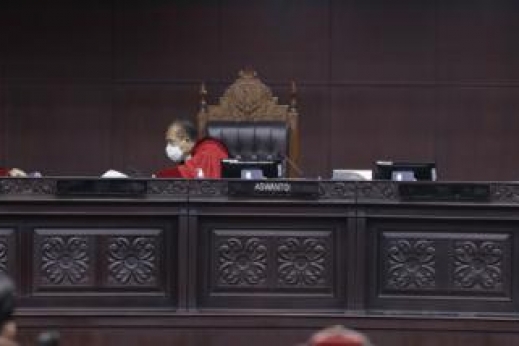
Panel petition revision hearing of the COVID-19 Law, Monday (13/7) in the Plenary Courtroom of the Constitutional Court. Photo by Humas MK/Gani.
JAKARTA, Public Relations of the Constitutional Court—The Constitutional Court (MK) held a second judicial review hearing of cases No. 42/PUU-XVIII/2020, which was filed by fifty petitioners affiliated with the Pro-Democracy (ProDem) movement; No. 43/PUU-XVIII/2020, which was filed by Munarman and peers; and No. 45/PUU-XVIII/2020, which was filed by Sururudin. The Petitioners challenge Law No. 2 of 2020 on the Government Regulation In Lieu of Law No. 1 of 2020 on the Stipulation of the State’s Financial Policy and Fiscal Stability for the Mitigation of the COVID-19 Pandemic and/or in Order to Face Threats That Endanger the National Economy and/or the Financial System’s Stability into Law.
At the hearing, the Petitioners of case No. 42/PUU-XVIII/2020, represented by attorney Ruth Yosephine, stated that they had revised the legal argument as well as format of the petition following the procedural law in the Constitutional Court.
“We make the legal argument concise and clear, based on the Petitioners’ ideas in relation to their constitutional damage,” Ruth said before the Court, which was presided over by Deputy Chief Constitutional Justice Aswanto, along with Constitutional Justices Wahiduddin Adams and Daniel Yusmic P. Foekh.
The Petitioners had previously argued that their constitutional rights had been violated by the enactment of Articles 1 through 25 of the Appendix to Law No. 2 of 2020. They believe the law is unconstitutional because it discusses state budget instead of financial policies amidst the COVID-19 pandemic, thus potentially harming the state and is contrary to Article 23 of the 1945 Constitution. They also believe that the state financial policy in Law No. 2 of 2020 is potentially misused without control and supervision by competent authorities, thus conflicting with provisions on state finances. Its stipulation that costs incurred by the Government and/or KSSK member institutions in implementing state revenue policies including regional financial policies, financing policies, financial system stability policies, and national economic recovery programs are part of the economic costs to save the economy from the crisis and do not constitute a loss to the state, which is not in accordance with the basic principles of state finance and negates the role of the Audit Board (BPK) to assess and monitor it.
Also read: Provision on State Financial Policy for COVID-19 Mitigation Challenged
Comparison to Other Countries
The Petitioners of case No. 43/PUU-XVIII/2020 removed Article 1 paragraph (3) of the 1945 Constitution from the list of touchstone, added a comparison of COVID-19 mitigation to other countries, and revised the petitum.
The Petitioners challenge the excessive authority of the Financial Sector Policy Committee (KKSK), who cannot be prosecuted following Article 27 paragraph (1) of Law No. 2 of 2020. They believe that it removes the category of state losses, thus allowing corruption to occur. They also believe that its formulation was legally defective.
They argued that the stipulation of Perppu (Regulation in Lieu of Law) No. 1 of 2020 into Law No. 2 of 2020 did not meet the quorum. The House plenary session was attended by all factions and 296 members out of 575, with 41 members attending the session physically and 255 virtually. Virtual attendance does not follow the House’s code of conduct, which regulates that every attending member should sign an attendance list.
Revising Typos
In this second hearing, the Petitioner of case No. 45/PUU-XVIII/2020 Sururudin conveyed the revision regarding the correction of typos. "In this petition, the Petitioner only corrected errors in the form of typos of terms in German and several other typographical errors," he said.
In his petition, he argues that great power was given to the president to regulate state finances without involving the House from 2020 to 2023 as stipulated in Article 2 and Article 12 paragraph (2) of Law No. 2 of 2020. Therefore, he requested that the Court declare Law No. 2 of 2020 unconstitutional, null and void. (Sri Pujianti/LA)
Translated by: Yuniar Widiastuti
Translation uploaded on 7/14/2020
Monday, July 13, 2020 | 19:42 WIB 325