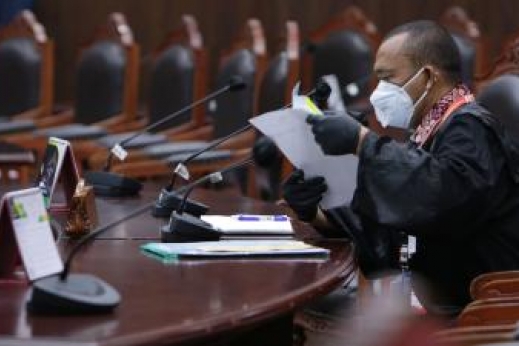
The Petitioner’s attorney Julianta Sembiring reading out the letter of petition withdrawal in the judicial review hearing of Law No. 7 of 2017 on the General Elections, Monday (13/7) in the Courtroom of the Constitutional Court. Photo by Humas MK/Ifa.
JAKARTA, Public Relations of the Constitutional Court—Ki Gendeng Pamungkas’ attorney Julianta Sembiring withdrew the judicial review petition of Law No. 7 of 2017 on General Elections in a hearing in the Constitutional Court (MK) on Monday (13/7/2020). The Petitioner’s legal team had sent a letter to the Court to withdraw the petition. In the hearing, Sembiring admitted that Ki Gendeng Pamungkas had passed away.
“Thank you, the Petitioner’s attorney. We will discuss the petition withdrawal letter in the justice deliberation meeting. However, we’d like to remind you that in court, facts must be revealed. If we cannot be honest in a courtroom, it would be difficult to be honest outside of the courtroom. This is a lesson for you,” stressed Constitutional Justice Saldi Isra, chairman of the panel.
Constitutional Justice Manahan M. P. Sitompul stated that the Petitioner’s petition attracted the Constitutional Court’s attention because the legal team did not provide a truthful statement as the death certificate submitted did not include the Principal Petitioner’s resident identity number (NIK).
Constitutional Justice Daniel Yusmic P. Foekh said that the advocate is an honorable profession, hence must display integrity in their attitude and behavior, especially in a public hearing.
The Court’s justice deliberation meeting (RPH) had reviewed the petition No. 35/PUU-XVIII/2020 after two sessions of hearing. The justices had doubts over the Petitioner’s attorneys’ statement regarding the Principal Petitioner Ki Gendeng Pamungkas, who they had claimed to be alive, despite the news stating that the psychic had passed away on June 6, 2020. After the deliberation, the justices decided to hold another hearing on Monday July 13 because they had doubts over the Petitioner’s attorneys’ statement.
Also read:
Ki Gendeng Pamungkas Challenges Election Law
Ki Gendeng Pamungkas Must Appear in Court Hearing
In the preliminary hearing, through his attorneys, Ki Gendeng Pamungkas challenged Article 1 number 28, Article 221, and Article 225 paragraph (1) of the Election Law. Article 1 number 28 reads, “A Pair of Candidates for President and Vice President, hereinafter referred to as Presidential Candidate Ticket, is a pairs of candidates for the Presidential and Vice President Election nominated by a political party or a coalition thereof that has fulfilled all existing requirements.”
Article 221 of the Election Law reads, “A Presidential Candidate and a Vice Presidential Candidate shall be nominated as pair in 1 (one) ticket by a Political Party or a Coalition Thereof,” as well as Article 222, “A Presidential Candidate Ticket is nominated by a Political Party or a Coalition Thereof Contesting in an election that meets the requirement of at least 20% (twenty percent) of the total number of seats in the DPR or 25% (twenty-five percent) of the national valid votes in the previous Election of members of the DPR.”
Article 225 paragraph (1) of the Election Law reads, “A Political Party or a Coalition Thereof may announce the Presidential and/or Vice Presidential Candidate before the establishment of the legislative candidates running as members of the DPR, DPD, and DPRD.”
The Petitioner argued that the norms reviewed are aimed at the integrity and comfort of citizens if the executive and the parliament are not from the party as it is now. Then, the ruling party would be able to reign in the presidency and parliament, where incidents would occur, such as the Corruption Eradication Commission (KPK) not being able to enter the Indonesian Democratic Party of Struggle’s (PDI-P) office, the entry of Chinese migrant workers amidst COVID-19, or the creation of the COVID-19 Perppu on budget regulation not requiring parliamentary approval. This had driven the Petitioner to help improve state administration by running as a president or vice president, not through speeches or demonstrations.
The Petitioner believes that the presidential and vice presidential election is carried out to elect president and vice president who have strong support from the public, not from political parties or coalitions thereof, thus able to carry out the functions of state government power in order to achieve national goals as mandated in the Preamble of the 1945Constitution. He also believes that the regulation regarding the presidential and vice presidential election in the a quo law has not emphasized a strong and effective presidential system that would prevent losing presidential or vice presidential candidates and/or political parties/coalitions thereof from becoming ministers or entering the president’s and/or vice president’s staff circle. (Nano Tresna Arfana/LTS/NRA)
Translated by: Yuniar Widiastuti
Translation uploaded on 7/13/2020
Monday, July 13, 2020 | 12:11 WIB 243