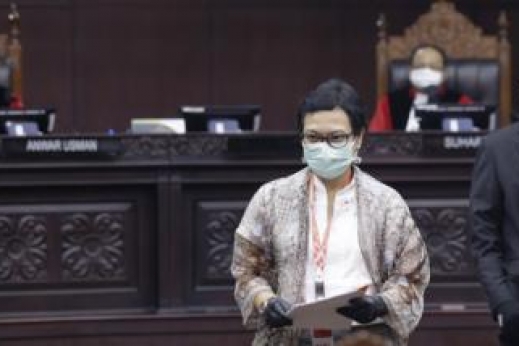
Padjajaran University constitutional law professor Susi Dwi Harijanti as an expert for the Petitioner of the judicial review of the Insurance Law, Monday (13/7) in the Plenary Courtroom of the Constitutional Court. Photo by Humas MK/Gani.
JAKARTA, Public Relations of the Constitutional Court—Suretyship is a general business line that guarantees one’s capabilities in accordance with the principal agreement with the obliged, where there is a principal agreement and recipients of guarantees. This reflects guarantee business more than insurance business. Therefore, suretyship should be subject to the provisions of the Guarantee Law. In relation to the argument that the Insurance Law limits insurance companies, the House (DPR) believe there is no need to add the phrase "can only" to the Insurance Law because it regulates insurance business including suretyship, said House Commission III member Arteria Dahlan in the sixth judicial review hearing of Law No. 40 of 2014 on Insurance held by the Constitutional Court (MK) on Monday (13/7/2020).
With regard to case No. 5/PUU-XVIII/2020 petitioned by the Association of Indonesian General Insurance Companies (AAUI), Arteria revealed that insurance services are increasingly varied, including the increasing types of financial services for insurance products. This expansion must pay attention to business specialization, relevance to the main business, and variations in business/product lines. Based on the OJK (Financial Services Authority (OJK) regulations regarding the operation of insurance companies, the expansion can only be based on merit services, credit insurance and suretyship activities, and based on government assignments.
Not Public Interest
Regarding the Petitioner’s legal standing, Arteria stated that the Petitioner, a private legal entity in the form of association, only represents the interests of the members and not public interest. Therefore, the House is of the view that the Petitioner clearly does not have constitutional rights.
In addition, the House believes that the a quo law does not regulate associations to implement the provisions of the norms and its enactment did not affect the association. As an association, the Petitioner cannot issue suretyship products. In accordance with the Insurance Law, the Petitioner must obtain a written approval from the OJK, while the Petitioner does not elaborate on this approval.
"Therefore, the Petitioner must prove this matter. The a quo article doesn’t have any effect nor authority, no constitutional rights and authorities were impaired by the enactment of the a quo law," Arteria explained regarding the Petitioner’s argument of the unconstitutionality of Article 5 paragraph (1) of the Insurance Law.
Legal Politics
Padjajaran University constitutional law professor Susi Dwi Harijanti in her expert statement for the Petitioner stated that the expansion of insurance within the Insurance Law and the OJK Regulations is only intended to realize legal politics. The OJK regulations are an exemption provision with the preconditions in the form of community needs. In this case, she added, the provisions of the Insurance Law don’t mention the criteria for community needs, which are only determined by the OJK’s assessment.
"Then insurance services are highly dependent on the single discretionary provision of the OJK. Even the [Insurance] Law doesn’t provide the extent to which the expansion is to be carried out. This kind of delegation can be categorized as a blank delegation, which is normatively prohibited based on Law Number 12 of 2011," Susi explained.
In relation to the expansion of insurance business in the a quo article, Susi believes that the delegation in the Insurance Law should be avoided, especially in relation to citizens’ rights. In order to maintain law order, Susi sees the need for a Government Regulation that regulates issues such as the meaning of community needs, the criteria of expansion that is permitted, and evaluation methods that need to be carried out.
"The material of the delegation often has a wide impact on the welfare of the community. If this is ignored, the Constitutional Court needs to clarify this, as an organic law whose formation is directly ordered by the 1945 Constitution," Susi said.
Also read…
Surety Business Unclear, Insurance Association Challenges Insurance Law
Petitioner of Insurance Law Affirms Legal Standing
Government’s Role in Improving Insurance Capacity
House Absent Again, Judicial Review Hearing on Insurance Law Delayed
OJK: Surety and Insurance Companies Can Operate Surety Business
The Petitioner believes that the a quo norm does not clearly state that suretyship is an expansion of insurance business. Suretyship is only based on the a quo norm, which authorizes the Financial Services Authority (OJK) to expand the insurance business. The Petitioner believes it had resulted in legal uncertainty. They argued that the a quo article is unconstitutional and does not have legal force insofar as not be interpreted as “prescribing that suretyshipis the expansion of insurance businessbased on public needs.”
Before concluding the session, Chief Justice Anwar informed that the hearing would resume on Wednesday, August 5, 2020 to hear the statements of an expert and a witness for the Petitioners. (Sri Pujianti/RA/NRA)
Translated by: Yuniar Widiastuti
Translation uploaded on 7/14/2020
Monday, July 13, 2020 | 19:38 WIB 249