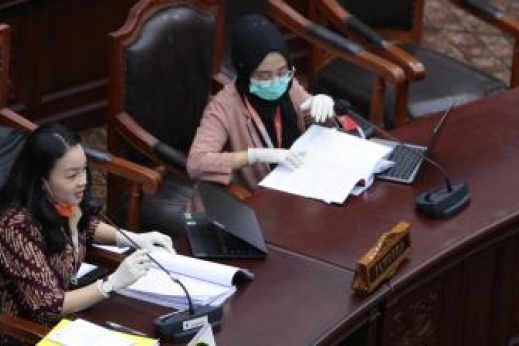
Attorneys Violla Reininda and Rahmah Mutiara for the Petitioners of case No. 37/PUU-XVIII/2020 on the judicial review of the Law on COVID-19 Mitigation, Wednesday (8/7) in the Courtroom of the Constitutional Court. Photo by Humas MK/Ifa.
JAKARTA, Public Relations of the Constitutional Court—The Constitutional Court (MK) held another judicial review hearing of Law No. 2 of 2020 regarding the Government Regulation In Lieu of Law No. 1 of 2020 regarding the Stipulation of the State’s Financial Policy and Fiscal Stability for the Mitigation of the COVID-19 Pandemic and/or in Order to Face Threats That Endanger the National Economy and/or the Financial System’s Stability into Law on Wednesday (8/7/2020). The hearing was scheduled for case No. 37/PUU-XVIII/2020 and No. 38/PUU-XVIII/2020, which were petitioned by several NGOs, researchers, and advocacy activists.
In the petition revision hearing presided over by Constitutional Justice Wahiduddin Adams, the Petitioners of case No. 37/PUU-XVIII/2020 through attorney Violla Reininda revealed the reason for the formal review of the Law on COVID-19 Mitigation. In principle, Violla said, the arguments are: first, the Regional Representatives Council (DPD) was not involved in the discussion to determine whether the COVID-19 Perppu was approved or not; second, the virtual House (DPR) meeting was likely not been attended by MPs. Therefore, Violla added, the Petitioners believe that the norms contradict Article 1 paragraph (2) and (3), Article 22D paragraph (2), and Article 23 paragraph (2) of the 1945 Constitution.
The Petitioners found a link between Article 22 of the 1945 Constitution on the issuance and enactment of the COVID-19 Perppu by the House and Article 22D on the DPD’s authority to participate in the discussion and recommendation of the bill relating to regional government (Pemda). They believe that the legal product of the Perppu is a bill. Thus, it would have been logical to involve the DPD in the discussion on whether to approve the COVID-19 Perppu. This is also strengthened by Article 71 paragraph (1) of the Law on the Formation of Legislation, which states that the discussion of the law concerning the stipulation of the Perppu has the same mechanism as the discussion of a bill.
For the material review, Violla added, the Petitioners reaffirmed the link between the judicial review of articles in the Constitution and the current state of emergency. "Here we’d like to draw a line from Article 12 of the 1945 Constitution regarding the President\'s authority to determine a state of emergency to Article 22 regarding the issuance of the Perppu," she said. She asserted the causal relationship that the issuance of the Perppu must be carried out with Article 12 of the 1945 Constitution.
For case No. 38/PUU-XVIII/2020, Petitioner Boyamin Bin Saiman said he formally challenged two things: session period and voting. He believes the lack of grace period of the ratification of the law unlawful. “If this is tolerated, it will be very dangerous for all the people and the Constitutional Court,” he said.
Also read: NGOs and Researchers Challenge COVID-19 Law
In the preliminary hearing, the Petitioners of case No. 37/PUU-XVIII/2020 argued that Article 1 paragraph (3); Article 2 paragraph (1) letter a numbers 1, 2, and 3; Article 3 paragraph (2); Article 4 paragraph (1) letter b; Article 4 paragraph (2), Article 6; Article 7; Article 9; Article 10; Article 27 paragraphs (1), (2), and (3); and Article 29 of the Law on COVID-19 Mitigation are unconstitutional. They argued that the articles being petitioned gave the government the authority to use a budget sourced from an endowment fund for education. As a result, the Petitioners had difficulty carrying out humanitarian activities to improve the public’s education.
In addition, the implementation of these norms has a very broad scope, which makes room for misuse of state finances. This allows for the use of state finances that has no sense of urgency. The Petitioners observed that the Title and Article 1 paragraph (3) of the COVID-19 Law are against the principles of the rule of law and prerequisites of state of urgency.
The Petitioners also argued that Article 2 paragraph (1) letter a numbers 1, 2, and 3 of Law No. 2 of 2020 is against the rule of law, the people’s sovereignty, the House’s (DPR) oversight and budget functions, as well as the management of state finances. Although in an emergency, the President as the holder of the power of state administrators so as not to deviate from the constitution, must still be balanced by the legislative power to conduct oversight in evaluating the magnitude of the deficit and the ability of the state finances in each fiscal year.
Contrary to Regional Autonomy
The Petitioners also believe that Article 3 paragraph (2) of Law No. 2 of 2020 is against the principle of regional autonomy as regulated in Article 18 paragraphs (2) and (5) of the 1945 Constitution. The regional government is not given the freedom and independence to determine the use of the regional budget (APBD), while in fact the formulation and management of the APBD is a crucial aspect in the implementation of regional autonomy.
The Petitioners also believe that the implementation period of Article 29 of the Law on COVID-19 is not clear although it is specified for the people’s healthcare in an emergency. So, to create fair legal certainty, it is necessary to limit the implementation period until the public health emergency status is revoked by the president.
Impunity
In the same hearing, the Petitioners of case No. 38/PUU-XVIII/2020 conveyed their petition for a formal and material review of Article 27 paragraphs (1), (2), and (3) of the Law on COVID-19.
The Petitioners believe that Article 27 of the Law on COVID-19 Mitigation has given the administration or officials of the KSSK, the Financial Services Authority (OJK), Bank Indonesia, and the Ministry of Finance impunity. They cannot be prosecuted in civil, criminal, or state administrative courts when carrying out their duties on the pretext of good faith, where any costs incurred do constitute a state loss.
"So, the provisions of this norm make these officials demigods and this [does not reflect] justice for all Indonesians including the Petitioners," Kurniawan Adi Nugroho explained.
The Petitioners requested that the Constitutional Court to declare Article 27; Article 27 (1), (2), and (3) of the COVID-19 Law against Article 1 paragraph (3), Article 7A, Article 23E, Article 24 paragraph (1), Article 27 paragraph (1), and Article 28D paragraph (1) of the 1945 Constitution. (Utami/Halim/NRA)
Translated by: Yuniar Widiastuti
Translation uploaded on 7/9/2020
Thursday, July 09, 2020 | 07:50 WIB 627