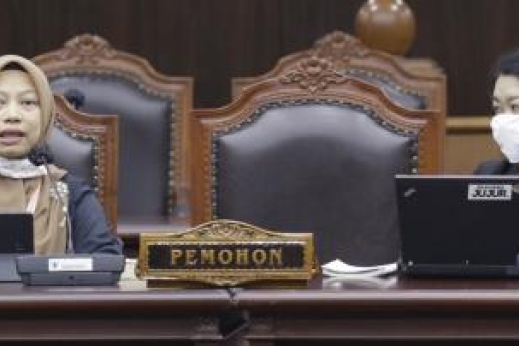
Principal Petitioner Titi Anggraini delivering the subjects of the petition of the judicial review of the Election Law, Wednesday (8/7) in the Plenary Courtroom of the Constitutional Court. Photo by Humas MK/Gani.
JAKARTA, Public Relations of the Constitutional Court—The Constitutional Court (MK) held a preliminary hearing of the judicial review of Law No. 7 of 2017 on General Elections on Wednesday (8/7/2020) in the Plenary Courtroom of the Constitutional Court. The case No. 48/PUU-XVIII/2020 was petitioned by the Association for Elections and Democracy (Perludem). The Petitioner argued that Article 414 paragraph (1) of the Election Law that reads, "A political party contesting in a legislative election must reach the electoral threshold of at least four percent of the national number of valid votes in order to be included in the seat allocation for DPR members," is contrary to Article 1 paragraph (2), Article 22E paragraph (1), Article 27 paragraph (1), and Article 28D paragraph (1) of the 1945 Constitution.
Attorney Fadli Ramadhanil said the threshold is simply defined as the minimum vote requirement that must be reached by political parties contesting in the legislative election in order to be included in the seat allocation in the House (DPR). The constitutionality of the parliamentary threshold has been challenged in the Constitutional Court and the Court has issued five decisions on it from 2009 to 2018. Almost all petitions questioned the parliamentary threshold regulation that eliminates a political party’s opportunity to contest in the election and receive seats in the House. It also led to the waste of votes given to political parties that did not reach the threshold.
Meanwhile, Fadli added, the Petitioner focused on the formulation of the percentage set as a parliamentary threshold regulation and a proportional electoral system regulation in Article 414 paragraph (1) of the Election Law. This provision led to the waste of votes due to threshold requirement that was not accurately formulated, thus giving birth to inconsistencies in the arrangements of proportional representation.
"When the legislative election system implements the proportional system, the election results show disproportionate results because the percentage of votes obtained by political parties is not in line with the percentage of seats acquired in parliament. So, there are fundamental issues that must be resolved in the proportional electoral system in Indonesia," Fadli said in a video conference from Andalas University, Padang.
Variables of Electoral System
Another attorney Heroik Mutaqin Pratama said that the Petitioner saw a connection with the provision on parliamentary threshold, which is one of the variables of the electoral system. There is a mathematical formula for elections that are used by experts and practitioners who study politics, elections, and government systems. So that the parliamentary threshold do not conflict with political rights, popular sovereignty, and rationality, it is necessary to question the basic argument for the formation of the law to determine the 4% set out in the Election Law. "The Petitioner investigated that the formulation of this figure [was not based on] an open, transparent calculation that is in accordance with the principle of proportional [representation] as stipulated in the a quo law," Heroik explained in the hearing led by Constitutional Justice Saldi Isra, along with Constitutional Justices Wahiduddin Adams and Arief Hidayat.
Distinguishing Characteristic of the Petition
Constitutional Justice Saldi Isra advised the Petitioner to pay attention to the touchstones of the constitutionality review in the case because there have been similar cases in the Court. He advised the Petitioner not to focus too much on the similarity between her petition and others in relation to Article 6 of the Constitutional Court Law. “Explain its distinguishing characteristic because it hasn’t been mentioned in the petition, as the touchstones of the petition has been used by petitioners [of previous case],” he said.
Justice Saldi didn’t find the unconstitutional article in the Constitution. He asked the Petitioner the basis for the judicial review of the article, which she deems contrary to four norms in the 1945 Constitution used as touchstones. Justice Saldi observed that the constitutionality issue challenged by the petitioners of previous cases was based on Article 22E paragraph (1) of the 1945 Constitution, while other articles didn’t have strong arguments.
Legal Standing
Observing the Petitioner’s status as a private legal entity, Justice Arief asked who has the right to represent Perludem in the case, both in and out of the court. “If [you don’t have] legal standing, it must be clarified [that you represent the organization] because if this is not met, the case will not go forward. The evidence can be shown in which part of the statement or piece of evidence of this petition?” he asked the attorneys.
Before concluding the session, Justice Saldi reminded the Petitioner to submit a revised petition no later than July 21, 2020 at 14:00 WIB to the Registrar’s Office of the Constitutional Court. (Sri Pujianti/tir/NRA)
Translated by: Yuniar Widiastuti
Translation uploaded on 7/8/2020
Wednesday, July 08, 2020 | 17:10 WIB 282