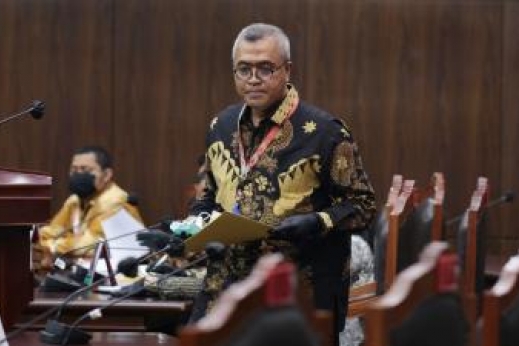
Government’s expert Eko Prasojo after giving a testimony in the judicial review hearing of Article 10 of Law No. 39 of 2008 on State Ministries, Thursday (2/7) in the Plenary Courtroom of the Constitutional Court. Photo by Humas MK/Ifa.
JAKARTA, Public Relations of the Constitutional Court—The president has discretion to form state government organizations, such as ministries, state institutions, non-ministerial agencies, and so on as mandated by law. This authority also includes the formation of various bodies, centers, and work units to assist the president in implementing the constitutional mandate to achieve the country’s objectives, such as the deputy minister position.
Government’s expert Eko Prasojosaid this in the seventh judicial review hearing of the provision on deputy ministers in Article 10 of Law No. 39 of 2008 on State Ministries on Thursday (2/7/2020) in the Plenary Courtroom of the Constitutional Court. The case No. 80/PUU-XVII/2019 was petitioned by Forum on Law and Constitutional Studies (FKHK) Chairman Bayu Segara.
"Whereas the government organization (deputy minister) is the embodiment of presidential power as regulated in Article 4 paragraph (1) of the 1945 Constitution," said Eko, an expert in state administration.
Also read: Deputy Ministerial Position Shows Govt Keeping up with the Times
Eko then explained that to understand the deputy minister position, one must understand its status and position within the Indonesian administration. Based on the 1945 Constitution, he said, the president holds the power of the government according to the law in a presidential system. However, the president is also restricted by norms that prioritize efficiency, effectiveness, and accountability. In addition, the president must also be able to create a government structure that doesn’t violate the rule of law and the republic.
Eko said that the Petitioner must understand Article 4 paragraph (1) of the 1945 Constitution, which states expressly that the president is the holder of government authority according to the Constitution. Whereas Article 10 of the State Ministry Law only regulates the government organizations that the president can form to carry out the constitutional mandate.
"The president can do this because of the dynamics and [advancement] in the state, so that in essence the president is given authority to design government structure. And it needs to be understood that the Constitution does not regulate all the technicalities of government as required by the president in the implementation of his administration," explained Eko, who served as State Deputy Minister of the Ministry of Administrative and Bureaucratic Reform in 2011-2014.
Eko added that although the deputy minister position is not mentioned in the article, the president could still form it as a response to the government’s workload based on the needs and strategic considerations and challenges that will be faced in performing tasks in ministries.
"So, the number of deputy ministers in the government must be based on the complexity and priority programs of national development in a particular government," said Eko before the hearing chaired by Chief Justice Anwar Usman along with the other eight constitutional justices.
Political Office
Eko also said that the deputy minister office is actually a political one because of appointment by the president. A deputy minister must have sufficient expertise and be appointed from among professionals, therefore can help ministers in tasks that can’t be completed by bureaucratic officials. Deputy ministers can also play a role in connecting high-ranking state officials whose relations are highly bureaucratic, thus, they can also execute daily tasks in the ministry to coordinate and ensure synergy between institutions.
In his petition, the Petitioner challenges the constitutionality of the inauguration of 12 deputy ministers by President Joko Widodo on October 25, 2019. He believes it is in violation of Article 1 paragraph (3) of the 1945 Constitution as the deputy minister office is subjective without a clear position, authority, and function in the State Ministry Law. The function of deputy ministers is regulated by a presidential regulation, which goes against the constitutional rules, in which the duties and authority of the deputy minister are subject matters of the law.
The State Ministry Law does not regulate the duties, functions, and authorities of deputy ministers at all. This certainly can lead to arbitrariness, by giving authority to deputy ministers without involving the House as the people’s representatives. The Petitioner also mentioned that the appointment of 12 deputy ministers was a subjective act of the president, which did not have a clear reason for its urgency. The Petitioner considered the deputy ministerial position to have resulted in the state having to prepare special facilities, which only wasted the state budget.
The hearing took place with physical distancing to curb the spread of COVID-19, in accordance with the health protocols set by the Indonesian Health Ministry and the World Health Organization (WHO). Before concluding the session, Justice Anwar informed all parties that the litigants were expected to submit their conclusions by Wednesday, July 8, 2020 at 14:00 WIB. (Sri Pujianti/A.L./LA)
Translated by: Yuniar Widiastuti
Translation uploaded on 7/3/2020
Thursday, July 02, 2020 | 22:48 WIB 270