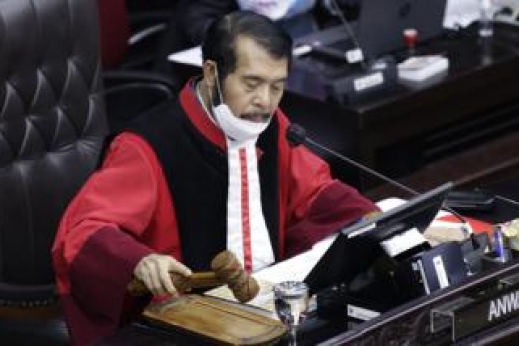
Plenary ruling hearing of the judicial review of the Notary Law, Tuesday (23/6) in the Plenary Courtroom of the Constitutional Court. Photo by Humas MK/Gani.
JAKARTA, Public Relations of the Constitutional Court—The Constitutional Court (MK) decided to dismissed the judicial review petition of Law No. 2 of 2014 on the Notary Law filed by the Indonesia Prosecutors Association (PJI) and four other petitioners.
"The verdict adjudicated, declares the petition of Petitioners I, III, IV, and V not accepted, rejects the petition of Petitioner II for its entirety," said plenary chairman Chief Constitutional Justice Anwar Usman along with the other constitutional justices in the ruling hearing on Tuesday afternoon (23/6/2020).
Also read: Deemed Harming Prosecutors and the Public, Notary Law Challenged
Not Fully Understand
The Court believed that the Petitioners of case No. 16/PUU-XVIII/2020 did not fully understand the provision of Article 66 paragraph (1) of the Notary Law as a whole in relation to other provisions in the a quo law, including the authority of the Notary Honor Council (MKN). MKN’s approval does not aim to complicate the investigation process or an examination of a notary public.
"That has been anticipated by the provision of Article 66 paragraph (3) of the Notary Law, which states that the MKN, in no later than 30 working days, must accept or reject the approval. This is also reaffirmed in Article 66 paragraph (4) of the Notary Law, which states that in the event that the MKN does not provide an answer within the time referred to in Article 66 paragraph (3), the MKN is deemed to have received a request for approval," said Constitutional Justice Wahiduddin Adams who read out the opinion of the Court.
The Court was of the opinion that the Petitioners’ argument that Article 66 paragraph (4) of the Notary Law was redundant for resembling Article 66 paragraph (3) was inaccurate. Article 66 paragraph (4) of the Notary Law affirms that the MKN cannot obstruct the authority of investigators, public prosecutors, or judges in exercising their authority for the benefit of the judicial process as stipulated in Article 66 paragraph (1) of the Notary Law.
"Moreover, the provision of the a quo article is intended to provide protection to notaries as public officials in carrying out their duties, especially to protect notary minutes as confidential state documents," he said.
The Petitioners requested that the Court declare Article 66 paragraph (1) of the Notary Law unconstitutional because they believe the Constitutional Court Decision No. 49/PUU-X/2013 made it difficult for law enforcement officials to examine the notary public. However, the Court was of the opinion that the Petitioners did not understand the substance of that decision and even incorrectly quoted it. The Constitutional Court Decision whose substance is related to the Notary Law as referred to by the Petitioner is the Constitutional Court Decision No. 49/PUU-X/2012 dated May 28, 2013.
According to the Court, if the petition was granted, thus the entire Article 66 paragraph (1) of the Notary Law be annulled, this would eliminate the Notary Honor Council in advising the notary public, particularly regarding their obligations, including keeping deeds confidential.
Accordingly, according to the Court, although the basis and reasons for the judicial review petitionswere different so that the a quo petition could be submitted, as the constitutional issue was the same, regarding Notary Honor Council’s approval to take a photocopy of a deed or related documents and to summon notaries in connection with the examination of the deed, the Court was in the opinion that the judicial review of Article 66 paragraph (1) of the Notary Law in the Constitutional Court Decision No. 22/PUU-XVII/2019 applies mutatis mutandis to the a quo petition. The Court was of the opinion that the Petitioners’ argument was legally groundless.
The Indonesia Prosecutors Association (Petitioner I) and four other petitioners who are advocates challenged Article 66 paragraph (1) of the Notary Law. Petitioner II Olivia Sembiring experienced lossed due to a quo article as the prosecutor in charge of handling the case of the Criminal Act of Giving False Information into an Authentic Deed, which started with a police report to investigators No. LP/508/IV/2018/Bareskrim on April 16, 2018. Then in the investigation process, the National Police’s Criminal Investigation Department (Bareskrim Mabes Polri) sent letter No. B/1044/V/Res.2.4/2019/Dit.Tipideksus to the Chairperson of the West Java Province Notary Honor Council on May 3, 2019 to request an approval to investigate notary public Patricia Tirta Isoliani Ginting.
The Notary Honor Council responded that they had not been able to approve the request. Until today, the investigation has been delayed and harmed or potentially will harm prosecutors and the public. (Nano Tresna Arfana/LA)
Translated by: Yuniar Widiastuti
Translation uploaded on 6/23/2020
Tuesday, June 23, 2020 | 15:33 WIB 401