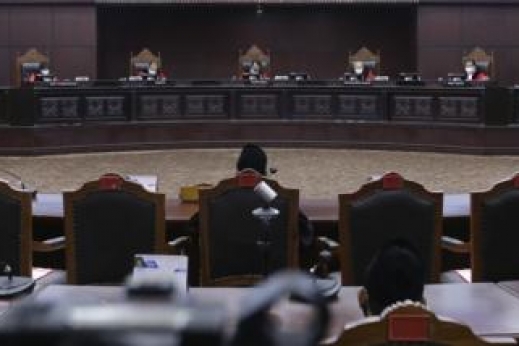
Plenary ruling hearing of the judicial review of the Perppu on COVID-19 Mitigation on Tuesday (23/6) in the Plenary Courtroom of the Constitutional Court. Photo by Humas MK/Gani.
JAKARTA, Public Relations of the Constitutional Court—The Constitutional Court (MK) dismissed the petition of the Government Regulation In Lieu of Law Number 1 of 2020 regarding the State’s Financial Policy and Fiscal Stability for the Mitigation of COVID-19 Pandemic (Perppu on COVID-19 Mitigation). The decisions for cases No. 23/PUU-XVIII/2020 and No. 24/PUU-XVIII/2020 were read out in the ruling pronouncement hearing on Tuesday (23/6/2020)in the Plenary Courtroom of the Constitutional Court.
The hearing took place with physical distancing to curb the spread of COVID-19, in accordance with the health protocols set by the Indonesian Health Ministry and the World Health Organization (WHO).
Also read: Community Members and Figures Challenge COVID-19 Perppu
Regarding the case No. 23/PUU-XVIII/2020, which was petitioned by M. Sirajuddin Syamsuddin, Sri Edi Swasono, Amien Rais, and 21 other individuals of various professions, Constitutional Justice Arief Hidayat said that at the time of the submission of the petition, the perppu had not been approved by the House (DPR), so the Court had the authority to review Perppu No. 1 of 2020.
Based on Article 51 paragraph (1) of the Constitutional Court Law and its Elucidation, those who can file a petition judicial review of a law against the 1945 Constitution must have their constitutional rights impaired by the enactment of a law. The Constitutional Court was of the opinion potential constitutional impairment argued by the Petitioners, that is, unequal treatment before the law, could indeed occur because the a quo provision gives immunity to certain parties, but will not occur if the provision is revoked by the Court or is interpreted differently.
"For the Court, this shows a causal relationship between the constitutional impairment and the provisions petitioned for review. However, the potential impairment does not mean that the provisions applied are always [unconstitutional], because assessment of impairment is often subjective and influenced by various non-constitutional factors," he explained.
Also read: Government Admits Ratification of Perppu on COVID-19 Mitigation into Law
Lost Object
Deputy Chief Constitutional Justice Aswanto said that in the hearing for case No. 23/PUU-XVIII/2020 on May 20, 2020, the President’s legal representative explained that the norm had been approved by the House into law. Considering the promulgation of Law No. 2 of 2020 concerning the Stipulation of Government Regulation In Lieu of Law Number 1 of 2020 regarding the State’s Financial Policy and Fiscal Stability for the Mitigation of the Coronavirus Disease 2019 (COVID-19) Pandemic and/or in Order to Face Threats That Endanger the National Economy and/or the Stability of the Financial System into Law, then Perppu No. 1 of 2020 no longer exists legally.
"This resulted in the Petitioners’ petition submitted for constitutionality review, regarding Perppu No. 1 of 2020 has lost its object," he explained.
Change of Legal Status
Regarding case No. 23/PUU-XVIII/2020, which was petitioned by the Indonesian Anticorruption Community (MAKI), Mega Bintang Solo Indonesia 1997 Foundation, and three other organizations, Constitutional Justice Daniel Yusmic P. Foekh read out the legal considerations of the Court, that based on new legal facts related to the petition for the judicial review of Article 27 of Perppu No. 1 of 2020, especially the President’s legal counsel explained that the norm had been approved by the House into law, "Then this new legal fact resulted in a change in the legal status of Perppu No. 1 of 2020."
In the preliminary hearing, the Petitioners of case No. 23/PUU-XVIII/2020 had argued that Article 2 paragraph (1) letter a numbers 1, 2, and 3; Article 16; Article 23; Article 27; and Article 28 of the Perppu on COVID-19 Mitigation are unconstitutional. They believe that the a quo perppu does not meet the three force majeure requirements as a parameter for the issuance of a perppu according to the Constitutional Court Regulation No. 138/PUU-VII/2009. The a quo norm would allow for the state budget deficit beyond the 3% gross domestic product (GDP) limit without a ceiling. This regulation would directly inhibit the House of Representatives (DPR) from giving approval on the state budget. In addition, they believe that Article 27 paragraph (1) of the perppu potentially leads to corruption.
Meanwhile, the Petitioners of case No. 24/PUU-XVIII/2020 had argued that Article 27 paragraph (1) of the a quo perppu states that the costs incurred by the Government in the context of implementing state revenue policiesshall not constitute a loss to the state, while in fact the source of state revenue comes from the state budget. They also believe that in Article 27 paragraph (2) of the a quo perppu there is the word “if,” which the president or the Government could use to avoid any allegation of legal immunity. So, the word “if” carries multiple interpretations and public officials could hide behind the phrase “good faith” to be free of any legal charges. Law No. 12 of 2005 on the Ratification of the International Covenant on Civil and Political Rights stipulates that any policy based on good faith that leads to state loss should be reviewed legally and openly. So, there shouldn’t be such a thing as good faith based merely on a subjective judgment by a government administration. (Sri Pujianti/RA/LA)
Translated by: Yuniar Widiastuti
Translation uploaded on 06/23/2020
Tuesday, June 23, 2020 | 15:27 WIB 279