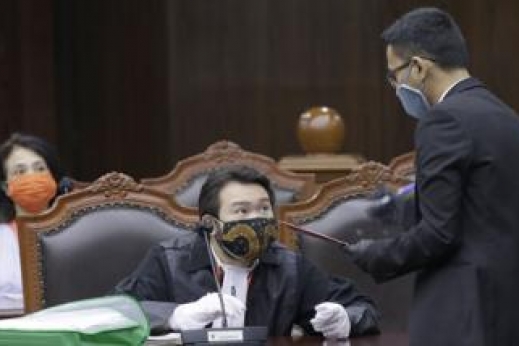
The Petitioners’ attorney Rene Tantrajaya in the ruling hearing of the judicial review of the Law on Bankruptcy and Suspension of Debt Payment (KPKPU), Tuesday (23/6) in the Plenary Courtroom of the Constitutional Court. Photo by Humas MK/Gani.
JAKARTA, Public Relations of the Constitutional Court—The Constitutional Court (MK) rejected the material review petition of Law No. 37 of 2004 on Bankruptcy and Suspension of Debt Payment (KPKPU) filed by foreign investment company PT Korea World Center Indonesia, which was represented by its director Mr. Gi Man Song, a South Korean national. The Petitioner challenged Article 235 paragraph (1) of the KPKPU Law that reads, “There are no legal actions could be taken against the decision on suspension of obligation for payment of debt,” and Article 293 paragraph (1) that reads, “No legal actions can be initiated to judgment of Court based on Provision in this Chapter III, unless stipulate otherwise under this Law.”
The decision was read out by the Chief Constitutional Justice Anwar Usman in the ruling hearing on Tuesday (23/6/2020) in the Plenary Courtroom of the Constitutional Court. "The verdict adjudicated, rejects the petition for its entirety," he said reading out the ruling for case No. 17/PUU-XVIII/2020 alongside the other eight constitutional justices.
In the legal considerations read out by Constitutional Justice Enny Nurbaningsih, the Court was of the opinion that a company that has trouble repaying debt to creditors cannot be declared bankrupt. The KPKPU Law provides a clear legal mechanism in the form of a request to Suspend Debt Payment (PKPU) to establish a peace plan between the creditor and the debtor regarding the restructure of the debt. Setting a time limit to carry out the stages of PKPU including arbitration between the debtors and the creditor as stipulated in the KPKPU Law will provide sufficient opportunity or time for the debtor to repay their debts to the creditor in a lump sum or in stages based on an agreement. Thus, the norm of the article not only fulfills a sense of justice for the parties but also provides legal certainty for debtors and creditors because the time limit has been determined by law.
The Court was of the opinion that no legal measure can be taken against a ruling on debt payment suspension as stipulated by Article 235 paragraph (1) and Article 293 paragraph (1) of the KPKPU Law because the PKPU process has given sufficient time for both parties to mediate through the judiciary to settle the debt. "Thus, if the result of the PKPU ruling is questioned by one of the parties though a legal action, this will create deliberation between the two parties, [where they both have gone] to the court […] for quite a long time. It will actually lead to legal uncertainty for the PKPU request itself, because the debt between the creditor and the debtor is unfinished, so its end cannot be ascertained," Justice Enny said.
This emphasizes that in addition to the PKPU case cannot be filed for the second time because it will cause legal uncertainty regarding the mediation between both parties, this also clearly contradicts the nature of the PKPU case itself and the principle of swift, simple, and affordable justice.
The Petitioner hoped that the inaccurate PKPU ruling be corrected by a higher court. Justice Enny added that the Court had considered the Petitioner’s argument that the PKPU is essentially the result of mediation between the debtor and the creditor. The Court viewed that it is irrelevant to worry whether a PKPU ruling needs to be corrected. Moreover, there are legal remedies for bankruptcy statement from the court related to bankruptcy that is not preceded by PKPU.
Meanwhile, with regard to the Petitioner’s arguments on a concrete case they experienced, the Constitutional Court is not authorized to judge them. Therefore, based on the considerations as described above, according to the Court, there is no constitutionality issue regarding Article 235 paragraph (1) and Article 293 paragraph (1) of the KPKPU Law, so the Petitioner’s arguments are legally groundless.
Also read:
South Korean Nationals Challenge KPKPU Law
Foreign National Revises Petition on KPKPU Law
Read the Constitutional Court Decision No. 17/PUU-XVIII/2020 here…
In the preliminary hearing, the Petitioners, represented by attorney Rene Tantrajaya, confirmed that their constitutional rights and/or authority had been impaired de facto and de jure and they experienced legal discrimination due to Article 235 paragraph (1) and Article 293 paragraph (1) of the KPKPU Law. The Petitioners were declared bankrupt, along with all legal consequences, in a case of Request for Delaying Debt Payment Obligation (PKPU).
They believe they were declared bankrupt not because of debts but an obligation to pay the services of a mediator, which was clearly unlawful and detrimental to them as investors who had contributed to the development of Indonesia. "In fact, homologation was approved by all creditors, which should have been carried out and should not have been rejected by the judge only because there was no guarantee for the payment of the management team\'s fees, even though the Petitioners had provided 7 (seven) written transfer instructions on an active account for payment of the fees, and they were received by the management team," Rene said.
The Petitioners had requested a review of court decision, which was denied. The ruling stated that the a quo case started from suspension of debt payment (PKPU), in which case the provision of Chapter III Article 289 of the KPKPU Law applies, in which Debtors were declared bankrupt. On the ruling, the provision of Article 290 in conjunction with Article 293 of the KPKPU Law applies. It means that there is not any legal action to be taken, including request for a review of court decision, as regulated in Article 14 in conjunction with Article 290 of the KPKPU Law.
The Petitioners believe that Article 235 paragraph (1) and Article 293 paragraph (1) of the KPKPU Law are against Article 28D paragraph (1) of the 1945 Constitution, which states that each person has the right to recognition, security, protection, and certainty under the law. The article leads to legal uncertainty and injustice, because there is no clear and firm interpretation of the clause “extraordinary remedies cannot be filed,” while those remedies are absolute right for legal certainty and justice.
In addition, those articles do not reflect the principle of justice, causing constitutional harm to both the Petitioners and other debtors, whose cases are not simple. With the limitation of legal remedies, it is possible that loopholes will be exploited to create an unfair business competition with the aim of bringing down and stopping its competitors\' business through commercial justice. According to the Petitioners, this must be prevented and should not happen, because Indonesia really needs investors’ confidence to invest in the country for the development of Indonesia, the results of which are expected to be enjoyed for the prosperity of all Indonesian people.
Therefore, in their petitum, the Petitioners requested that the Constitutional Court declare Article 235 paragraph (1) and Article 293 paragraph (1) of the KPKPU Law unconstitutional and not legally binding along with all its legal consequences. (Utami/AL/NRA)
Translated by: Yuniar Widiastuti
Translation uploaded on 6/23/2020
Tuesday, June 23, 2020 | 16:51 WIB 336