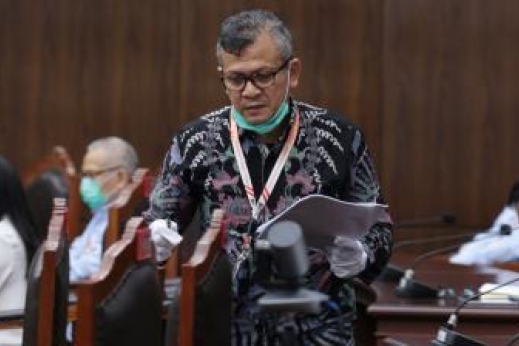
The OJK’s (Financial Services Authority) Deputy Commissioner for Law and Investigation Rizal Ramadhani after giving a statement on behalf of the relevant party in the judicial review hearing of Insurance Law, Monday (22/6) in the Courtroom of the Constitutional Court. Photo by Humas MK/Ifa.
JAKARTA, Public Relations of the Constitutional Court—In principle, surety business products are not limited to activities that can only be carried out by certain businesses, but can also be carried out by surety or insurance companies, said the OJK’s (Financial Services Authority) Deputy Commissioner for Law and Investigation Rizal Ramadhani on behalf of the relevant party in the judicial review hearing of Law No. 40 of 2014 on Insurance held by the Constitutional Court (MK) on Monday (22/6/2020).
The case No. 5/PUU-XVIII/2020 was petitioned by the Association of Indonesian General Insurance Companies (AAUI). Today’s hearing was scheduled to hear a statement from the House of Representatives (DPR), but the House was absent. The hearing took place with physical distancing to curb the spread of COVID-19, in accordance with the health protocols set by the Indonesian Health Ministry and the World Health Organization (WHO).
Rizal explained that Article 5 paragraph (1) of the Insurance Law have fulfilled the requirements as regulated in Article 61 paragraph (1) of the Guarantee Law, which reads, “Every person outside the guarantee agency who has carried out guarantee activities before the enactment of the law must adjust to this law no later than 3 years from the ratification of this law,” and paragraph (1) that reads, “The provision referred to in paragraph (1) do not apply to guarantee activities carried out under a separate law.”
He added that Article 1 number 6 of the Guarantee Law states that guarantee business is a guarantee company, a sharia guarantee company, a re-guarantee company, and a sharia re-guarantee company that engage in guarantee activities. So in this regard, an insurance company, which is outside a guarantee company, must meet the requirements for a guarantee company to carry out business activities regulated in Article 1 number 1 juncto Article 4 paragraph (1) of the Guarantee Law.
Article 4 paragraph (2) of the Guarantee Law regulates that surety business can also be carried out by an insurance company under Article 5 paragraph (1) of the Insurance Law, which regulates the scope of insurance business activities, since surety business regulated in Article 4 paragraph (2) of the Guarantee Law does not require status as a guarantee agency as stated in Article 1 number 1 of the Guarantee Law.
"Thus, surety business line activities as referred to in the Guarantee Law can be carried out by guarantee companies, insurance companies, and other financial service institutions based on statutory regulations," said Rizal regarding the Petitioner’s argument that Article 5 paragraph (1) of the Insurance Law is unconstitutional.
Only for General Insurance Companies
Rizal also said that as the implementation of the mandate of Article 5 paragraph (3) of the Insurance Law, the OJK has issued the POJK No. 69 of 2016 to provide an opportunity for insurance companies to run surety business. However, this line of business is only open for general insurance companies and not for sharia general insurance companies, life insurance companies, and sharia life insurance companies. This is clearly stated in Article 4 letter a of the POJK No. 69 of 2016. Thus, the surety business carried out by insurance companies based on Article 5 paragraph (1) of the Insurance Law and further stipulated in the POJK No. 69 of 2016 is in accordance with the provision of Article 61 of the Insurance Law.
"So, insurance companies that conduct surety business cannot be subject to criminal sanctions as the Petitioner feared," Rizal explained before a hearing led by Chief Justice Anwar Usman along with the other eight constitutional justices.
Increasing Use of Services
In relation to Article 5 paragraph (1) of the Insurance Law along the phrase "according to the people’s needs," Rizal emphasized that this cannot be separated from the insurance industry that continues to develop in the community. The general elucidation to the Insurance Law mentions that the regulation of insurance is motivated by the rapid development of the insurance industry, as indicated by the increasing business volume and use of insurance services in the community.
The regulation on the expansion of insurance company business in those norms will make it easier to regulate the expansion of insurance business following the development of the community’s needs for insurance. This actually makes it easier for the OJK to further regulate additional businesses that can be carried out by insurance companies, which are tailored to public needs.
"In relation to the Petitioner’s petition regarding the phrase" including surety business" in Article 5 paragraph (1) of the Insurance Law, it does not provide legal certainty for insurance companies to be able to expand its scope of business because the phrase […] actually seems to limit the scope of activities of insurance companies other than surety business, because the purpose of the norm is [so that] the scope of insurance business be based on the development of public needs, which are not only related to surety business," Rizal explained.
Also read…
Surety Business Unclear, Insurance Association Challenges Insurance Law
Petitioner of Insurance Law Affirms Legal Standing
Government’s Role in Improving Insurance Capacity
The Petitioner believes that the a quo norm does not clearly state that surety business is an expansion of insurance business. Surety business is only based on the a quo norm, which authorizes the Financial Services Authority (OJK) to expand the insurance business. The Petitioner believes it had resulted in legal uncertainty. They argued that the a quo articleis unconstitutional and does not have legal force insofar as not be interpreted as “prescribing that surety businessis the expansion of insurance businessbased on public needs.”
To help curb the spread of COVID-19, the petitioners and their attorney(s), the government, experts, witnesses, and other parties can use the online courtroom facilities. The Constitutional Court uses Cloudx and Zoom for online hearing from the parties’ respective residences. In order to be able to use the online courtroom facilities, the litigating parties are to notify the Court’s ICT team of their locations and the instruments that they have at least two days before the hearing. Other parties can watch the hearing online through the Court’s YouTube channel’s livestream.
Before concluding the session, Chief Justice Anwar informed that the next hearing was scheduled for Monday, July 13, 2020 at 11.00 WIB to listen to an expert’s statement for the Petitioners. (Sri Pujianti/Raisa/NRA)
Translated by: Yuniar Widiastuti
Translation uploaded on 06/23/2020
Monday, June 22, 2020 | 17:08 WIB 529