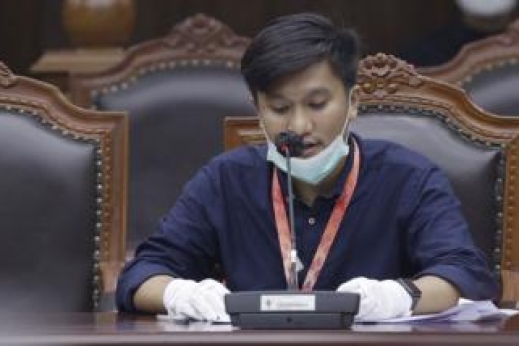
Petitioner II Oktoriusman reading out the petition revision in the judicial review hearing of Law No. 4 of 1996 on Mortgage over the Land and Objects Related to the Land (Mortgage Law) on Tuesday (9/6) in the Courtroom of the Constitutional Court. Photo by Humas MK/Ifa.
JAKARTA, Public Relations of the Constitutional Court—The Constitutional Court (MK) held another judicial review hearing of Law No. 4 of 1996 on Mortgage over the Land and Objects Related to the Land (Mortgage Law) on Tuesday (9/6/2020). The hearing for case No. 21/PUU-XVIII/2020 took place with physical distancing amidst the large-scale social restrictions (PSBB) in the Jakarta Special Capital Region to curb the spread of COVID-19, accordance with the health protocols set by the Indonesian Health Ministry and the World Health Organization (WHO).
Petitioners I through III Inri Januar, Oktoriusmas Halawa, and Eliadi Hulu argued that Article 14 paragraph (3) and Article 20 paragraph (1) of the Mortgage Law are contradictory to Article 1 paragraph (3), Article 27 paragraph (1), Article 28D paragraph (1), Article 28G paragraph (1), and Article 28H paragraph (4) of the 1945 Constitution. In the second hearing, the Petitioners conveyed several points of revision to the petition, including their legal standing and constitutional interest.
In relation to legal standing, Petitioner II Oktoriusman explained that Petitioner I is a citizen who has constitutional rights that are potentially violated by the enactment of Article 14 paragraph (3) and Article 20 paragraph (1) of the Mortgage Law. Petitioner I is a debtor who put up land and buildings as collateral for a national private bank in six installments, therefore is bound by a bank loan agreement dated 17/11/2017. This resulted in a principal agreement contained in a certificate of ownership. This principal agreement resulted in a contract that involves Petitioner I.
The large-scale social restrictions (PSBB) limit the mobility of many economic actors and affect the socio-economic lives of the community, including Petitioner I. It is highly likely that Petitioner I is inable to pay the loan installments due to reduced income, thus potentially makes Petitioner I unable to carry out his obligations as a debtor. Consequently, it can be ascertained that when this happens, creditors can seize the properties that are the objects of the mortgage, due to the enactment of those articles.
"So based on this, Petitioner I has fulfilled the requirement of potential constitutional loss that will occur in the future," said Oktoriusman before the Court led by Constitutional Justice Suhartoyo along with Constitutional Justices Wahiduddin Adams and Manahan M. P. Sitompul in the Plenary Courtroom of the Constitutional Court.
Also read: Deemed Not Providing Legal Protection, Land Mortgage Law Challenged
In the previous hearing, the Petitioners argued that the object of mortgage over land and objects related to the land includes the buildings on or below the land. They feel that they are potentially harmed as, in principle, Article 14 paragraph (3) and Article 20 paragraph (1) of the Mortgage Law provide guarantee and legal certainty protection to the holder of the mortgage right (creditor) by equalizing the executorial powerof the certificate of mortgage against a court decision that has permanent legal force.
Article 14 paragraph (3) of the Mortgage Law reads, “The certificate of mortgage as referred to in paragraph (2) has the same executorial power as a court decision that has obtained permanent legal force and is valid as a substitute for grosse acte hypotheek insofar as it relates to land rights.”
Article 20 paragraph (1) of the Mortgage Law reads, “In the debtor defaults, based on a. the right of the first mortgage holder to sell the object of mortgage as referred to in Article 6, for b. executorial title contained in the certificate of mortgage as referred to in Article 14 paragraph (2), the object of mortgage shall be sold through a public auction in accordance with the procedure specified in the legislation for the repayment of the mortgage holder by taking precedence over other creditors.”
The Petitioners believe that the articles only focus on providing legal certainty to the creditor. The creditor can execute the mortgage object immediately, if the mortgage holder (debtor) defaults. Therefore, the provision of the a quo articles, especially along the phrases ‘executorial power,’ ‘the same as a court decision that has obtained permanent legal force,’ and ‘defaults’ have led to injustice and legal uncertainty for debtors.
In addition, the Petitioners also believe that if the debtor could prove they default not because of their own will, but due to an urgent condition (overmacht), a mechanism is needed for them to obtain justice and legal certainty. Therefore, the Petitioners are of the opinion that the articles do not provide legal protection, justice, and legal certainty for debtors.
The Constitutional Court offers the petitioners and their attorney(s), the government, experts, witnesses, and other parties to come to the courtroom or to hold the hearing online. The Constitutional Court uses Zoom and Cloudx to enable litigating parties to follow the court hearing from their respective locations. When filing a petition for an online hearing, they must inform the Court’s ITC team of their communication devices at least two days prior. (Sri Pujianti/RA/NRA)
Translated by: Yuniar Widiastuti
Translation uploaded on 06/10/2020
Tuesday, June 09, 2020 | 14:27 WIB 220