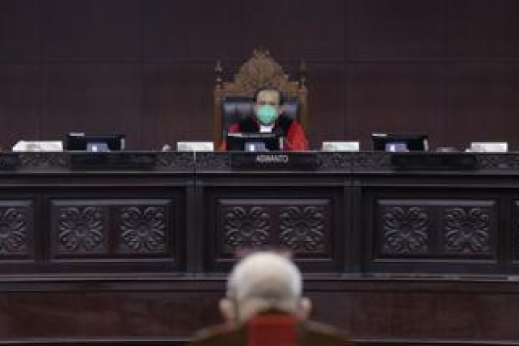
Panel preliminary examination hearing of the judicial review of the State Ministry Law, Monday (18/5) in the Plenary Courtroom of the Constitutional Court. Photo by Humas MK/Gani.
JAKARTA, Public Relations of the Constitutional Court—The preliminary judicial review hearing of Law No. 39 of 2008 on State Ministries was held by the Constitutional Court (MK) on Monday (18/5/2020). The hearing of case No. 30/PUU-XVIII/2020 was held in accordance with the COVID-19 health protocols set by the Indonesian Health Ministry and the World Health Organization (WHO), such as by wearing a mask, gloves, checking temperatures, and applying physical distancing.
Bogor resident Aristides Verissimo de Sousa Mota requested the judicial review of Articles 10 and 15 of the State Ministry Law. Article 10 reads, “In the event that there is a workload that requires special treatment, the President may appoint a Deputy Minister at a particular Ministry.” Article 15 reads, “The total number of Ministries as referred to in Article 12, Article 13, and Article 14 is no more than 34 (thirty four).”
The Petitioner argued that the forced formation of ministries gave the impression that the president must accommodate those who have contributed to the presidential election without considering the benefits for the interests of the nation and state. The problem became more complex when the President added more cabinet members with a number of deputy ministers in accordance with the provisions of Article 10 of the State Ministry Law.
The Petitioner added that a minister of a State-Owned Enterprise (BUMN) is now assisted by two deputy ministers when for decades prior the BUMN ministry had only been led by a minister without a deputy, and everything went well.
"The deputy minister position, in addition to being wasteful, is also unconstitutional because in Article 17 of the 1945 Constitution there is no [such a provision stating that] the president [shall be] assisted by ministers and deputy ministers. This means that the official position of aide to the president is a minister not a deputy minister and, logically, the deputy minister [position] is legally flawed because it contradicts Article 17 of the 1945 Constitution," de Sousa Mota said.
The Petitioner requested that the deputy minister position be declared void, the number of ministers as many as 34 as required in Article 15 of the State Ministry Law be reviewed and be determined at around 20 (minimum), and the coordinating minister positions be integrated into the relevant ministries, for example the Minister of the Interior to become the Coordinating Minister for Political, Legal, and Security known as the Minister of Home Affairs/Korbid Polhukam.
Justices’ Advice
Constitutional Justice Manahan M. P. Sitompul observed that the petition’s format is nearly perfect. “The Petitioner wish in the petition must be elaborated in the posita section. The posita must explain the touchstone for the judicial review; it must be explained in more detail. In addition, the Petitioner’s legal standing, which mentions two Constitutional Court Decisions, must be described in detail. The constitutional loss must be specific. This is to convince [the Court] that you really have a legal standing,” he said.
Constitutional Justice Arief Hidayat advised that the Petitioner revise the Court’s authorities and his constitutional loss in the legal standing. "In this case, the Petitioner’s assumption regarding wasteful deputy ministers. However, the deputy minister [position] is constitutional, based on a previous Constitutional Court Decision. Meanwhile, you believe the deputy minister [position] is unconstitutional," he said.
Deputy Chief Constitutional Justice Aswanto as panel chairman asked about the Petitioner’s constitutional loss. "We want to clarify your petition regarding your loss, is it a constitutional or material loss?" he asked. He explained that the requirement to submit a judicial review petition to the Constitutional Court is the constitutional loss experienced by the petitioner. "If there is no constitutional loss, there is no point in the Constitutional Court continuing the petition," he said.
Finally, the Petitioner decided to withdraw the petition. "Alright. You [hereby] withdraw the petition. You do not need to submit the request for revocation in writing because you have conveyed it verbally in the hearing," Justice Aswanto said. (Nano Tresna Arfana/NRA)
Translated by: Yuniar Widiastuti
Translation uploaded on 05/18/2020
Monday, May 18, 2020 | 12:53 WIB 182