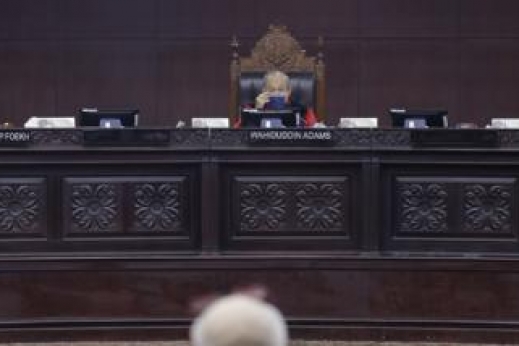
Preliminary examination hearing of the judicial review of the Indonesian Armed Forces Law, Monday (18/5) in the Plenary Courtroom of the Constitutional Court. Photo by Humas MK/Gani.
JAKARTA, Public Relations of the Constitutional Court—The Constitutional Court (MK) held a preliminary judicial review hearing of Law No. 34 of 2004 on the Indonesian Armed Forces (TNI) on Monday (18/5/2020) in the Plenary Courtroom of the Constitutional Court. Amidst the large-scale social restrictions (PSBB) in the Jakarta Special Capital, the Court applied physical distancing in accordance with the health protocols set by the Indonesian Health Ministry and the World Health Organization (WHO).
Petitioner Aristides Verissimo de Sousa Mota argued that Articles 1, 4, 12, 13, and 14 of the Armed Forces Law are unconstitutional. He interpreted that the Armed Forces Commander has indirectly removed the President’s position as supreme commander. In his petition, de Sousa Mota illustrated that during state funeral of former presidents and vice presidents, the ones in charge of holding the national flag at the tomb are the Army Chief of Staff, the Navy Chief of Staff, and the Air Force Chief of Staff, and the National Police Chief. Upon observing this, he considers the position of the Armed Forces Commander invalid because it contradicts Article 10 of the 1945 Constitution that reads, "The President is the Supreme Commander of the Land Forces, the Navy, and the Air Force."
"So, based on the phrase ‘... the Supreme Commander of the Land Forces, the Navy, and the Air Force,’ the direct superior of the Army, Navy, and Air Force is the President and not the Commander of the Armed Forces. That is the basis of our authorities," said Aristides, who actively participates in the Civil Society Empowerment Institute (LPMKD).
Therefore, in his petitum, de Sousa Mota requested that the Court declare Articles 1, 4, 12, 13, and 14 of the Armed Forces Law unconstitutional and order it be recorded in the State Report.
Legal Standing
Panel chairman Constitutional Justice Wahiduddin said that the Petitioner’s legal standing as a citizen must be supported by the enactment of the norms. Despite not suffering constitutional loss, he must elaborate on the cause of his constitutional loss. Justice Wahiduddin also said that the Petitioner must study each and every provision of those articles.
“Has the substance of the articles really harmed the Petitioner’s constitutional rights? You have to focus. Imagine the impacts if this petition is granted. The state will be in chaos. Therefore, reconsider and review the background of this petition,” he said.
Justice Manahan stated that the Petitioner needs to revise the petition’s rationale that did not comply with the procedural law in the Constitutional Court. As the Petitioner requested norms irrelevant to the Constitution, the petitum potentially conflicts with the 1945 Constitution. “Therefore, the Petitioner must be careful and focused. The Petitioner’s ideal concept must be conveyed to representative institutions, while the Constitutional Court focuses on norms by explaining the Petitioner’s constitutional loss due to the enactment of this law,” he explained.
Constitutional Concept
Justice Foekh advised that the Petitioner reconsider the substance of the articles, seeing that if the entirety of those petitions is challenged, it could result in the nation’s dissolution. In addition, he also requested that the Petitioner learn the constitutional concept. "This is necessary to strengthen the philosophical aspect and the position of the Commander of the Armed Forces […] that exists in the history of the Indonesian constitution in strengthening the Petitioner’s petition," he explained.
Panel chairman Constitutional Justice Wahiduddin Adams advised that the petitioners and their attorney(s), the government, experts, witnesses, and other parties use the online courtroom facilities. Other parties can watch the hearing online through the Court’s YouTube channel’s livestream.
Before concluding the session, Justice Wahiduddin reminded the Petitioner to submit the petition revision by Tuesday, June 2, 2020 at 11:00 WIB to the Registrar’s Office of the Constitutional Court. (Sri Pujianti/tir/LA)
Translated by: Yuniar Widiastuti
Translation uploaded on 05/18/2020
Monday, May 18, 2020 | 12:49 WIB 271