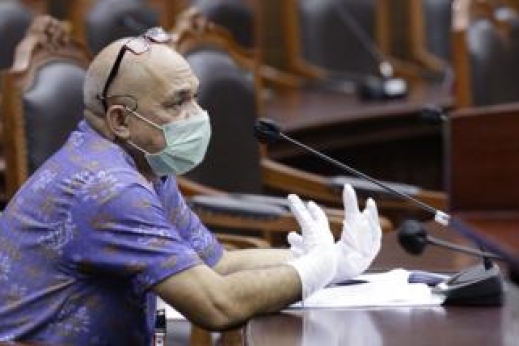
Principal Petitioner Aristides Verissimo de Sousa Mota delivering the subjects of the petition in the judicial review hearing of the Election Law, Monday (18/5) in the Plenary Courtroom of the Constitutional Court. Photo by Humas MK/Gani.
JAKARTA, Public Relations of the Constitutional Court—The Constitutional Court (MK) held a preliminary judicial review hearing of Law No. 7 of 2017 on the General Elections on Monday (18/5/2020) in the Plenary Courtroom of the Constitutional Court. In the hearing for case No. 29/PUU-XVIII/2020, the Court applied physical distancing in accordance with the health protocols set by the Indonesian Health Ministry and the World Health Organization (WHO).
In his petition, Petitioner Aristides Verissimo de Sousa Mota argued that the Election Law is contrary to Article 1 paragraph (2), Article 6A paragraph (1), Article 18 paragraph (3), Article 19 paragraph (1), and Article 22C of the 1945 Constitution. Without attorney, de Sousa Mota stated that the 2019 simultaneous elections led to a number of fatalities due to fatigue. The complex method to elect candidates for legislative members (DPR RI, Provincial DPRD, and regency/city DPRD) was implemented with an open proportional system and the election of DPD members was carried out with a multi-representative district system.
"By using such a complicated electoral system, the principles of effective and efficient election as regulated in Article 3 letters j and k of Law Number 7 of 2017 were not implemented," he said before the hearing presided over by Constitutional Justice Enny Nurbaningsih along with Constitutional Justices Arief Hidayat and Manahan M. P. Sitompul.
However, de Sousa Mota believes the election system for DPD candidates was correct because it used the people’s representative district system as mandated by Article 168 paragraph (2). However, the number of candidates was not limited so people did not know who they would vote for and after voting the they did not remember who they voted for.
"The 2019 general elections caused casualties. The Petitioner hopes that the Constitutional Court Justices make arrangements in accordance with the Petitioner’s [request] to the electoral system so that the implementation of the general elections in 2024 onwards will no longer cause fatalities," he said .
He hopes the number of DPD candidates for each electoral district (dapil) will be limited to 10 people. Thus, for each province the number of DPD candidates will be no more than 40 people. If a candidate/member of the DPR, the Provincial DPRD, and the Regency/City DPRD dies, the central executive board (DPP) of the winning party in the district has the right to replace it with a new member. So, in the petitum the Petitioner requested that the Court accept and grant the entire judicial review petition.
Justices’ Advice
Constitutional Justice Arief Hidayat advised the Petitioner to revise petition regarding the Constitutional Court’s authorities, the posita, and the petitum. He said that the Petitioner should explain his legal standing as a citizen.
"You are not focused. What you [requested to review is] the Election Law. There is no need to mention that you pay taxes and so forth. Why have your constitutional rights been violated by the Election Law? This means that the focus is that you as a citizen have the right to vote and be elected in relation to the law," he said.
Constitutional Justice Manahan M. P. Sitompul said that legal standing is crucial to see whether the Petitioner’s constitutional rights have been violated. “The Petitioner [should] not only consider material loss, but also constitutional loss,” he emphasized.
Similarly, Justice Enny Nurbaningsih said that the petition must detail the constitutional rights that have been violated by the enactment of the law. “Focus on your constitutional loss,” she said.
To avoid misperception, at the beginning of the hearing, panel chairman Constitutional Justice Enny Nurbaningsih offer the petitioners and their attorney(s), the government, experts, witnesses, and other parties the options to use the online courtroom facilities or to come directly to the Court. To help curb the spread of COVID-19, online courtroom facilities are available.
The Constitutional Court uses Cloudx and Zoom for online courtroom from the parties’ respective residences. In order to be able to use the online courtroom facilities, the litigating parties are to notify the Court’s ICT team of their locations and the instruments that they have at least two days before the hearing.
Before concluding the session, Justice Enny reminded the Petitioner to submit a revised petition no later than Tuesday, June 2, 2020 at 9:00 WIB to the Registrar’s Office of the Constitutional Court. (Utami/Halim/LA)
Translated by: Yuniar Widiastuti
Translation uploaded on 05/18/2020
Monday, May 18, 2020 | 12:51 WIB 234