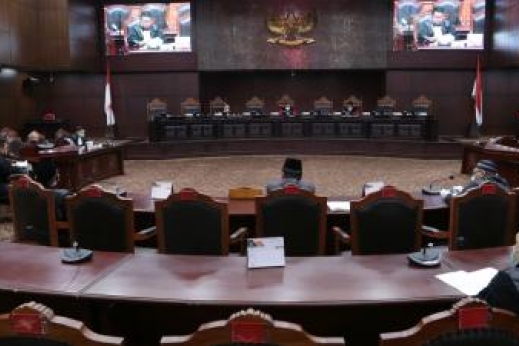
The constitutional justice panel in the revision hearing of the judicial review of the Perppu on COVID-19 Mitigation on Thursday (14/05) in the Plenary Courtroom of the Constitutional Court. Photo by Humas MK/Ifa.
JAKARTA, Public Relations of the Constitutional Court—The Constitutional Court (MK) held the second material review hearing of the Government Regulation In Lieu of Law Number 1 of 2020 regarding the State’s Financial Policy and Fiscal Stability for the Mitigation of COVID-19 Pandemic on Thursday morning (14/5/2020). Amidst the large-scale social restrictions (PSBB) in the Jakarta Special Capital, the hearing for cases No. 23/PUU-XVIII/2020, 24/PUU-XVIII/2020, and 25/PUU-XVIII/2020 applied physical distancing in accordance with the health protocol regulated by the Indonesian Health Ministry and the World Health Organization (WHO).
To help curb the spread of COVID-19, panel chairman Constitutional Justice Aswanto advised that the petitioners and their attorney(s), the government, experts, witnesses, and other parties use the online courtroom facilities. The Constitutional Court uses Cloudx and Zoom for online courtroom from the parties’ respective residences. In order to be able to use the online courtroom facilities, the litigating parties are to notify the Court’s ICT team of their locations and the instruments that they have at least two days before the hearing. Other parties can watch the hearing online through the Court’s YouTube channel’s livestream.
In this hearing, Constitutional Justice Aswanto said that the Petitioner of case No. 25/PUU-XVIII/2020 attorney and humanitarian activist Damai Hari Lubis had sent a letter to the Court to request the withdrawal of the petition. The hearing would then only continue with the petition revision for the two other cases. Case No. 23/PUU-XVIII/2020 was petitioned by M. Sirajuddin Syamsuddin, Sri Edi Swasono, Amien Rais, and 21 other individuals of different professions, while case No. 24/PUU-XVIII/2020 was petitioned by the Indonesian Anticorruption Community (MAKI), Mega Bintang Solo Indonesia 1997 Foundation, and three other organizations.
Comparison of Instruments of Emergency Laws
Ibnu Sina C. on behalf of the Petitioners of case No. 23/PUU-XVIII/2020 said that they have additional attorneys totaling 24 people and they strengthened the Petitioners’ legal standing in relation to public health by stating that the Petitioners’ health is threatened by the enactment of Article 2 paragraph (1) letter a numbers 1, 2, and 3; Article 16; Article 23; Article 27; and Article 28 of the Perppu on COVID-19 Mitigation. He also added a comparison of instruments of emergency laws in other countries in relation to COVID-19 mitigation.
Ibnu illustrated that Taiwan did not issue a peppu but directly applied an emergency law without complicated mechanism. He also talked about the South Korean government that had already prepared with a special law on the mitigation of contagious diseases, quarantine, regional community’s health, AIDS prevention, as well as an emergency financial law. New Zealand did not use a law or a perppu but applied a non-legal product and has applied it eight times.
“In addition to the legal measures of those countries, this revised petition also includes the budget determination by the WHO. In essence, it explains how to improve the budget system, aside from having an element of flexibility, each budget must be accountable. We (Indonesia) already have state finance laws [but] are not used by the government,” Ibnu explained before Constitutional Justices Wahiduddin Adams and Daniel Yusmic P. Foekh (panel members).
In the preliminary hearing, the Petitioners had argued that Article 2 paragraph (1) letter a numbers 1, 2, and 3; Article 16; Article 23; Article 27; and Article 28 of the Perppu on COVID-19 Mitigation are unconstitutional. They believe that the a quo perppu does not meet the three force majeure requirements as a parameter for the issuance of a perppu according to the Constitutional Court Regulation No. 138/PUU-VII/2009. The a quo norm would allow for the state budget deficit beyond the 3% gross domestic product (GDP) limit without a ceiling. This regulation would directly inhibit the House of Representatives (DPR) from giving approval on the state budget. In addition, they believe that Article 27 paragraph (1) of the perppu potentially leads to corruption.
Norm Irregularity
The Petitioners of case No. 24/PUU-XVIII/2020 through Boyamin bin Saiman said that in the revised petition they included experts’ opinions on some terms that are necessary for each part of Perppu on COVID-19 Mitigation. Boyamin observed an irregularity in this norm, whose format is unusual, in that there are no general provisions. Thus, he considered this norm to serve justice only for officials and not the people. He made a comparison with Malaysia, which did not create an emergency law but declared a state of military emergency. “Malaysia only [declared] a state of military emergency but not [of[ finance,” he explained.
The Petitioners also added more evidence in the form of the managing committee list according to the organization’s structure. They also revised the petitum by requesting that the Court declare Article 27 paragraphs (1) and (3) of the Perppu on COVID-19 Mitigation conditionally constitutional.
In the preliminary hearing, the Petitioners had argued that Article 27 paragraph (1) of the a quo perppu states that the costs incurred by the Government in the context of implementing state revenue policiesshall not constitute a loss to the state, while in fact the source of state revenue comes from the state budget. They also believe that in Article 27 paragraph (2) of the a quo perppu there is the word “if,” which the president or the Government could use to avoid any allegation of legal immunity. So, the word “if” carries multiple interpretations and public officials could hide behind the phrase “good faith” to be free of any legal charges. Law No. 12 of 2005 on the Ratification of the International Covenant on Civil and Political Rights stipulates that any policy based on good faith that leads to state loss should be reviewed legally and openly. So, there shouldn’t be such a thing as good faith based merely on a subjective judgment by a government administration. (Sri Pujianti/RA/LA)
Translated by: Yuniar Widiastuti
Translation uploaded on 05/14/2020
Thursday, May 14, 2020 | 16:36 WIB 191