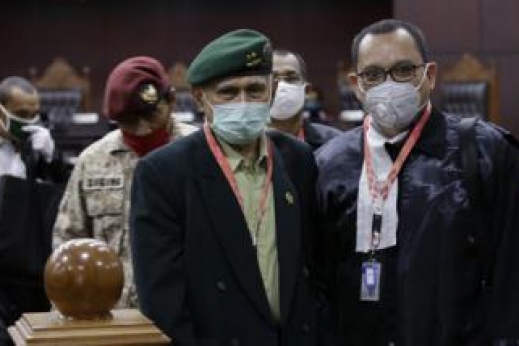
Petitioner Kivlan Zen and attorney after the preliminary examination hearing of the judicial review of the Firearm Law, Wednesday (13/5) in the Plenary Courtroom of the Constitutional Court. Photo by Humas MK/Gani.
JAKARTA, Public Relations of the Constitutional Court—The Constitutional Court (MK) held a preliminary judicial review hearing of Law No. 12 of 1951 on the Amendment to Ordonnantietijdelijke Bijzondere Strafbepalingen (Stbl. 1948 No.17) and Law No. 8 of 1948 (Emergency Law No. 12 of 1951) on Firearms on Wednesday (13/5/2020) in the Plenary Courtroom of the Constitutional Court. In the hearing for case No. 27/PUU-XVIII/2020, the Court applied physical distancing in accordance with the health protocols regulated by the Indonesian Health Ministry and the World Health Organization (WHO).
In order to avoid misperception, at the beginning of the session, panel chairman Constitutional Justice Arief Hidayat offered the petitioners and their attorney(s), the government, experts, witnesses, and other parties the option to either come to the Court or to use the online courtroom facilities. The second option is available to help curb the spread of COVID-19.
The Constitutional Court uses Cloudx and Zoom for online courtroom from the parties’ respective residences. In order to be able to use the facilities, the litigating parties are to notify the Court’s ICT team of their locations and the instruments that they have at least two days before the hearing.
The Petitioner, Indonesian Army retiree Kivlan Zen, felt aggrieved by the enactment of Article 1 paragraph (1) of the Firearm Law that reads, “Anyone who, without the right to enter Indonesia, make, receive, try to obtain, deliver, or try to surrender, control, carry, possess, stock up on him/her or own in his/her possession, store, transport, conceal, use, or release from Indonesia any firearms, ammunition, or explosives, is punishable by death or life imprisonment or sentence a temporary prison of a maximum of twenty years.” He believes the provision violates Article 1 paragraph (3), Article 27 paragraph (1), Article 28D paragraph (1), and Article 28I paragraph (2) of the 1945 Constitution.
The Petitioner’s attorney Tonin Tachta Singarimbun said that in a concrete case, the Petitioner was arrested on May 29, 2019 on suspicion of illegal possession of firearms and bullets. In the subsequent legal process, the Petitioner was charged of committing or participating in a criminal act and of being an accomplice in a crime and sentenced in case No. 1113/Pid.Sus/2019/PN Jkt.Pst on March 3, 2020.
Singarimbun added that the article of the Firearm Law has led to legal uncertainty to the Petitioner and violated his constitutional rights because in the elucidation there is no explanation, jurisprudence, or derivative regarding the authority of investigators and public prosecutors to carry out a case investigation or before interlocutory injunction to the Petitioner’s exception was ruled. The Petitioner believes that the Firearm Law is an emergency law relating to a state of emergency and that the government needs to make amendments to it.
"Thus, if the constitutional basis is examined, it is no longer relevant for the protection of the Petitioner’s constitutional [rights] because [the investigator and the public prosecutor could take fragments of phrases in that article and link them to the Petitioner]," Singarimbun explained before the hearing which was also attended by Constitutional Justices Suhartoyo and Enny Nurbaningsih (panel members).
The Petitioner also believes that the norm does not reflect the rule of law as stated in Article 1 paragraph (3) of the 1945 Constitution because the phrases contained in the Firearm Law are complex and multi-interpretive while norms of law should be easy to understand and use appropriate grammar. In the absence of a minimum and maximum [measure] as in the phrase “make, receive, try to obtain, deliver, or try to surrender, control, carry, possess, stock up on him/her or own in his/her possession, store, transport, conceal, use” in the article, the investigator and the public prosecutor’s interpretation is legally groundless.
The Petitioner also believes that the article contradicts Article 28I paragraph (2), especially relating to the discriminatory treatment experienced by the Petitioner in the verdicts on several cases related to possession of illegal firearms and bullets imposed on him. He encountered this discrimination when one of the defendants who possessed a firearm was acquitted, while he, who denied the charge, was indicted.
Therefore, the Petitioner requested that the Court decide or at least declare the phrases in the Emergency Law No. 12 of 1951 with commas (,) as well as the phrases ‘… or…,’ ‘… who, without the right to enter Indonesia make…,’ and ‘… try to obtain…’ “to not be legally binding or to be revoked.”
Causality
Constitutional Justice Suhartoyo observed that the Petitioner included something not usually existing in the petition, such as background and arguments of constitutional loss. He said that he hadn’t found the main things that the Petitioner petitioned because it has not followed the appropriate structure in accordance with the Court’s procedural law.
He also said that the Petitioner did not mention the causality between the norm and his concrete and/or potential constitutional damage. “This is to describe legal uncertainty so that the Petitioner’s legal standing [be coherent]. This will be the clarification that the Petitioner really has the legal standing to challenge this article,” he explained.
Constitutional Loss
Constitutional Justice Enny Nurbaningsih said that the law applies in Indonesia although it was issued during a state of emergency, hence it must be treated the same as any other law. She added that the Petitioner must indicate the parts of the Firearm Law that violate his constitutional rights. She also advised that the Petitioner study the article used as touchstone. For example, she stated that Article 1 paragraph (3) is relating to state of law, not to constitutional rights.
Inappropriate Terms
Constitutional Justice Arief observed that the Petitioner use the inappropriate terms for the laws he wishes to review, which could result in the petition having the wrong object. Therefore, he advised that the Petitioner use the appropriate terms of the laws according to the corresponding state gazettes.
Before concluding the session, Justice Arief asked the Petitioner to submit the petition revision by Tuesday, May 26, 2020 at 12:00 WIB to the Registrar’s Office. (Sri Pujianti/AL/LA)
Translated by: Yuniar Widiastuti
Translation uploaded on 05/14/2020
Wednesday, May 13, 2020 | 16:20 WIB 271