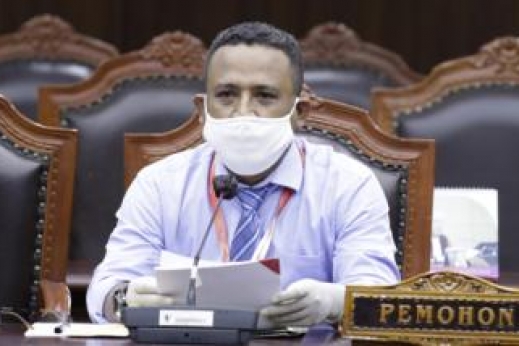
Principal Petitioner Jack Lourens Vallentino Kastanya delivering the subjects of the petition in the judicial review hearing of the Public Prosecution Law, Wednesday (13/5) in the Plenary Courtroom of the Constitutional Court. Photo by Humas MK/Gani.
JAKARTA, Public Relations of the Constitutional Court—The Constitutional Court (MK) held a judicial review hearing of Law No. 16 of 2014 on Public Prosecution Service on Wednesday (13/5/2020). The Principal Petitioner Jack Lourens Vallentino Kastanyawas present in the courtroom. Amidst the COVID-19 pandemic, the Court held the hearing in compliance with health protocols set by the Health Ministry and the WHO, such as by wearing a mask, gloves, checking temperatures, and applying physical distancing.
Panel chairman Constitutional Justice Enny Nurbaningsih first informed that the litigating parties may follow the court hearing online from their respective locations by using the facilities offered by the Court. In order to be able to use the online courtroom facilities, the parties are to request the Court to use the facilities two days before the hearing by notifying their locations and the instruments that they have. The software used by the Constitutional Court are Cloudx and Zoom.
“In the future, to follow the hearing, [you] may request an online hearing if you can’t come to the Constitutional Court,” she said.
The Petitioner of case 28/PUU-XVIII/2020 challenges Article 13 paragraph (1) of Law No. 16 of 2014 that reads, “A prosecutor may be dishonorably discharged from their position for the reason: a. having been sentenced for a crime, based on a court decision that has obtained permanent legal force….”
The Petitioner was a civil servant (PNS) and a functional prosecutor at the North Maluku High Prosecution Office who was dismissed based on the Attorney General Decree No. KEP-003/A/JA/01/2013 dated January 14, 2013 on the Dishonorable Discharge of a Civil Servant. He received grave disciplinary punishments: discharge from a structural office, criminal charge, and prison sentence of 1 year, dishonorable discharge from a public prosecutor position.
"The provision of Article 13 paragraph (1) letter a of Law No. 16/2004, which was used as the basis for issuing the a quo Attorney General Decree doesn’t provide guarantee, protection, and fair legal certainty for the Petitioner because it doesn’t consider disciplinary sentences that have previously been imposed," the Petitioner explained.
The Petitioner argued that he has suffered damage, losing job as a prosecutor and a civil servant, thus affecting his livelihood and that of his wife and children. In addition, the Petitioner didn’t receive a fair legal certainty and equal treatment before the law, considering that for a single case he had to undergo two legal proceedings and received two types of legal sanctions. Therefore, if his petition is granted, the constitutional damage as he argued will no longer occur.
According to the Petitioner, the dishonorable discharge as a prosecutor due to criminal sentencing as stipulated in Article 13 paragraph (1) letter a of Law No.16 of 2004 is contrary to Article 27 paragraph (2) and Article 28D paragraph (1) of the 1945 Constitution. The enactment of Article 13 paragraph (1) letter a of Law No.16 of 2004 was used as the basis for issuing the Attorney General Decree No. KEP-003/A/JA/01/2013 dated January 14, 2013 on the Dishonorable Discharge of a Civil Servant Jack Lourens Vallentino Kastanya as a Functional Prosecutor of the North Maluku High Prosecution Office.
Concrete Case
Constitutional Justice Enny Nurbaningsih said that the petition had the correct format and was detailed enough, but put too much emphasis on the concrete case. “A concrete case has another legal avenue. You must remember, the Constitutional Court reviews laws, whether the enactment of a norm harms you,” she said.
Justice Manahan M. P. Sitompul advised the Petitioner to add the latest law in the Court’s authorities. “In addition, you must detail your constitutional damage in relation to your legal standing. In the subject of the petition, elaborate the issue of office position, the provisions on PNS status and office position,” he said.
Justice Daniel Yusmic Pancastaki Foekh observed that the petitum led to legal uncertainty, thus needed to be revised. He also advised that terms in foreign language be italicize. (Nano Tresna Arfana/NRA)
Translated by: Yuniar Widiastuti
Translation uploaded on 05/14/2020
Wednesday, May 13, 2020 | 14:25 WIB 304