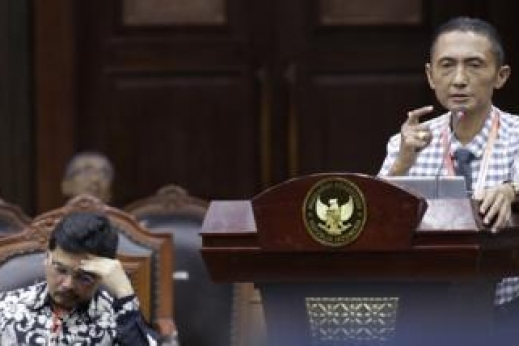
Brawijaya University law expert Abdul Rachmad Budiono presented by the Petitioner delivering his expertise in the judicial review hearing of the Law on the Protection of Indonesian Migrant Workers (PPMI) on Tuesday (10/3) in the Plenary Courtroom of the Constitutional Court. Photo by Humas MK/Gani.
JAKARTA, Public Relations of the Constitutional Court—The sixth judicial review hearing of Law Number 18 of 2017 on the Protection of Indonesian Migrant Workers (PPMI Law) was held by the Constitutional Court (MK) on Tuesday (10/3/2020). The Association of Migrant Worker Placement Companies (ASPATAKI) as Petitioner of case No. 83/PUU-XVII/2019 challenge Article 54 paragraph (1) letters a and b, Article 82 letter a, and Article 85 letter a of the PPMI Law.
Brawijaya University law expert Abdul Rachmad Budiono presented by the Petitioner stated that Indonesian migrant worker placement companies (P3MI) can be viewed from two viewpoints. First, as a social institution that help Indonesian citizens (WNI) find work. Second, as business entities.
In relation to Article 54 paragraph (1) letter b of the PPMI Law, especially along the phrase “a government bank” and “one billion five hundred million rupiah,” the requirement has to really be met by any business, thus closing any opportunity for P3MI to run their business. This will close opportunities for Indonesians to work overseas. This is why Article 54 paragraph (1) letter b is unconstitutional.
"If the state is not able to fully provide employment, do not bother any party who wants to help people to work, like P3MI. Don\'t treat them as enemies. They are businesspeople who want to help people who want to find work abroad. Not enemies to be imposed with obligations. The figure of Rp5 billion for paid-up capital and Rp1.5 billion for licensing is not [proper] and is not effective," Abdul explained before the court presided over by Chief Justice Anwar Usman along with the other constitutional justices.
Violating Material Criminal Law
Article 82 of the PPMI Law can be said to have violated material criminal law as part of it reads “deliberately places Prospective Indonesian Migrant Workers.” The word “prospective” means the worker in question has not started their work, since the indicator is a work agreement.
A work agreement is signed by an Indonesian migrant worker and their employer in the destination country. In other words, the employer is a foreign national (WNA) that is not subject to Indonesian law. “How can a [prospective Indonesian migrant worker] be harmed when they have not started work yet? How to prove this loss?” Abdul asked.
Business Partners
Next, the Petitioner’s expert Amiruddin explain his view on Article 85 letter a of the PPMI Law, especially with regard to its target. He believes that the party responsible for the placement of Indonesian migrant workers in the target country is anyone, which could include individuals and/or corporations, based on Article 1 number 19 of the PPMI Law.
Based on Article 1 number 10 of the PPMI Law, the party is business partners. Therefore, the business partners are targeted by Article 82 letter a and Article 85 letter a of the PPMI Law. “Meanwhile, P3MI are business entities in the form of limited liability companies that have received written permits from the minister to carry out [migrant worker placement services]. So, P3MI are not the parties targeted by the a quo articles,” Amiruddin explained.
Not Licensed
Labor law lecturer of Airlangga University M. Hadi Shubhan, who was presented by the Petitioner, talked about the relation between the increase in the capital to be paid by P3MI to the state shows that the state is unaware of the issues regarding the protection of Indonesian migrant workers because violations on migrant workers placement are caused by unlicensed P3MI. The increase of P3MI deposit from 500 million to 1.5 billion also shows the state’s unawareness of the weak protection for Indonesian migrant workers.
“While in fact P3MI license is one of the state’s methods in controlling business activities. The licensing is administrative in nature and not a criminal one,” Hadi said.
The Petitioner felt disadvantaged by the enactment of Article 54 paragraph (1) letters a and b of the PPMI Law, especially along the phrase “a government bank” and the 1.5 billioncapital in the form of a deposit to be paid by P3MI. The Petitioner believes it is not an affordable amount for many entities, including P3MI.
The requirement of at least 5 billion paid capital in the company\'s deed of establishmentis clearly unfair while Article 32 of Law No. 40 of 2007 on Limited Liability Company only demands minimum 50 million. It is unclear whichlaw shouldbe abode by P3MI. ASPATAKI said the organization has 142 members operating as Private Placement Companies for Indonesian Migrant Workers (PPTKIS), who place and sent Indonesian workers abroad.
Before concluding the session, Justice Anwar informed that the next hearing will take place on Wednesday, March 18 at 11:00 WIB to listen to two witnesses for the Petitioner. (Sri Pujianti/NRA)
Translated by: Yuniar Widiastuti
Translation uploaded on 3/11/2020
Also read:
Paid-Up Capital for P3MI Deemed Exorbitant
Petitioner of PPMI Law Revises Petition
Court Postpones Hearing on the Protection of Indonesian Migrant Workers
House: ASPATAKI Not a Subject of PPMI Law
PPMI Law Serves to Protect Indonesian Migrant Workers
Wednesday, March 11, 2020 | 13:37 WIB 459