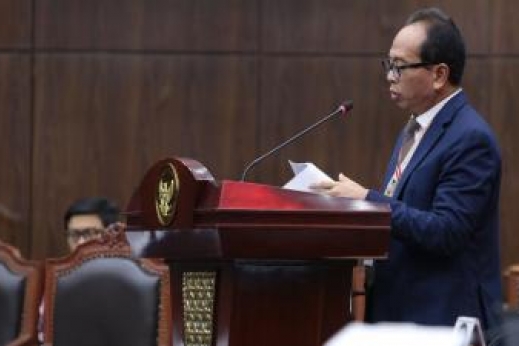
Supreme Justice I Gusti Agung Sumanatha as the Relevant Party giving a statement in a follow-up judicial review hearing of Law No. 3 of 2009 concerning the Second Amendment to Law No. 14 of 1985 concerning the Supreme Court, Thursday (5/3) in the Courtroom of the Constitutional Court. Photo by Humas MK/Ifa.
JAKARTA, Public Relations of the Constitutional Court—Supreme Justice I Gusti Agung Sumanatha representing the Supreme Court (MA) as the Relevant Party stressed the differing characteristics between the judiciary and the executive as determined in the 1945 Constitution in a follow-up judicial review hearing of Law No. 3 of 2009 concerning the Second Amendment to Law No. 14 of 1985 concerning the Supreme Court. The hearing of case No. 2/PUU-XVIII/2020 took place on Thursday (5/3/2020) in the Plenary Courtroom of the Constitutional Court to listen to the statements of the House of Representatives (DPR) and the Relevant Party.
Sumanatha continued, tenures in the judiciary is not determined by the 1945 Constitution, while that of the executive (president and vice president) is explicitly determined for a term of five years and with a one-time possible re-election in the same office. As for the legislature, they are elected through general elections every five years. Therefore, based on differences in the terms of office of the three institutions, it is not accurate that supreme justices are discriminated against in terms of tenure according to Articles 7 and 11 of the Supreme Court Law. Therefore, the arguments of the Petitioners, who believe that the a quo article is unconstitutional, are groundless.
Sumanatha also argued that as the 1945 Constitution does not explicitly determines the tenure of supreme justices, making it an open legal policy for lawmakers. He explained that as lawmakers determined that Supreme Court justices may serve until 70 years without any fixed term, it is constitutional, in contrast to the president and vice president whose term of office of has been determined by the 1945 Constitution.
On behalf of the Judicial Commission as a Relevant Party, Judges Recruitment Division head Aidul Fitriciada Azhari explained that the tenure of supreme justices and court judges, be it for life or until a certain term, must be guaranteed freedom from the executive’s intervention or arbitrary nomination by those in power.
Aidul added that Article 11 of the Supreme Court Law stipulates that a chief supreme justice, a deputy chief supreme justice, a junior chief supreme justice, and a supreme justice be honorably discharged by the president upon the Supreme Court’s recommendation after turning 70 years old. Meanwhile, in other courts, chief judge, deputy chief judge, and judges are honorably discharged after turning 65 years old.
Also read:
Petitioner of Supreme Court Law Challenges Term of Office of Supreme Court Justices
Petitioner of Supreme Court Law Revises Petition
House Absent and Govt Not Ready, Hearing on Supreme Court Law Postponed
Government: Terms of Office of President and Supreme Justices Different
Petitioner Aristides Verissimo de Sousa Mota had previously stated that the norms in the Supreme Court Law have caused discrimination because there are restrictions on the term of office of the president and vice president, but not to the Supreme Court justices. If a person is elected as a Supreme Court justice at the age of 45, then the person most likely will be in office for 25 years because the retirement age of the justices is 70 years.
Therefore, the Petitioner requested that the Court decide the term of office of supreme justices for five years with a re-election for one more period. As such, the maximum tenure of supreme justices would be 10 years. If a supreme justice has served for 10 years, after the ruling, they must resign. The tenure of a supreme justice who has served for over 5 years but less than 10 years will end after 10 years. In addition, the Petitioner also requested that the tenure of supreme justices who have served less than 5 years be determined at 5 years and after that they can apply for the supreme justice office. (Utami/tir/NRA)
Translated by: Yuniar Widiastuti
Translation uploaded on 3/11/2020
Monday, March 09, 2020 | 14:26 WIB 580