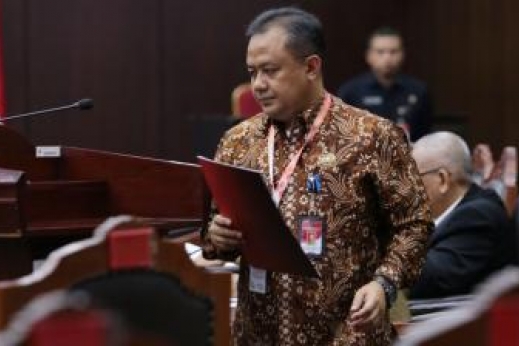
Head of the Interior Ministry’s Legal Bureau R. Gani Muhamad giving a statement on behalf of the Government in the judicial review hearing of the Law on the Establishment of Sungai Penuh City, Wednesday (4/3) in the Courtroom of the Constitutional Court. Photo by Humas MK/Ifa.
JAKARTA, Public Relations of the Constitutional Court—Law No. 25 of 2008 on the Establishment of Sungai Penuh City in Jambi Province give the region freedom to exercise its autonomy, said the Head of the Interior Ministry’s Legal Bureau R. Gani Muhamad on behalf of the Government in a follow-up judicial review hearing of the Establishment of Sungai Penuh City held by the Constitutional Court (MK) on Wednesday (4/3/2020). The hearing of case No. 3/PUU-XVIII/2020 had been scheduled to listen to the statements by the House of Representatives (DPR) and the Government.
Gani said the purpose of Regional Autonomy is to improve people’s welfare, which is expected to be accelerated through the improvement of services in the regions. Proliferation is a strategic step taken by the government to improve the quality of governance in terms of service, empowerment, and development, towards the realization of an advanced, independent, prosperous, and just society. In essence, the proliferation of autonomous regions is more focused in bringing government services closer in order to improve the people’s welfare.
"Regional proliferation is a way or approach to accelerate regional development. And the newly-formed autonomous region is an entity as a geographical, political, economic, social, and cultural entity," said Gani.
Also read: Affected by Regional Proliferation, Civil Servants Challenge Law on the Establishment of Sungai Penuh City
In principle, Gani explained, proliferation must be driven by the desire to improve community services and agreement from the local government. However, if it is only driven by the wishes of a certain group or people, it should not be done. According to Gani, Sungai Penuh City as a new autonomous region needs funds for the construction of facilities and infrastructure to support the local administration in realizing community services and promote welfare for the community. "So, with the a quo law, Sungai Penuh City as a new autonomous region can immediately realize the goals of a regional autonomy," he explained.
The case No. 3/PUU-XVIII/2020 was petitioned by nine petitioners who are civil servant retirees, advocates, youth figures, lecturers, and former Kerinci Regency DPRD members. The Petitioners argued that the a quo article is ambiguous and multi-interpretive. The issue actually stemmed from the proliferation of Kerinci Regency into a new autonomous city named Sungai Penuh. Four other regencies in Jambi Province were expanded into regencies. This difference resulted in the movement of the regency capital to Bukit Tengah Village, Siulak Sub-district. The expansion of Kerinci Regency into two autonomous regions was the consequence of the proliferation within the conditions stipulated in the Proliferation Law.
In addition, although the new regency capital was imposed on Kerinci Regency, the special funding was given by the Central Government to Sungai Penuh City, even though the parent regency also needed funding for the development of infrastructure in the infrastructure-deficient Bukit Tengah Village.
In the petitum,the Petitioners requested that the Court declare Article 13 paragraph of the Law on the Establishment of Sungai Penuh City contrary unconstitutional insofar as not be interpreted. (Utami/Lambang/LA)
Translated by: Yuniar Widiastuti
Translation uploaded on 3/5/2020
Thursday, March 05, 2020 | 06:49 WIB 373