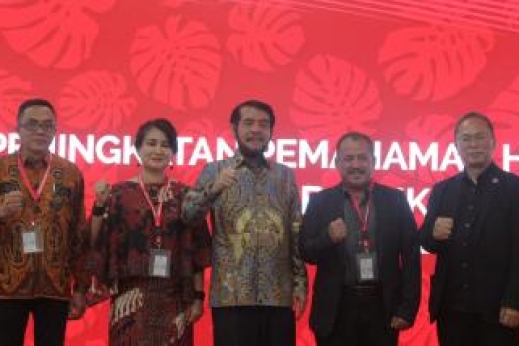
BOGOR, Public Relations of the Constitutional Court—All citizens are subject to law and regulations. Since birth up to death, their lives are recorded. When working in a certain profession, such as as an architect, they are subject to legislation that regulate all things in relation to the profession. “Any profession is related to legislation,” said Chief Constitutional Justice Anwar Usman before 71 participants of the technical guidance program on the constitution for the Indonesian Institute of Architects (IAI) on Monday evening (2/3/2020) at the Pancasila and Constitution Education Center, Bogor, West Java.
To the participants, Chief Justice Anwar stressed that all things related to the architect profession are regulated. All societies have law to create public order and keep the members from furthering their individual interests.
However, Justice Anwar added, law is politically motivated including in its inception, leading to potential of the violation of citizens’ rights. “Such law is not in accordance with the state objective to promote welfare for its people,” he said along with Secretary General M. Guntur Hamzah and acting Head of the Pancasila and Constitution Education Center Imam Margono.
Therefore, the Constitutional Court serves to collect judicial review petitions of laws that violate the people’s constitutional rights and to guarantee that the Constitution is applied. "Therefore, the Constitutional Court hopes that every citizen will increasingly understand and implement the Constitution conceptually. [Hopefully] the participants of this training can […] spread the values of the Constitution in the life of the nation and state," Justice Anwar said.
Profession of Legal Consequences
Chairman of the Indonesian Institute of Architects Ahmad Djuhara in his remarks said that Law No. 6 of 2017 regulates the architect profession. As law and government develop, architects are included in the Omnimbus Law, especially in articles relating to economy, licenses, and even building permit (IMB) procedure.
"The government facilitates investment, reduce bureaucracy [and] corruption, but investment also requires legal certainty, one of which is the architect profession. With a regulated profession, we have legal power and consequences. Thus, buildings, which are part of investment, [will] also have legal certainty," Ahmad explained.
Ahmad expressed his hope that during the technical guidance program, the Constitutional Court would give insights to architects to protect the nation. He believes that architects serve as some kind of soldier to protect the nation’s sovereignty in their architectural works. It is reflected in the regulation specifying that all architectural works cannot involve only foreign architects.
Promote Understanding
Guntur in his remarks said that the Constitutional Court is responsible to promote understanding among the public about Pancasila. Through the Pancasila and Constitution Education Center, the Court facilitates elements of the people, including Indonesian architects, to improve public access to justice, including the procedural law in the Constitutional Court. "Architects citizens who are key to development planning that integrates art and technology. Architects are required to continue to innovate, and as citizens professional architects are expected to be able to overcome legal issues related to their field," Guntur explained.
The technical guidance program on the Constitution for the Indonesian Institute of Architects will take place for four days, Monday-Thursday (2-5/3/2020). All participants will listen to presentations by constitutional justices, constitutional law experts, researchers, and substitute registrars of the Constitutional Court related to constitutional law and governance according to the 1945 Constitution, as well as the filing of judicial review petition. (Sri Pujianti/LA)
Translated by: Yuniar Widiastuti
Translation uploaded on 3/5/2020
Tuesday, March 03, 2020 | 13:00 WIB 262