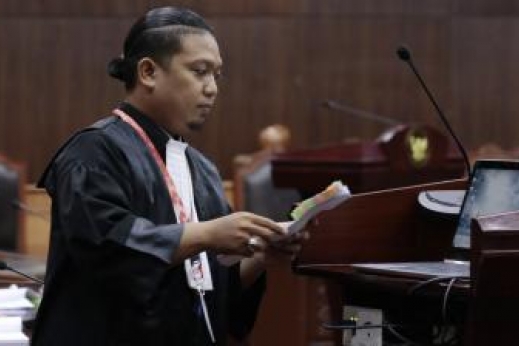
The Relevant Parties\' attorney Viktor Santoso Tandiasa giving a statement in the judicial review hearing of Law Number 18 of 2017 on the Protection of Indonesian Migrant Workers (PPMI Law) on Monday (2/3) in the Courtroom of the Constitutional Court. Photo by Humas MK/Ifa.
JAKARTA, Public Relations of the Constitutional Court—The Constitutional Court (MK) held another judicial review hearing of Law Number 18 of 2017 on the Protection of Indonesian Migrant Workers (PPMI Law) on Monday (2/3/2020) to hear statements by Migrant Care (Relevant Party I) and the Indonesia Migrant Worker Union (Relevant Party II).
The Relevant Parties were represented by Viktor Santoso Tandiasa. "The Relevant Parties have made efforts to protect migrant workers from [unauthorized] Indonesian labor placement companies […] that lean toward human trafficking," Viktor told presiding Justice Anwar Usman.
If the Constitutional Court grant the Petitioner\'s petition, Viktor said, those efforts would be in vain. "This is detrimental to Relevant Party I and Relevant Party II in carrying out their duties and functions. In addition, if the Constitutional Court grant the Petitioner\'s petition, then Relevant Party II will suffer direct losses because the members of Relevant Party II are Indonesian migrant workers who has begun the process of working abroad or who are active abroad," Viktor explained.
Viktor said the PPMI Law is enacted for the state to guarantee rights, opportunities, and protection for every citizen without discrimination, to obtain decent work and income, both at home and abroad according to their expertise, skills, talents, interests, and abilities. In addition, Indonesian migrant workers are protected from human trafficking, slavery, forced labor, victims of violence, abuse, crimes against human dignity, and treatment that violates human rights.
Viktor added that based on empirical data, women and children are most vulnerable to human trafficking, especially those who work abroad. Human trafficking victims are not only employed in prostitution, but also exploited for forced labor or practices similar to slavery. "This is clearly not in accordance with the employment agreement between the worker and the placement company. From 2014 to 2018, based on data from the Criminal Investigation Department, about 1,154 Indonesian citizens were victims to human trafficking practices in a number of countries," he explained.
Migrant Care Secretary Anis Hidayah said Article 54 paragraph (1) letter a of the PPMI Law was enacted due to many cases faced by Indonesian migrant workers, especially women workers who get entangled in legal cases that require large handling costs.
"As experienced by Satinah from Semarang who works in Saudi Arabia. She could be freed from the death sentence by paying Rp21 billion. She was forced to kill her employer because of threats of persecution and attempted rape. Satinah was finally released and returned to Indonesia in 2010 after paying Rp21 billion. [However,] Satinah suffered a stroke due to the accumulation of depression during the legal process," Anis explained.
Also read:
Paid-Up Capital for P3MI Deemed Exorbitant
Petitioner of PPMI Law Revises Petition
Court Postpones Hearing on the Protection of Indonesian Migrant Workers
House: ASPATAKI Not a Subject of PPMI Law
The Petitioner of case No. 83/PUU-XVII/2019 is the Association of Migrant Worker Placement Companies (ASPATAKI). They challenge Article 54 paragraph (1) letters a and b, Article 82 letter a, and Article 85 letter a of the PPMI Law.
Article 54 paragraph (1) letters a and b of the PPMI Law reads, "In order to obtain SIP3MI as referred to in Article 51 paragraph (1), the Indonesian Migrant Worker Placement Agency must meet the following requirements: a. having a paid-up capital stated in the deed of establishment of at least Rp5,000,000,000 (five billion rupiah); b. depositing money to a government bank in the form of a deposit of at least Rp1,500,000,000 (one billion five hundred million rupiah) that can be disbursed at any time as a collateral to fulfill obligations in the Protection of Indonesian Migrant Workers."
Article 82 letter a reads, "Being sentenced to imprisonment for a maximum of 10 (ten) years and fined for a maximum of Rp15,000,000,000 (fifteen billion rupiah), every Person who deliberately places Prospective Indonesian Migrant Workers in: a. jobs and type of works that do not match the employment contract so they harm the Prospective Indonesian Migrant Workers as referred to in Article 67 letter a."
Article 85 letter a reads, "Being sentenced to imprisonment for a maximum of 5 (five) years and fined for a maximum of Rp5,000,000,000 (five billion rupiah), every person who: a. places Indonesian Migrant Workers in works that do not match the Employment Contracts that have been agreed and signed by Indonesian Migrant Workers as referred to in Article 71 letter a."
Through attorney Wilman Malau, ASPATAKI said the organization has 142 members operating as Private Placement Companies for Indonesian Migrant Workers (PPTKIS), who place and sent Indonesian workers abroad.
The Petitioner argues their constitutional right in freedom of business, and that criminal threats they received are not based on acts that it did and violated the principle of material acts. Actions carried out by parties who employ migrant workers must be borne by the Petitioners. (Nano Tresna Arfana/NRA)
Translated by: Yuniar Widiastuti
Translation uploaded on 3/3/2020
Monday, March 02, 2020 | 15:10 WIB 324