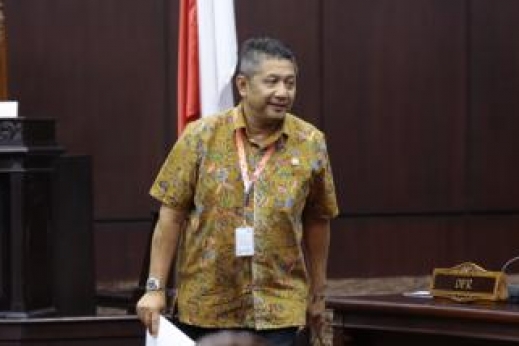
Statement of the House given by Dipo Nusantara Pua-Pua in the judicial review hearing of the People\'s Consultative Assembly (MPR), the Regional Representatives Council (DPD), and the Regional Legislative Council (DPRD), Wednesday (22/1) in the Plenary Courtroom of the Constitutional Court. Photo by Humas MK/Gani.
JAKARTA, Public Relations of the Constitutional Court—The Constitutional Court (MK) held the judicial review hearing of Law Number 13 of 2019 on the Third Amendment to Law Number 17 of 2014 on the People\'s Consultative Assembly (MPR), the Regional Representatives Council (DPD), and the Regional Legislative Council (DPRD), also known as the MD3 Law, on Wednesday (22/1/2020) in the Plenary Courtroom of the Constitutional Court. The hearing of case No. 66/PUU-XVII/2019 was presided over by Deputy Chief Constitutional Justice Aswanto.
In the third hearing, Dipo Nusantara Pua-Pua on behalf of the House said that the Petitioners are not directly related to the MD3 Law, making their legal standing questionable. The Government argued that the House already revised the MD3 Law while the petition proposed by the Petitioners is a bill before the revision. He also mentioned that the MD3 Law was included in the 2015-2019 National Legislative Program (Prolegnas).
"Based on the chronological discussion of the Third Amendment to the MD3 Law, the formation of the law has followed all processes and mechanisms in accordance with statutory regulations," Dipo said.
Dipo said that the number of House members in the 2019-2024 period increased, increasing the number of MPR leaders, form initially 5 people to 10 people. The Petitioners\' argument that the leadership sided with certain political parties is false. The increasing number of MPR leaders to 10 has, in contrast, created justice and developed a check and balance mechanism. Furthermore, he also mentioned that the formation of the law was in accordance with article 11 paragraph (4) of the House\'s code of conduct.
The House also mentioned that the issue being petitioned was not a matter of norm constitutionality but rather a technical issue. The House then requested that the justices reject or dismiss the entire petition.
Meanwhile, a representative of the Government, Andriansyah, gave a fairly brief statement. The Government considered that the establishment of the MD3 Law was in accordance with statutory laws and regulations and that the discussions had been intensively conducted by the Parliament and the President.
Before concluding the session, Constitutional Justice Saldi Isra said that the statement of the House and the Government was too substantive because the Petitioners\' petition was related to the formal review of the law. He asked both parties to complete information about the process of forming the law along with the minutes of its discussions.
In the previous hearing, Sidik stated that his constitutional damage is focused on the mandate from the Petitioners/individual citizens to the Parliament to carry out their duties fairly, honestly, and responsible for the interests of the people. The constitutional loss in the formal review is proven if the Petitioners feel that the House (DPR) has not carried out fiduciary duties that mandated by the people fairly, honestly, and responsibly, even though the Petitioners used their right to vote to elect members of the House in the general elections.
The Petitioners believe that the 1945 Constitution does not regulate mandatory approval of the House and the President. If the formulation of laws reviewed formally against the 1945 Constitution, they would not be unconstitutional since they are always approved by both institutions before being promulgated.
In addition, the Petitioners alleged that the Third Amendment to the MD3 Law violated the procedure as regulated in the House code of conduct as it was not included in the 2015-2019 National Legislative Program (Prolegnas) or the 2019 Prolegnas priority list. If the Bill of the Third Amendment to the MD3 Law had been submitted outside of the Prolegnas, it could only have been proposed by the House and the President. He also considered the change in Article 15 of the MD3 Law not driven by the need to fill a legal vacuum or a critical situation. On the contrary, it tends to accommodate the political interests of political parties, giving each political party faction one leading position in the MPR, be it Chairperson or Deputy Chairperson.
In his petition, the Petitioners also argued that the MD3 Law Number is not supported by sociologically and philosophically qualified academic texts. He concluded that the Third Amendment to the MD3 Law does not meet the principles of the formation of legislation or, in other words, that it followed a flawed procedure. (Rian/Olin/Audi/LA)
Translated by: Yuniar Widiastuti
Thursday, January 23, 2020 | 15:13 WIB 200