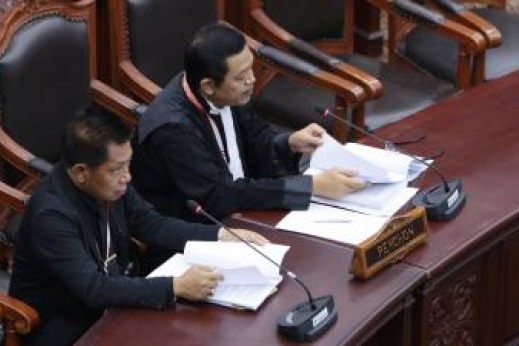
The Petitioner’s attorney Wilman Malau (right) explaining the principal points of the petition in the preliminary hearing of the material review of Law Number 18 of 2017 on the Protection of Indonesian Migrant Workers, Wednesday (18/12) in the Courtroom of the Constitutional Court. Photo by Humas MK/Ifa.
JAKARTA, Public Relations of the Constitutional Court—The Constitutional Court (MK) held a preliminary hearing of the material review of Law Number 18 of 2017 on the Protection of Indonesian Migrant Workers (PPMI Law) on Wednesday (18/12/2019). The presiding justices were Constitutional Justices Manahan M. P. Sitompul (chairman), Saldi Isra (member), and Enny Nurbaningsih (member).
The Petitioner of case No. 83/PUU-XVII/2019 is the Association of Migrant Worker Placement Companies (ASPATAKI). They challenged Article 54 paragraph (1) letters a and b, Article 82 letter a, and Article 85 letter a.
Article 54 paragraph (1) letters a and b of the PPMI Law reads, "In order to obtain SIP3MI as referred to in Article 51 paragraph (1), the Indonesian Migrant Worker Placement Agency must meet the following requirements: a. having a paid-up capital stated in the deed of establishment of at least Rp5,000,000,000 (five billion rupiah); b. depositing money to a government bank in the form of a deposit of at least Rp1,500,000,000 (one billion five hundred million rupiah) that can be disbursed at any time as a collateral to fulfill obligations in the Protection of Indonesian Migrant Workers."
Article 82 letter a reads, "Being sentenced to imprisonment for a maximum of 10 (ten) years and fined for a maximum of Rp15,000,000,000 (fifteen billion rupiah), every Person who deliberately places Prospective Indonesian Migrant Workers in: a. jobs and type of works that do not match the employment contract so they harm the Prospective Indonesian Migrant Workers as referred to in Article 67 letter a."
Article 85 letter a reads, "Being sentenced to imprisonment for a maximum of 5 (five) years and fined for a maximum of Rp5,000,000,000 (five billion rupiah), every person who: a. places Indonesian Migrant Workers in works that do not match the Employment Contracts that have been agreed and signed by Indonesian Migrant Workers as referred to in Article 71 letter a."
The Petitioner’s attorney Wilman Malau presented the legal standing of ASPATAKI as a private legal entity formed professionally as a forum for Private Placement Companies for Indonesian Migrant Workers (PPTKIS). ASPATAKI has 142 members.
According to the Petitioner, 5 billion is not affordable by all companies, including Indonesian migrant worker placement companies (P3MI), given the slowing down of global economy and the resulting decrease of P3MI activities. Two main activities of P3MI decreased after the enactment of the PPMI Law: recruitment and training, now taken over by the government, both central and provincial, and regency/city. "Therefore, it is unreasonable to impose paid-up capital to P3MI entities. It could even cause a number of P3MI entities to close their businesses," Wilman said.
Wilman added that the1.5 billion deposit is not necessarily used. "The obligation will actually [cause a number of P3MI entities] to close their business. The closed opportunity for P3MI to run their business will close the opportunities for many Indonesian citizens who want to work abroad," he added.
Constitutional Justice Saldi Isra examined the legal standing of the Petitioner. "The Petitioner should have written it as Petitioner because [you] represent the organization, Mr. Wilman. So the word \'para\' [implying plural nouns] should be omitted all because the Petitioner is one organization. In the legal standing, the position of the Petitioner should be explained, whether as a public or private legal entity," he said.
Justice Enny Nurbaningsih highlighted the format of the petition. "The format is indeed unusual. [The petition is commonly started by] the authorities of the Court first, then the legal standing [of the Petitioner], the posita, and finally the petitum. This needs to be revised," she said.
Panel chair Constitutional Justice Manahan M. P. Sitompul commented on the statute/bylaws of the Petitioner’s organization. "It must be mentioned which article of statute/bylaws that states that the chairperson of the organization alone or with the secretary general has the right to go forward to a court or to represent the organization outside or in a court. It must elaborated in this petition clearly," he advised. (Nano Tresna Arfana/NRA)
Translated by: Yuniar Widiastuti
Thursday, December 19, 2019 | 15:04 WIB 323