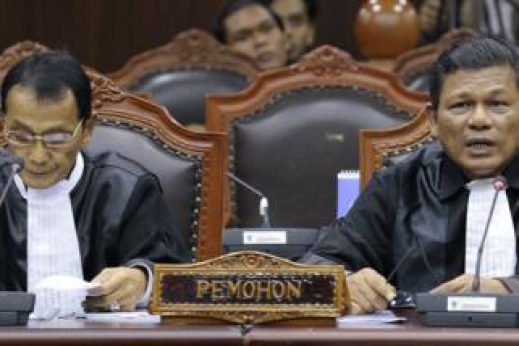
Petitioners Martinus Butarbutar and Risof Mario delivering the subjects of the judicial review petition of the KPK Law, Wednesday (18/12) in the Panel Courtroom of the Constitutional Court. Photo by Humas MK/Gani.
JAKARTA, Public Relations of the Constitutional Court—Law No. 19 of 2019 on the Corruption Eradication Commission (KPK) was challenged again at the Constitutional Court (MK), this time by advocates Martinus Butarbutar and Risof Mario, who attended the preliminary hearing on Wednesday (18/12/2019) in the Panel Courtroom of the Constitutional Court.
In the hearing presided over by chair Constitutional Justice Arief Hidayat with Constitutional Justices Manahan M. P. Sitompul and Suhartoyo, Martinus said that Article 12B, Article 21 paragraph (1) letter a, Article 37B paragraph (1) letter b, Article 38, as well as Article 47 paragraphs (1) and (2) of the KPK Law contradict the 1945 Constitution. In the case No. 84/PUU-XVII/2019, Martinus explained that as an Indonesian citizen and an advocate, his constitutional rights have been impaired by the enactment of the KPK Law. According to the Petitioners, in the a quo, article there is a transfer of authority. According to them, the KPK leaders and investigators should not have the authority in the KPK Law in question.
Because the KPK Law regulates the authority to carry out procedural law to eradicate corruption, Martinus added, the authority falls to the hand of the Supervisory Council, as the law grant the Supervisory Council the right to grant or withhold permit to carry out research, investigations, searches, wiretaps, and other matters.
"Therefore, the Supervisory Council is an organ formed by the President through a Presidential Regulation. So, even the Supervisory Council grants such a permit not entirely based on its authority but based on the authority of the President contained in the Perpres as the creator of the Supervisory Council. It means that the President also has power over the Supervisory Council," Martinus explained next to Petitioner II Risof Mario.
Therefore, according to the Petitioners, lawmakers have dishonestly built an assumption as if the Corruption Eradication Commission (KPK) is an institution that is a subordinate of the government. This assumption, Martinus explained, is inaccurate or was purposefully created by lawmakers, who built the impression that there was sufficient reason for the government to form a Supervisory Council. In fact, it should be interpreted that in addition to the government there are other executive institutions outside the government. Those executive institutions are not branches of government and do not answer to one other. Therefore, the Petitioners through their petition requested that the Court declare the KPK Law contradictory to Article 1 paragraph (3) of the 1945 Constitution.
Legal Standing
Constitutional Justice Suhartoyo asked the Petitioners to consider whether to file the petition as individual citizens, who happen to work as advocates, considering the constitutional impairment, both factual and potential, is not clearly experienced. He requested that the Petitioners consider their legal standing.
"You could maybe get a power of attorney from someone who is factually harmed by the enactment of the KPK Law or you from NGOs who have concern for the enforcement of this law and want to build a clean government. Any institution [that falls to that category] may be proposed as a Petitioner. However, if you [file the petition as] advocates, please reinforce the argument that you have a relevant constitutional loss due to the enactment of the KPK Law," Justice Suhartoyo asked.
Before concluding the hearing, Constitutional Justice Arief Hidayat requested that the Petitioners revise their petition and submit it no later than Tuesday, December 31, 2019 at 15:30 WIB to the Registrar\'s Office. (Sri Pujianti/LA)
Translated by: Yuniar Widiastuti
Thursday, December 19, 2019 | 16:31 WIB 323