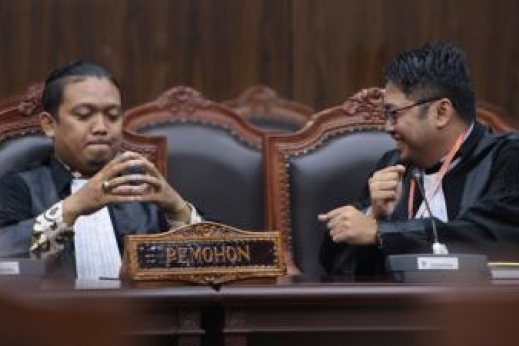
The Petitioner’s attorney Salman Darwis in the ruling hearing of the judicial review of the Pilkada Law, Wednesday (18/12) in the Plenary Courtroom of the Constitutional Court. Photo by Humas MK/Ifa.
JAKARTA, Public Relations of the Constitutional Court—The Constitutional Court (MK) rejected the entire judicial review petition of Law Number 10 of 2016 on the Second Amendment to Law Number 1 of 2015 on the Implementation of the Government Regulation in Lieu of Law Number 1 of 2014 on the Election of Governors, Regents, and Mayors into Laws (Pilkada Law) on Wednesday (18/12/2019) in the Plenary Courtroom of the Constitutional Court.
In the case No. 99/PUU-XVI/2018 petitioned by Ahmad Wazir Noviadi, the Petitioner argued that Article 7 paragraph (2) letter i of the Pilkada Law that reads, "... Never committed a disgraceful act as evidenced by a police certificate," potentially harmed his constitutional rights. The former Regent of Ogan Ilir argued based on the Decree of the Minister of Home Affairs No. 131.16-463 of 2016 on the Appointment of Regent of Ogan Ilir, South Sumatra dated February 11, 2016, he was inaugurated and sworn into office on February 17, 2016. However, on March 18, 2018 he was permanently dismissed based on the Decree of the Minister of Home Affairs Number 131.16-3030 of 2016 dated March 21, 2016 because he had been declared a suspect of narcotics abuse.
The Palembang District Court ordered the Petitioner to undergo rehabilitation for six months. On March 18 to September 13, 2016 he underwent medical and social rehabilitation at the Narcotics Rehabilitation Center of the National Narcotics Agency in Lido, Bogor, West Java and at Ernaldi Bahar Hospital Palembang, South Sumatra. He wished to run for the 2021-2026 election, but was banned due to the enactment of the norm. Therefore, through the petitum, the Petitioner had requested that the Court declare Article 7 paragraph (2) letter i of the Pilkada Law contradictory to the 1945 Constitution insofar as it was interpreted as "never committed a disgraceful act, except for narcotics abusers who have been declared cured, and openly and honestly revealed to the public that they had been convicted narcotics abuse."
Reading out the legal consideration, Constitutional Justice I Dewa Gede Palguna explained that even though the requirement "free from narcotics abuse" for regional head candidates is regulated in the Election Law, given the magnitude of the threat posed by narcotics abuse, narcotics users should still be included as people who commit despicable acts as referred to in the Pilkada Law and its elucidation.
Avoiding Multiple Interpretations
Justice Palguna stated that to avoid multiple interpretations and abuse of power in its application, the phrase "narcotics users" must not be interpreted as narcotics users under three conditions.
"However, the despicable nature is inappropriate to attach to: a. narcotics users who, for health reasons and proven by a statement by the doctor treating the user; or b. former narcotics users who because of their own awareness report themselves and have finished rehabilitation process; or c. former narcotics users proven to be victims, who, based on a court decision/order, were ordered to undergo rehabilitation and have been declared to have completed the rehabilitation process as evidenced by a statement from a state agency that has the authority to declare someone having finished undergoing rehabilitation process," Justice Palguna explained in the ruling hearing presided over by Chief Justice Anwar Usman, with the other seven constitutional justices.
"Based on this consideration, the Court is of the opinion that the Petitioner\'s argument regarding the phrase ‘narcotics users’ in the Elucidation to Article 7 paragraph (2) letter i of Law 10/2016 legally groundless," Justice Palguna declared. (Sri Pujianti/LA)
Translated by: Yuniar Widiastuti
Wednesday, December 18, 2019 | 16:10 WIB 243