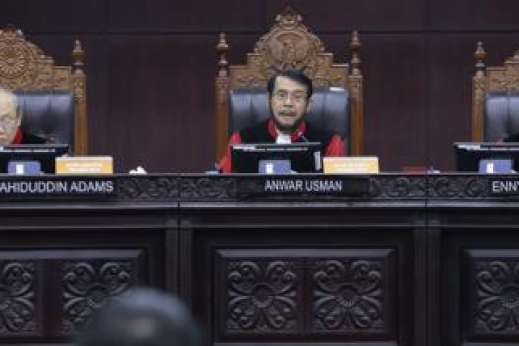
Revision panel hearing of the judicial review of the KPK Law, Tuesday (12/11) in the Plenary Courtroom of the Constitutional Court. Photo by Humas MK/Gani.
JAKARTA, Public Relations of the Constitutional Court—The Constitutional Court (MK) held the examination judicial review hearing of Law No. 30 of 2002 on the Corruption Eradication Commission (KPK Law), Tuesday (12/11/2019). The petition No. 62/PUU-XVII/2019 was heard by Chief Justice Anwar Usman (panel chairman) and Constitutional Justices Wahiduddin Adams and Enny Nurbaningsih (panel members).
Petitioner Gregorius Yonathan Deowikaputra conveyed the petition revision. "Based on recommendations from the panel of justices in the previous session, I added the number to the law that will be reviewed to become Law of the Republic of Indonesia Number 19 of 2019 concerning the Second Amendment to Law Number 30 of 2002 concerning the Corruption Eradication Commission," the Petitioner said.
In addition, the Petitioner added the section on the Authority of the Constitutional Court on a legal basis to be Law Number 15 of 2019 concerning Amendment to Law Number 12 of 2011 concerning Formation of Laws and Regulations.
"The next revision to the petition, this petition becomes a petition for the formal review of the formation of Law Number 19 of 2019 concerning the Second Amendment to Law Number 30 of 2002 concerning Corruption Eradication Commission, State Gazette Number 197, and Supplement to State Gazette Number 6409, against The 1945 Constitution," the Petitioner explained.
The Petitioner was listed in the 2019 General Elections final voters list (DPT) so he had the right to elect DPR (House) members. The Petitioner feels disadvantaged by the performance of the House members that had been elected and given the mandate to carry out their duties to form legislation but did not carry out the mandate properly, honestly, fairly, openly, in good faith, and responsibly, as evidenced by the approval of the Law on the Second Amendment to the KPK (Corruption Eradication Commission) Law, which had rejected by various elements of society from the very beginning in 2010.
“The formation of the Second Amendment to the KPK Law closed and secretive, without involving the public. The minutes of the meeting on the DPR\'s official website related to discussions on the revision of the KPK Law were difficult to access. Given these facts, he added, it is clear that the provision is not based on the mandatory principles of usefulness, effectiveness, and openness in forming legislation as outlined in Article 118 of the House Code of Conduct,” Gregorius said before the bench led by Chief Justice Anwar Usman in the preliminary hearing on Wednesday (30/10/2019).
"The violation of the principles of usefulness and effectiveness in the formation of the a quo Law is evidenced by rejections [of the law] by the public. These rejections are clear evidence that the a quo Law is not useful and is not needed by the public and it evidently violated the principle of openness because of no public access to provide input and proposals on the law," he added.
In his petitum, the Petitioner requested that the Constitutional Court declare the formation of the a quo Law contrary to the 1945 Constitution and not legally binding. (Nano Tresna Arfana/NRA)
Translated by: Yuniar Widiastuti
Wednesday, November 13, 2019 | 10:08 WIB 183