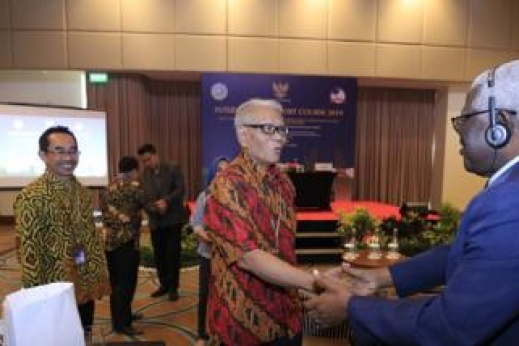
Constitutional Justice of 2003-2008 and 2008-2013 Harjono after speaking at an international short course program, Wednesday (6/11) in Nusa Dua, Bali. Photo by Humas MK/Gani.
BALI, Public Relations of the Constitutional Court—There are a number of challenges to the protection of the socio-economic rights to citizens. First, legislation on socio-economic rights is drafted by several commissions in the House of Representatives (DPR), which might have differing opinions. Second, socio-economic rights are spread across numerous laws, leading to the need to synchronize all of them.
This was conveyed by Dr. Harjono in the second session of the international short course program organized by the Constitutional Court of the Republic of Indonesia (MKRI) on Wednesday (6/11/2019) in Nusa Dua, Bali. The session was moderated by the Court’s Bilateral Cooperation Analyst Olfiziana Tri Hastuti. The program was part of The 3rd Indonesian Constitutional Court International Symposium (ICCIS 2019), which took place Monday-Thursday (5-7/11/2019). Academics and constitutional law practitioners from a number of countries delivered presentations and participated in the program.
The Constitutional Justice of 2003-2008 and 2008-2013 and DKPP (Election Organizer Ethics Council) Chairman revealed that the Constitutional Court (MK) faces obstacles in the protection of citizens\' socio-economic rights. One of these obstacles is the limit of authority in the formation of laws. "Does the Constitutional Court only revoke laws does [it] also have the right to make laws? That is also one of the problems (for the Court)," he said. If the Constitutional Court\'s authority stops there, there is the potential of legal vacuum.
Harjono also cited the changes to the Marriage Law, which had been presented by Constitutional Justice Enny Nurbaningsih in the previous session. The minimum age of marriage for women determined by the Court and directly ratified by the Government in the law is a positive example of the authority of the Court. However, the process of changing the law that the Constitutional Court has interpreted is generally sluggish. Generally, after the Constitutional Court\'s verdict is issued, the public must wait for the legislature to change the interpreted law. "What should be decided by the Constitutional Court has direct power when it is decided. But, if in fact the legislature does not change (the law), what happens?" asked Harjono about the unresolved problem in the Indonesian legal system.
Harjono also mentioned how the Constitutional Court resolved the problems that occurred in the community. "Indeed, there is one well-known case where the Constitutional Court in its decision not only stated that (a law) is against the Constitution, but was also involved in rule-making, which should be the right of the legislative. The case was related to the right to vote in the elections. In the provisions of the law, (the right) is only given to citizens registered in (the final voters list).” In the case, given the time limit, it was decided that all citizens can use their voting rights even though they were not registered in the final voters list (DPT).
It is very difficult for the Court to decide whether any law is constitutional or not, he added. Therefore, the Court created a solution in the form of conditional constitutional rulings, where the Constitutional Court provides guidelines for laws that can be interpreted broadly. (Yuniar Widiastuti/NRA)
Translated by: Yuniar Widiastuti
Monday, November 11, 2019 | 14:49 WIB 242