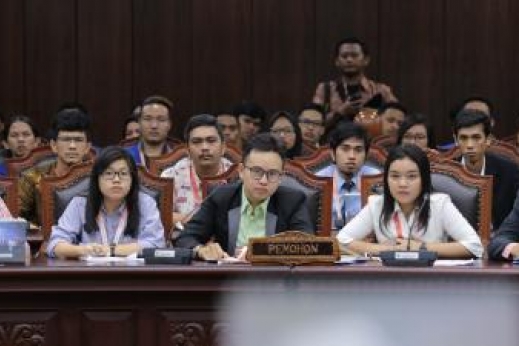
The Petitioners’ legal counsel Zico Leonard Djagardo Simanjuntak (center) with the Petitioners in the petition revision hearing of the judicial review of the Amendment to Law No. 30 of 2002 on the Corruption Eradication Commission, Monday (21/10) in the Courtroom of the Constitutional Court. Photo by Humas MK/Ifa.
JAKARTA, Public Relations of the Constitutional Court—The Constitutional Court (MK) held the second judicial review hearing of the Amendment to Law No. 30 of 2002 on the Corruption Eradication Commission (KPK Law) on Monday (21/10/2019) in the Plenary Courtroom of the Constitutional Court. The session had been scheduled to hear the petition revisions.
The petition No. 57/PUU-XVI/2019 was filed by 190 Petitioners, including Muhammad Raditio Jati Utomo, Deddy Rizaldy Arwin Gommo, and Putrida Sihombing. The majority of them are university students.
Before the bench led by Chief Constitutional Justice Anwar Usman, the Petitioners conveyed a number of revisions to the petition in accordance with the advice of the justices in the preliminary hearing. The Petitioners strengthened the reasons for submitting the petition in relation to the KPK supervisory council.
According to the Petitioners, the KPK supervisory council is a paradox that actually weakens corruption of. Its formation in the KPK structure was the legislators’ effort to oversee the KPK so that the institution does not have absolute authority. The authority of the KPK supervisory council exceeds the oversight limits because it authorizes wiretapping, search and seizure, which is outside the systemic limits of oversight, as the council is not a law enforcement apparatus.
In addition, the Petitioners emphasized the judicial review petition of Law Number 19 of 2019 concerning the Second Amendment to Law Number 30 of 2002 concerning the Corruption Eradication Commission and Law Number 30 of 2002 concerning the Corruption Eradication Commission against the 1945 Constitution. The Petitioners included an elaboration of the constitutional losses between generations as well as collective and individual constitutional losses. In addition, the Petitioners revised the petitum of the petition.
The Petitioners had previously challenged the amendment to the KPK Law that was passed on September 17, 2019 that they deemed having tried to break the spirit of the KPK as an institution specifically designed to deal with corruption cases and jeopardized corruption eradication in Indonesia. Corruption is a chronic problem in a democratic society and a dangerous plague that has enormous damaging effects on society.
According to the Petitioners, the prevention and eradication of corruption is in the public interest. A contrario, every effort to weaken the eradication of corruption means threat against the people and a violation of constitutional rights. Therefore, in the a quo case, the Petitioners as individual citizens have an interest that was harmed by the KPK Law, which could have been prevented if the principles of establishing good laws had been met.
In addition, there is a void in the Law No. 30/2002 concerning the KPK Law related to the enforcement of the requirements for KPK members as stipulated in Article 29 of the a quo Law. However, currently there is no remedy for the violation of those requirements. Therefore, the Petitioners are of the opinion that the election of Firly Bahuri as the KPK Chairman did not meet the requirements, whether the allegations against Firly are true or not.
According to the Petitioners, there should be a mechanism or legal remedy through the court regarding this matter, in order to eliminate slander or division in society, for both the people who support Firly and those who are against his appointment. The Petitioners requested that the Constitutional Court protect the constitutional rights of the Petitioners in the a quo case, in relation to the election of KPK leaders, by ensuring new norms to cover up the vacuum of existing norms and provide fair legal protection for the Petitioners.
The Petitioners also requested that the Constitutional Court order the Parliament and the President to dismiss KPK members\' appointment. They believe that the formation of the a quo Law ignored the basic principles of the formation of good laws and regulations as stipulated in Article 5 of Law Number 12/2011 concerning the Formation of Laws and Regulations regarding transparency.
Based on the transparency principle, the community should be involved through public consultation as regulated in Article 188 paragraph 1-3 of the Presidential Regulation No. 87 of 2014 concerning the Formation of Laws and Regulations, starting from preparing the bill, discussing the bill, to implementing the law. This principle was not met, given the sudden decision of the revision and the closed, hasty discussion. Instead of first involving the people, lawmakers ratified the a quo law despite outright rejection by the people. The Petitioners requested that the Constitutional Court declare the formation of the KPK Law not meeting the provision of the formation of a law based on the 1945 Constitution and not having binding legal force. (Ega/NRA)
Translated by: Yuniar Widiastuti
Tuesday, October 22, 2019 | 08:13 WIB 227