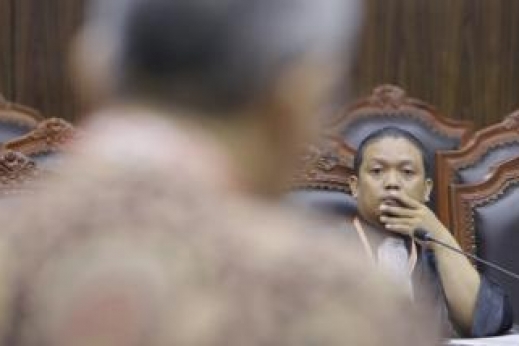
The Petitioners’ attorney Viktor S. Tandiasa listening to the Government’s statement in the judicial review hearing of the Election Law, Thursday (3/10) in the Plenary Courtroom of the Constitutional Court. Photo by Humas MK/Ganie.
JAKARTA, Public Relations of the Constitutional Court—Director of Litigation of the Ministry of Law and Human Rights Ardiansyah conveyed the Government’s statement in the judicial review hearing of Law Number 7 of 2017 on General Elections in the Constitutional Court on Thursday (3/10/2019).
The Government wasis of the opinion that the simultaneous elections was expected to have a positive influence on the administration system, including saving the election budget so that it can be utilized to fulfill other constitutional rights of citizens, ranging from 5-10 trillion rupiahs.
"This is in accordance with the objectives of the state as mandated in the Preamble to the 1945 Constitution, among which is to advance the general welfare and the greatest prosperity of the people," Ardiansyah told the panel of justices led by Constitutional Justice Saldi Isra.
The concept of simultaneous elections, said Ardiansyah, combines the legislative and executive elections on the same day, thus enabling a congruent government, meaning the election of executive officials (President and Vice President) receives legislative support so that the government is stable and effective.
In addition, according to the Government, simultaneous elections can create policy-based coalitions because elections also require strong political parties and adequate resilience in representing the interests of the community and offering policy choices to demonstrate their ability to lead for the common good and at the same time minimize political pragmatism, which is often referred to by politicians and political parties in coalition.
"With simultaneous elections, it is believed that political parties can no longer form coalitions pragmatically. Political parties will be more selective in looking for candidates and not merely rely on mathematical considerations. In the long run, this is expected to lead to the simplification of the party system naturally," Ardiansyah said.
The case No. 37/PUU-XVII/2019 was petitioned by seven Petitioners from various professions and legal entities, including election observers Arjuna, M. Faesal Zuhri, and Ronaldo Heinrich Herman. The Petitioners challenged Article 167 paragraph (3), which reads, "Voting shall be conducted simultaneously on a holiday or a nationally-declared day off," and Article 347 paragraph (1), which reads, "Election voting shall be conducted simultaneously."
The Petitioners through attorneys Viktor S. Tandiasa and Yohanes Mahatma Pambudianto stated that those articles contradict Article 28G paragraph (1) and Article 28I paragraph (4) of the 1945 Constitution. When delivering the reason for the petition, Yohanes stated that the provision of Article 22E paragraph (1) of the 1945 Constitution on the implementation of elections should bring benefits to the people and should not harm the interests of the people, especially concerning human lives.
The Petitioners considered the 2019 Simultaneous Elections heavy and full of pressure, as the presidential/vice presidential election conflated with the election of legislative members. In fact, the Medical Emergency Rescue Committee (MER-C) recorded 544 election administrators died and 3,788 people fell ill. (Nano Tresna Arfana/NRA)
Translated by: Yuniar Widiastuti
Thursday, October 03, 2019 | 15:24 WIB 231