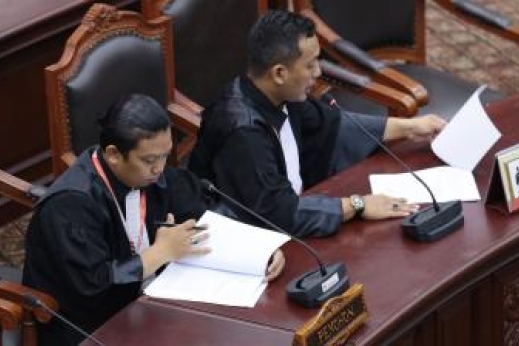
Attorneys Viktor S. Tandiasa and Yohanes Mahatma Pambudianto reading out the subject of petition in the preliminary judicial review hearing of Law Number 7 of 2017 on General Elections, Tuesday (3/9) in the Courtroom of the Constitutional Court. Photo by Humas MK/Ifa.
JAKARTA, Public Relations of the Constitutional Court—The Constitutional Court (MK) held a judicial review hearing of Law Number 7 of 2017 on General Elections on Tuesday (3/9/2019) in the Plenary Courtroom of the Constitutional Court. Photo by Humas MK/Ifa. The preliminary hearing for cases No. 37/PUU-XVII/2019 and 38/PUU-XVII/2019 was presided over by Constitutional Justice Saldi Isra with Constitutional Justices Suhartoyo and Enny Nurbaningsih. Until the justices were in session, ten Petitioners of the case No. 38/PUU-XVII/2019, who had informed their intention to withdraw the petition, had not submitted a formal letter concerning the withdrawal.
The case No. 37/PUU-XVII/2019 was petitioned by seven Petitioners from various professions and legal entities, including election observers Arjuna, M. Faesal Zuhri, and Ronaldo Heinrich Herman. Through attorneys Viktor S. Tandiasa and Yohanes Mahatma Pambudianto, the Petitioners argued that Article 167 paragraph (3), which reads "Voting shall be conducted simultaneously on a holiday or a nationally-declared day off," and Article 347 paragraph (1), which reads "Election voting shall be conducted simultaneously" on the word "simultaneously" contradict Article 28G paragraph (1) and Article 28I paragraph (4) of the 1945 Constitution.
When delivering the reason for the petition, Yohanes stated that the provision of Article 22E paragraph (1) of the 1945 Constitution on the implementation of elections should bring benefits to the people and should not harm the interests of the people, especially concerning human lives. He considered the 2019 Simultaneous Elections heavy and full of pressure, as the presidential/vice presidential election conflated with the election of legislative members. In fact, the Medical Emergency Rescue Committee (MER-C) recorded 544 election administrators died and 3,788 people fell ill.
"This was even said to be a humanitarian disaster. The 2019 Elections claimed many victims, so the design of these (the 2019) Elections needs to [evaluated for that] of the next elections," Johanes explained.
Johanes added that the 2019 Simultaneous Elections, initially had thought to be more efficient and could have saved state money, in fact showed a 61% jump of budget according to the Ministry of Finance. "It means [it fell short of expectations] and the goals of the Constitutional Court when deciding Case Number 14/PUU-XI/2013," Johanes explained.
Johanes explained that although the Court’s opinion on the elections is constitutional in the socio-political context in society, the constitutional basis would not be alive so that it would not be able to fulfill the current needs of the community. He observed that the presidential election needed to be separate from the legislative election. Therefore, in the petition the Petitioners requested that the Court declare the a quo article contrary to the 1945 Constitution and not legally binding.
New Law
Responding to the petition, Constitutional Justice Enny Nurbaningsih questioned the Petitioners’ legal standing, especially the election observers. She questioned whether those election observers have certification in election oversight and whether they are entitled to represent the organization in and out of the courtroom. In addition, Justice Enny also did not find a clear description of the constitutional loss potentially experienced by the Petitioners due to the enactment of the a quo law.
Constitutional Justice Suhartoyo also stated that he did not discover the potential factual constitutional loss experienced by the Petitioners. Supposedly, he added, if they wanted to relate it to simultaneous elections as a humanitarian disaster, it would be better for the victims\' families to file the a quo petition. "Or even if the observers did, then the observers propose someone that was harmed by the principles of these simultaneous elections, because if [nobody was harmed], then [there would be no correlation to] the things proposed," he explained.
Justice Suhartoyo also requested that the Petitioners build an argument to convince the Court to see the novelty of the petition so as to offer a new perspective on the simultaneous elections. Constitutional Justice Saldi Isra even asked the Petitioners to bring new ideas related to the new electoral law so that the judicial review petition of this law did not end up merely as an assumption that would undermine the previous Constitutional Court\'s decision.
Before concluding the session, Justice Saldi reminded the Petitioners to submit the revised petition by Monday, September 16, 2019 at 10.00 WIB to the Court’s Registrar’s Office. (Sri Pujianti/Louisa/LA)
Translated by: Yuniar Widiastuti
Wednesday, September 04, 2019 | 10:01 WIB 195