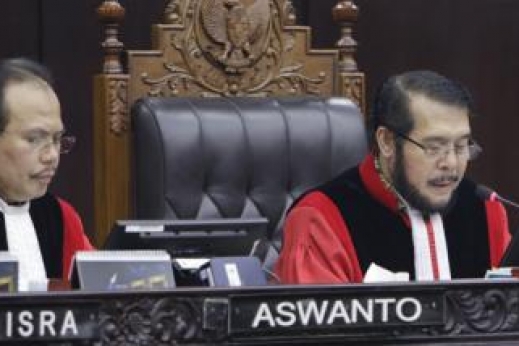
Plenary ruling hearing of the judicial review of Law on Mass Organizations (Ormas Law), Tuesday (21/5) in the Plenary Courtroom of the Constitutional Court. Photo by Humas MK/Ganie.
JAKARTA, Public Relations of the Constitutional Court—The Constitutional Court rejected the entire judicial review of Law No. 16/2017 on the Stipulation of Government Regulation in Lieu of Law No. 2/2017 on the Amendment of Law No. 17/2013 on Mass Organizations into a Law (Ormas Law) in a ruling hearing on Tuesday (21/5/2019) in the Plenary Courtroom of the Constitutional Court.
Dewan Da’wah Islamiyah Indonesia, Yayasan Forum Silaturrahmi Antar-Pengajian Indonesia, and Perkumpulan Hidayatullah claim that Article 82A paragraphs (1) and (2) of the Ormas Law is contrary to Article 28D paragraph (1) and Article 28G paragraph (1) of the 1945 Constitution and threatens the freedom of assembly, association, expression of thoughts and attitudes, according to conscience, as it eliminates the role of the court in imposing sanctions on mass organizations.
Regarding the petition No. 2/PUU-XVI/2018, the Constitutional Court through Justice I Dewa Gede Palguna explained that the formulation of the norm in Article 82A paragraphs (1) and (2) of the Ormas Law states that the party subject to the sanctions per the provision is not any ormas member and/or administrator, but ormas member and/or administrator who intentionally and directly or indirectly violates the provision, including by committing acts of violence; disturbing the peace and public order; or damaging public and social facilities; committing acts of hostility on the basis of ethnicity, religion, race, or class; committing separatist activities that threaten the sovereignty of the Unitary State of the Republic of Indonesia; and adhering to, developing, and disseminating teachings or views that are contrary to Pancasila.
"Thus, even if someone becomes a member and/or administrator of an ormas, [as long as] they do not commit prohibited acts, they will not be subject to criminal sanctions as per Article 82A paragraph (1) and paragraph (2) of the Ormas Law," Justice Palguna said before the hearing chaired by Chief Justice Anwar Usman, accompanied by seven other constitutional justices.
In addition, Justice Palguna added, a member and/or administrator of an ormas is subject to criminal sanctions as per Article 82A paragraphs (1) and (2) of the Ormas Law is one who deliberately commits prohibited acts directly or indirectly. Therefore, the Petitioners’ argument based on the proposition that a person is subject to criminal sanctions because they become a member and/or administrator of an ormas even if the perpetrator is the ormas, is not true. Justice Palguna added that regarding the word "indirectly" that the Petitioners claimed being lax, the Elucidation to Article 82A paragraph (1) of the Ormas Law has elaborated on it, so the Petitioners\' argument regarding the unconstitutionality of the a quo article is legally groundless. (Sri Pujianti/LA/Yuniar Widiastuti)
Tuesday, May 21, 2019 | 19:21 WIB 218