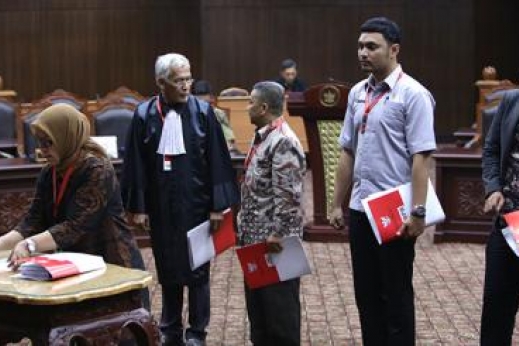
Petitioners, Government, House of Representatives receiving copies of Constitutional Court decision after ruling hearing. Photo by Humas MK/Dedy.
JAKARTA, Public Relations of the Constitutional Court—The Constitutional Court granted in part the petition filed by Hendrik in Case No. 87/PUU-XVI/2018 in the ruling hearing in the Plenary Courtroom of the Constitutional Court, Thursday (25/4/2019). Constitutional Justice Saldi Isra, who read out the legal considerations, said that the Petitioner had claimed that Article 87 paragraph (4) letter b of the ASN Law does not specify the deadline of inkracht ruling that is referred to in imposing dishonorable discharge on civil servants (PNS). The Petitioner questioned whether the inkracht ruling in question is that begun in 2000, since the enactment of Government Regulation (PP) No. 11 of 2017, or since the enactment of a Joint Decree (SKB) in 2018.
The Court is of the opinion that the question is irrelevant because the provision in Article 87 paragraph (4) letter b of the ASN Law applies to active civil servants. Therefore, whenever a court hands down a sentence pursuant to the norm, its ruling is has permanent legal force (inkracht) as long as the civil servant is still active.
“Therefore, the Petitioner’s argument that Article 87 paragraph (4) letter b of the ASN Law does not provide legal certainty in relation to the lack of provision on deadline as the Petitioner claimed is legally groundless,” said Justice Saldi before the Court led by Chief Justice Anwar Usman, with the other constitutional justices.
Potential Injustice
However, regardless of the Petitioner’s argument, he added, the Court believes that Article 87 paragraph (4) letter b of the ASN Law regulates the reasons resulting in the dishonorable discharge of a civil servant. However, the phrase “and/or general criminal offense” inseparable from the norm of Article 87 paragraph (4) letter b of the ASN Law is related to the norm of Article 87 paragraph (4) letter b of the ASN Law.
Constitutional Justice I Dewa Gede Palguna said problems that arise handled by the personnel supervisor officer (PPK) in case a civil servant committed criminal offense sentenced with two years imprisonment based on a court ruling that has permanent legal force, whether to enforce Article 87 paragraph (4) letter b of the ASN Law.
This, he said, in addition to leading to legal uncertainty, also allows the personnel supervisor officer to give different treatments to two or more subordinates who committed the same offense. In addition, pursuant to Article 87 paragraph (4) letter b of the ASN Law, it cannot be accepted by reasonable legal reasoning that a civil servant is dishonorably discharge due to having committed a “general criminal offense” whose minimum sentence is not specified. Therefore, the phrase “and/or general criminal offense” in Article 87 paragraph (4) letter b of the ASN Law has led to legal uncertainty and potential injustice, thus is contrary to Article 28D paragraph (1) of the 1945 Constitution.
“Declares the phrase ‘and/or general criminal offense’ in Article 87 paragraph (4) letter b of Law No. 5/2014 on the State Civil Apparatus contrary to the 1945 Constitution and is not legally binding, so that Article 87 paragraph (4) letter b of Law No. 5/2014 on the State Civil Apparatus now reads, “sentenced to imprisonment or detention based on a court decision that has permanent legal force due to a crime of occupational crime or a crime related to office position,” Justice Anwar read out the ruling.
Cannot Be Accepted
In the same hearing, the Court also declared the petition No. 88/PUU-XVI/2018 filed by Fatah Yasin, Panca Setiadi, Nawawi, Nurlaila, and Djoko Budiono; petition No. 91/PUU-XVI/2018 filed by Novi Valentino, Fatmawati, Markus Iek, Yunius Wuruwu, and Sakira Zandi; and petition No. 15/PUU-XVII/2019 filed by Musi Banyuasin civil servant Yuliansyah cannot be accepted.
In the legal consideration of case No. 88/PUU-XVI/2018, the Court through Constitutional Justice Wahiduddin Adams stated that the granting of part of the norm of Article 87 paragraph (4) letter b of the ASN Law and regardless of the fact that the a quo petition has met the provision of Article 60 paragraph (2) of the Constitutional Court Law and Article 42 paragraph (2) of the Constitutional Court Regulation No. 06/PMK/2005, the petition had lost its object.
The Petitioners had filed for case No. 88/PUU-XVI/2018. They argued that the word "may" in Article 87 paragraph (2) of the ASN Law could lead to the subjective implementation of norms. They further claimed that the phrase "having committed a criminal offense with a minimum sentence of 2 (two) years imprisonment and a premeditated criminal offense" in Article 87 paragraph (4) letter d does not specify any criminal acts. They considered it to have caused uncertainty in the implementation of the a quo norm. They concluded that all norms petitioned were contrary to legal certainty. (Sri Pujianti/LA/Yuniar Widiastuti)
Friday, April 26, 2019 | 07:36 WIB 165