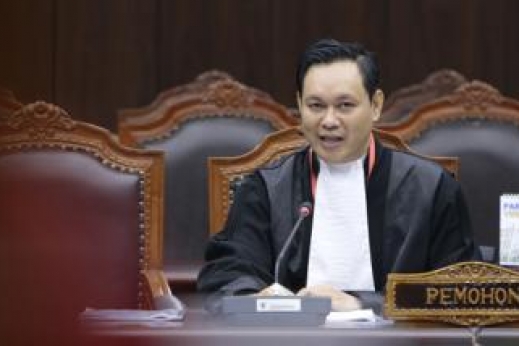
Attorney Arjumulia delivering the subjects of the petition in the judicial review of Foundation Law, Wednesday (24/4) in the Plenary Courtroom of the Constitutional Court. Photo by Humas MK/Ganie.
The Constitutional Court held the preliminary judicial review hearing of Law Number 16 of 2001 on Foundations as amended by Law Number 28 of 2004 on the Amendment to Law Number 16 of 2001 on Foundations in the Plenary Courtroom of the Constitutional Court on Wednesday (24/4/2019). The case No. 30/PUU-XVII/2019 was petitioned by Armen Kusumah, Sri Wuryatmi, and Saman on behalf of the administrators of Al-Ikhwan Meruya Foundation.
As attorney for the Petitioner, Arjumulia argued that Article 53 paragraph (2) of the Foundation Law that reads, “The investigation as meant in paragraph (1) letters a, b and c can only be done on the basis of a stipulation of the court upon a written request of the interested third party along with its reasons” contrary to Article 1 paragraph (3) and Article 28D paragraph (1) of the 1945 Constitution.
According to the Petitioner\'s, the phrase "interested third party" in Article 53 paragraph (2) of the Foundation Law is multi-interpretive because based on a concrete case of allegation experienced by the Petitioner before the a quo petition was submitted, there had been misinterpretation of the phrase. As a result, jamaah (congregation) in the broadest sense (anyone) can just examine matters related to Al-Ikhwan Meruya Foundation that allegedly had committed acts that harm the foundation or that neglected to carry out their duties as referred to in Article 53 paragraph (1) of the Foundation Law. Arjumulia said, the phrase "interested third party" must comply with Article 53 paragraph (3) of the Foundation Law.
"In essence, the parties authorized to submit a petition against a foundation or [be] petitioners are those that have been determined by the court at the request of the Prosecution’s Office to represent public interest," said Arjumulia in the session chaired by Constitutional Justice Saldi Isra, in the presence of Constitutional Justices Arief Hidayat and Manahan M.P. Sitompul.
Therefore, in the petitum, the Petitioner requested that the Court declare Article 53 paragraph (2) of the Foundation Law contrary to the norms of protection and legal certainty as determined in 28D paragraph (1) of the 1945 Constitution as long as it is not interpreted directly or indirectly “congregation of the Al-Ikhwan Mosque who, according to their belief, take part in prospering the Al-Ikhwan Mosque."
Legal Standing
Justice Manahan emphasized the need for the Petitioner to understand their legal standing as managers of the foundation with positions as chairperson, secretary, and treasurer. They are the ones authorized to file a petition. "In addition to the provision of the Foundation\'s statute/bylaws, are there any norms that state the legal standing of this management? If there are, [it] can be mentioned in the petition to strengthen the authority of the Petitioner," he explained.
In addition, he affirmed that, based on the substance of article 53 paragraph (2) of the Foundation Law, the Petitioner would like "interested third party" in the examination of the foundation to submit to the court so that the court can declare whether they have the right to file a petition or not.
"So is that what the Petitioner objects to if the "interested third party" is interpreted as congregation? So, anyone who interprets the third party as congregation has no direct interest in the foundation and is not the "interested third party" intended by the Petitioner," Justice Manahan explained.
Erga Omnes
Justice Arief reminded the Petitioner to first understand the definition of judicial review in Article 53 paragraph (2) of the Foundation Law, considering that in the petitum the Petitioner requested that the Court interpret or change the meaning of the phrase "interested third party" to explicitly mean certain parties.
"[We can] imagined that the phrase "interested third party" is replaced by "interpreted as congregation..." because it will only apply to the Petitioner. Even if, if canceled or changed, the norm actually applies to all parties," he said.
Justice Saldi reminded the Petitioner to understand the nature of the request in their petitum. He observed that if the petition was granted, to only involve the Al-Ikhwan Mosque congregation, it would violate the erga omnes principle.
Before concluding the session, Justice Saldi reminded the Petitioner to submit a revised petition no later than Tuesday, May 7, 2019 at 10.00 WIB to the Registrar\'s Office of the Constitutional Court. (Sri Pujianti/LA/Yuniar Widiastuti)
Wednesday, April 24, 2019 | 15:37 WIB 332