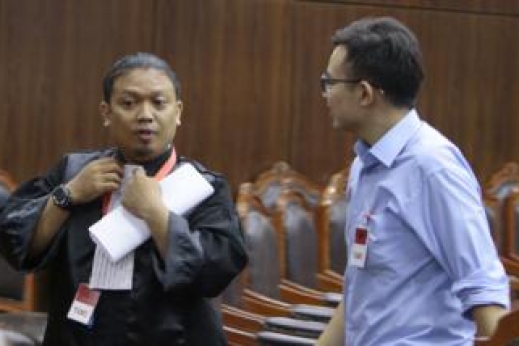
Viktor Santoso Tandiasa (Petitioner I) and Zico Leonard Djagardo Simanjuntak (Petitioner II) after judicial review hearing of Constitutional Court Law and Judicial Power Law, Tuesday (23/4) in the Panel Courtroom of the Constitutional Court. Photo by Humas MK/Ganie.
JAKARTA, Public Relations of the Constitutional Court—The Constitutional Court held a judicial review hearing of Law No. 8 of 2011 on the Constitutional Court and Law No. 48 of 2009 on the Judicial Power on Tuesday (23/4/2019) in the Panel Courtroom of the Constitutional Court. The case No. 28/PUU-XVII/2019 was petitioned by Viktor Santoso Tandiasa (Petitioner I) and Zico Leonard Djagardo Simanjuntak (Petitioner II). They claimed that Article 10 letter a and Article 30 letter a of the Constitutional Court Law as well as Article 29 paragraph (1) letter a of the Judicial Power Law are unconstitutional.
In this second hearing, Victor conveyed the revision points of the petition, including on the format of the petition, the petition background regarding the explanation of the rule of law in a constitutional court, and the change of article as reference in the 1945 Constitution. The referred Article 28I paragraph (4) reads, "Protecting, promoting, upholding, and the full realization of human rights are the responsibilities of the state, foremost of the government." According to Victor, the Constitutional Court as one of the main elements of the state in carrying out its responsibilities to protect, promote, enforce, and fulfill human rights has the function and duty to protect the constitutional rights of citizens and human rights. "This is the constitutional basis for the Constitutional Court in carrying out its duties and responsibilities," Victor explained in the session led by Constitutional Justice Suhartoyo accompanied by Constitutional Justices Wahiduddin Adams and Saldi Isra.
Victor also emphasized the revision to the petitum by appealing to the Constitutional Court Justices to examine and decide on the judicial review by declaring the elucidation to Article 29 paragraph (1) letter a of the Judicial Power Law along the phrase quite clear unconstitutional and conditionally not legally binding insofar as not interpreted as "in this provision including the authority to examine and decide on constitutional complaints."
Petitioner I once litigated in the Constitutional Court in case No. 123/PUU-XIII/2015, where the Court ruled, "There is indeed a vacuum of judges, in that the absence or lack of confirmation of legal mechanisms that can be taken by a suspect without reason clearly not immediately forwarded to the court by the public prosecutor," but 3 years since the decision, lawmakers have not followed up on the verdict.
Petitioner II once fought for his constitutional rights through cases No. 76/PUU-XVI/2018 and case Number 5/PUU-XVII/2019. In both petitions, he did not request the review of the laws, but challenged the lack of revision of the laws by legislators. He considers the norms of the a quo articles unconstitutional on the grounds that the constitutional complaints mechanism is one of the mechanisms for protecting the constitutional rights of citizens through state court (in this case, the Constitutional Court) which aims to provide citizens with maximum protection of constitutional rights. Thus, as part of the Constitution, which is a fundamental law that limits state power, constitutional rights are also a limitation on state power. Whereas in modern, democratic rules of law, this is a legal effort to maintain the dignity of human beings that must not be contested, so that it is safe from acts of state powers. In addition, according to the Petitioners, the philosophical basis of the Constitutional Court as guardian of the Constitution sharply contradicts the spirit of the Constitutional Court if the Court did not have the complaint authority. (Sri Pujianti/LA/Yuniar Widiastuti)
Tuesday, April 23, 2019 | 17:27 WIB 220